Contents
- 1 Archetypal Psychology
- 1.1 Introduction
- 1.2 From analytical psychology to archetypal psychology
- 1.3 What did Hillman mean by “soul”?
- 1.4 Image as the primary language of psyche
- 1.5 The imaginal is not merely imaginary
- 1.6 Personification: meeting the figures of psychological life
- 1.7 Pathologising: why the psyche produces disturbance
- 1.8 Psychologising: seeing through literal explanations
- 1.9 Dehumanising and the challenge to human centrality
- 1.10 Psychological polytheism
- 1.11 The ego, the Self and the problem of unity
- 1.12 Dreams and the underworld
- 1.13 The anima mundi: returning psyche to the world
- 1.14 Beauty and the thought of the heart
- 1.15 What does archetypal psychotherapy look like?
- 1.16 Archetypal psychology beyond the consulting room
- 1.17 Is archetypal psychology scientific?
- 1.18 Criticisms and limitations
- 1.19 The continuing value of archetypal psychology
- 1.20 Conclusion
- 2 Reading guide
- 3 Formal bibliography
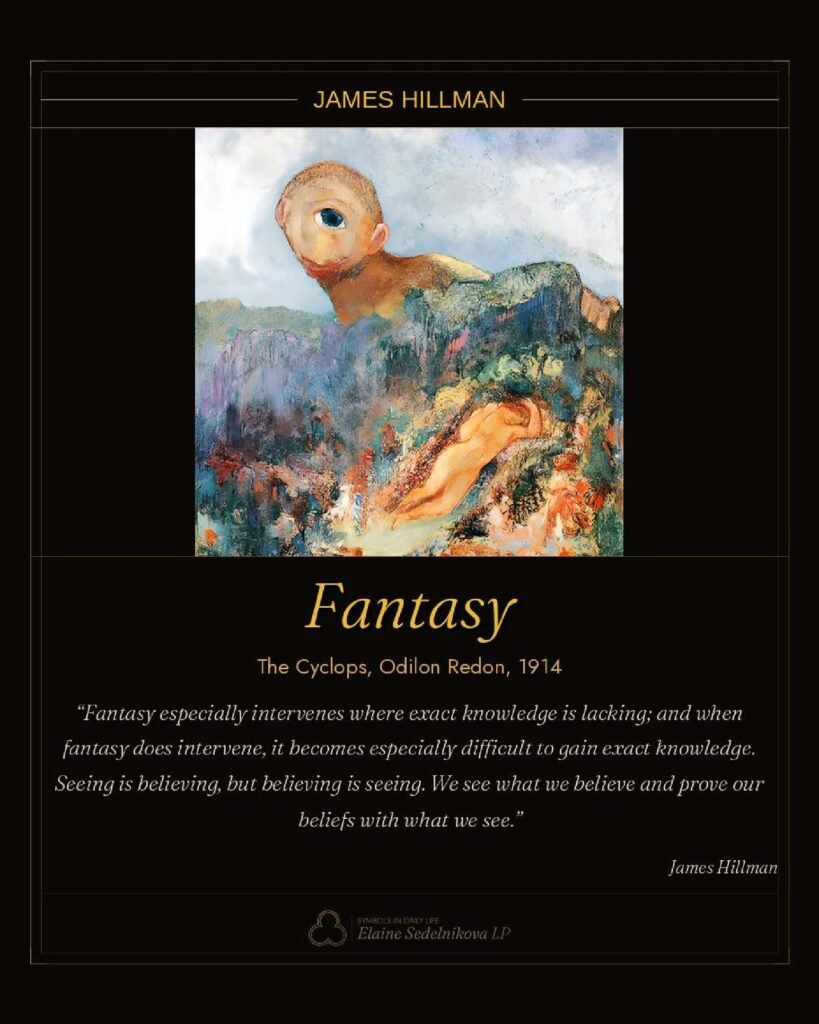 Archetypal Psychology
Restoring Image, Myth and Soul to Psychological Thought
Introduction
Archetypal psychology is the school of psychological thought most closely associated with James Hillman. Emerging as a distinct movement during the early 1970s, it developed out of Carl Gustav Jung’s analytical psychology while also questioning several of Jung’s central assumptions. It retained Jung’s interest in dreams, archetypes, mythology and the unconscious, but rejected the idea that psychological life should necessarily be organised around an integrating Self or directed towards a single process of individuation.
Hillman proposed instead that the psyche is fundamentally imaginative, metaphorical and plural. Human beings do not possess one completely unified identity beneath their changing moods and conflicts. They experience themselves through multiple voices, roles, images, desires, memories and emotional positions. Psychology should therefore not always attempt to make the personality consistent, unified or free from contradiction. It should learn how to recognise and relate to the many psychological presences through which human life is experienced (Hillman, 1975; Hillman, 1983/2004).
The word archetypal can initially be misleading. Hillman did not intend archetypal psychology to be merely a method for identifying mythological characters in dreams or assigning people to fixed archetypal types. Nor did he regard archetypes as a set of ancient personality categories. Archetypal psychology is better understood as a way of perceiving: an attempt to recognise the deep, recurring and often mythic patterns through which events acquire psychological meaning.
Its central concepts include:
- psyche or soul;
- image and imagination;
- archetype and the archetypal;
- personification;
- pathologising;
- psychologising or “seeing through”;
- psychological polytheism;
- the distinction between soul and spirit;
- dreams and the underworld;
- the anima mundi, or soul of the world.
Together, these ideas formed Hillman’s challenge to a psychology that he believed had become excessively literal, medical, individualistic and detached from philosophy, art, mythology and the surrounding world. OPUS Archives, which preserves Hillman’s papers, describes archetypal psychology as a field placing imagination at the centre both of psychic experience and of life itself.
From analytical psychology to archetypal psychology
Hillman was trained at the C. G. Jung Institute in Zürich and served as its Director of Studies between 1959 and 1969. Archetypal psychology should therefore not be understood as an external attack on Jung. It originated inside the Jungian tradition and developed through a close engagement with Jung’s later writings.
Jung had argued that psychological life was influenced by universal formative patterns that he called archetypes. At different points, however, he used the term in different ways. Sometimes archetypes appeared to be inherited organising structures without specific content. At other times he wrote as though mythological figures and symbolic images were themselves archetypes.
This ambiguity led later Jungians to distinguish between the archetype-as-such, an unknowable underlying form, and the archetypal image, the particular dream, fantasy, god, character or symbol through which that form becomes perceptible (Adams, 1997). Michael Vannoy Adams identifies this definitional problem as one of the central difficulties within Jungian theory.
Hillman shifted attention away from the hypothetical structure behind the image and towards the image itself. Psychology, he argued, does not encounter an abstract archetype directly. It encounters a snake in a dream, an abandoned house, a furious father, a wounded animal, an accusing voice, a recurring fantasy or a feeling that the world has become empty.
The psychologist’s first task is therefore not to decide which invisible structure produced an image. It is to attend carefully to the image as it appears.
Hillman consequently preferred to use archetypal as an adjective rather than treating archetype as the name of a fixed object. An image becomes archetypal through its depth, emotional power, autonomy, historical resonance and ability to connect an individual experience with patterns found in mythology, religion, literature and collective life.
This shift appears subtle, but it transforms the practice of interpretation. Instead of asking:
Which archetype is this?
archetypal psychology is more likely to ask:
What qualities make this image psychologically compelling?
What story does it seem to inhabit?
How does it alter the way the person perceives the world?
What other images, emotions or figures gather around it?
Hillman first publicly identified this developing approach as archetypal psychology around 1970. He subsequently described it not simply as a separate institution or therapeutic school, but as a direction within psychological thinking – one that could appear in psychotherapy, literature, art, philosophy, politics or environmental thought (Hillman, 1983/2004; Adams, 1997). Contemporary institutional summaries similarly describe the movement as a post-Jungian psychology organised around image, myth and soul-making.
What did Hillman mean by “soul”?
The word soul creates an immediate difficulty for modern psychology. It may suggest a religious substance, an immortal essence or a supernatural entity. Hillman did not require readers to accept any of those propositions.
For him, soul was not primarily a thing that a person possesses. It was a perspective: a way of experiencing events through depth, value, emotional resonance, imagination and relationship.
An event acquires soul when it becomes more than a fact to be processed or a problem to be solved. A room may possess atmosphere. A memory may continue to speak. A loss may alter the meaning of time. A city may feel hostile or inviting. A symptom may contain a story that cannot be expressed in ordinary language.
Soul, in this sense, refers to the capacity through which life becomes psychologically significant.
Hillman frequently distinguished soul from spirit. Spirit tends to move upwards towards unity, purity, transcendence, certainty and universal truth. Soul moves downwards towards complexity, ambiguity, memory, embodiment, relationship and the particular.
This does not mean that spirit is necessarily bad or soul necessarily good. Hillman’s concern was that Western religious and philosophical traditions often privileged the upward movement: clarity over ambiguity, light over darkness, unity over multiplicity, reason over imagination and transcendence over earthly involvement.
Archetypal psychology attempts to correct this imbalance by “deepening” experience rather than immediately trying to rise above it. Depression, uncertainty, grief and contradiction may not be solved simply through a more elevated ideal. They may require a descent into the specific images and histories through which they are being experienced (Hillman, 1975; Drob, 1999).
Sanford Drob identifies this deepening of soul, together with personification, image, myth, psychological polytheism and the world soul, as one of the foundational structures of Hillman’s psychology.
Image as the primary language of psyche
One of Hillman’s most important propositions is that the psyche speaks primarily through images.
An image is not limited to a visual picture. It may be:
- a dream scene;
- a recurring memory;
- an imagined conversation;
- a bodily metaphor;
- a fictional character;
- a sudden comparison;
- a persistent fear;
- an internal voice;
- a felt atmosphere;
- a story through which someone understands their life.
A person saying, “I feel trapped,” is already presenting an image. The experience has been organised as confinement. Psychological inquiry might therefore ask what kind of trap is imagined. Is it a prison, a net, a contract, a maze, a locked room or an obligation? Each image suggests a different emotional world.
Conventional interpretation often translates the image into a concept:
The prison means repression.
The snake means sexuality.
The house represents the personality.
The king represents authority.
Hillman objected to this procedure when it was performed too quickly. Once the image has been translated into an abstract meaning, the specific image may disappear. The unusual snake, house or king is replaced by a general theoretical category.
Archetypal psychology therefore encourages the interpreter to remain with the image before explaining it. Hillman’s instruction to “stick with the image” became one of the best-known principles associated with his work.
This does not mean refusing all interpretation. It means allowing interpretation to emerge from the qualities of the image rather than imposing a prefabricated code upon it.
Consider a dream of an injured black bird. A reductive interpretation might classify the bird as a symbol of freedom or spiritual aspiration. An archetypal inquiry would first ask:
- What species of bird did it resemble?
- Was it frightened, aggressive or calm?
- Where was it wounded?
- Could it fly?
- What was the dreamer’s response?
- What kind of landscape surrounded it?
- What cultural, literary or personal associations belong to black birds?
- Did the bird appear as an animal, a messenger, a victim, an omen or a companion?
The purpose is not to discover the one correct meaning. It is to allow the image to become more precise, differentiated and psychologically alive.
Hillman’s approach is phenomenological in this limited sense: it begins by describing what appears, rather than immediately explaining the appearance through a causal theory. His writings repeatedly connect image with fantasy, myth, metaphor and psychic reality (Hillman, 1979; Hillman, 1983/2004). The Dream and the Underworld, which develops his approach to dream images, is available through controlled digital borrowing at the Internet Archive.
The imaginal is not merely imaginary
Hillman’s understanding of image was strongly influenced by the French scholar Henry Corbin. Corbin used the term imaginal to distinguish a psychologically or spiritually meaningful realm of images from the merely imaginary.
In ordinary language, “imaginary” often means unreal, false or invented. A fantasy is assumed to be less real than an external event.
The term imaginal challenges this hierarchy. Dreams, myths, religious visions and fantasies may not exist as physical objects, but they can nevertheless produce real emotional, cultural and behavioural consequences. Nations organise themselves around founding stories. People make sacrifices for imagined futures. Religions are structured through revelatory images. A remembered humiliation may influence a person decades after the external event has ended.
The imaginal is therefore not simply an escape from reality. It is one of the domains through which human reality is formed and interpreted.
Hillman did not necessarily require belief in an independently existing supernatural world of images. His psychological point was that images possess a degree of autonomy. They are not always consciously designed or easily controlled. A dream arrives without permission. A mood changes what the world looks like. A fantasy returns despite attempts to suppress it.
To treat such phenomena only as unreal is to miss their psychological reality.
This helps explain why archetypal psychology resists the phrase “just imagination.” From Hillman’s perspective, imagination is not an inferior copy of reality. It is one of the fundamental activities through which anything becomes meaningful to a psyche.
Personification: meeting the figures of psychological life
The first of the four central movements presented in Re-Visioning Psychology is personifying.
Personification means experiencing psychological events as though they possess personality, voice, intention or point of view. Mythology provides a particularly developed language for this experience because gods, spirits, animals and legendary characters personify forces that would otherwise remain abstract.
Anger, for example, may be discussed as an emotion with measurable physiological effects. It may also be encountered as a warrior, an avenger, a persecutor, a guardian or a humiliated king. Each personification reveals a different pattern within anger.
A person may say:
Part of me wants revenge.
Another part wants to disappear.
Something in me keeps judging everything I do.
Ordinary language already personifies the psyche. We speak of inner critics, wounded children, demons, muses and consciences. Archetypal psychology takes these figures seriously without necessarily insisting that they are literally separate beings.
Personification gives psychological experiences enough independence to be examined. Instead of saying, “I am angry,” a person may come to recognise, “An angry figure is dominating my present perspective.” That distinction can create psychological distance without denying the anger.
The ego is no longer identical with every passing state. It becomes one participant in a larger psychic field.
Personification can therefore act as an alternative both to literal possession and to abstract reduction. The angry presence is neither the person’s entire identity nor merely a meaningless chemical disturbance. It is approached as a meaningful psychological position with its own history, demands and limitations (Hillman, 1975; Drob, 1999).
The danger is that personification can itself become literalised. Speaking of an inner figure is one matter; insisting without evidence that an autonomous supernatural being is controlling a person is another. Archetypal interpretation is most coherent when its mythological language remains metaphorically and psychologically reflective.
Pathologising: why the psyche produces disturbance
The second major movement is pathologising.
This is among Hillman’s most controversial terms because it can sound as though he wished to promote illness. His actual argument was that the production of disturbance appears to be an enduring capacity of psychological life.
Human beings dream frightening dreams, develop obsessions, experience irrational fears, repeat damaging patterns and imagine catastrophic possibilities. Psychological suffering cannot be understood only as an external accident occurring to an otherwise orderly mental system. The psyche itself appears capable of distortion, fragmentation and affliction.
Hillman wanted psychology to ask what this capacity reveals.
Modern clinical systems often begin with a distinction between normal functioning and pathology. The objective is to identify the malfunction and return the patient as closely as possible to an accepted range of functioning.
Hillman questioned whether this framework was sufficient. A symptom may be painful and disabling while also revealing conflicts or realities that ordinary consciousness has excluded. Anxiety may expose an intolerable environment. Depression may resist an exhausting demand for productivity. Obsession may reveal a desperate need for certainty. A bodily metaphor may express something that has not yet found conceptual language.
This does not mean that symptoms are secretly beneficial or should be left untreated. Nor does it mean that every illness is a symbolic message. It means that treatment should not assume in advance that the symptom is psychologically meaningless.
Pathologising is therefore an argument for attention before elimination.
Hillman was concerned that an exclusive emphasis on cure could silence the experience before it had been understood. A therapist might become so committed to restoring normality that the patient’s particular account of suffering becomes secondary to diagnostic classification.
At its best, Hillman’s position protects people from being reduced to disorders. It asks clinicians to remain curious about the experience represented by a symptom.
At its worst, it could romanticise severe suffering or underestimate the need for medical care, safeguarding and practical intervention. A symbolic interpretation cannot substitute for immediate protection during suicidal crisis, severe self-neglect, dangerous mania, delirium or other acute conditions.
Drob regards Hillman’s effort to honour psychopathology as one of the productive but controversial dimensions of archetypal psychology. Tacey later argued that Hillman’s suspicion of development and conventional models of healing left significant gaps in his psychological system (Drob, 1999; Tacey, 2014a; Tacey, 2014b).
Psychologising: seeing through literal explanations
Hillman’s third movement is psychologising, which can be described as “seeing through.”
Psychologising examines the images, fantasies and assumptions contained within statements that initially present themselves as literal facts.
Suppose an institution says:
Successful people are resilient, independent and productive.
Psychologising would not merely accept or reject this statement. It would ask:
- What image of the human being is being presented?
- Which forms of dependence are being hidden?
- What kind of hero does this definition admire?
- Which experiences are classified as failure?
- Who benefits from this account of success?
- What happens to people who cannot or will not inhabit it?
Psychologising therefore reveals the myth inside the apparently non-mythic statement.
Scientific, political and economic language can contain fantasies just as clearly as poetry or religion. The “rational actor,” the “productive citizen,” the “normal family,” the “disordered patient” and the “growing economy” are not neutral descriptions. Each carries an implied image of how human beings and societies ought to function.
Hillman called the loosening of literal belief deliteralisation. A person caught inside a literal interpretation sees only one possible reality. Deliteralisation opens the statement to metaphor, history and alternative perspectives.
This does not mean that all facts are merely metaphors. A broken bone remains physically broken. Poverty has measurable material effects. Medication produces physiological changes.
The point is that factual events are also experienced through images. A diagnosis can become a prison, an explanation, a passport, a stigma, a relief or a sentence. Psychologising asks how the fact functions within the person’s imaginative world.
Hillman’s approach therefore anticipates some later forms of discourse analysis and social constructionism, although his language remains mythological rather than primarily linguistic or sociological. He directs attention to the fantasies concealed inside institutions, explanations and cultural norms.
Dehumanising and the challenge to human centrality
The fourth movement in Re-Visioning Psychology is called dehumanising.
The term is deliberately provocative. Hillman did not mean treating people cruelly or stripping them of dignity. He meant challenging the assumption that human beings are the centre and measure of all psychological reality.
Most modern psychologies locate psyche inside individual human subjects. Animals, buildings, objects and landscapes become external stimuli interpreted by an internal mind.
Hillman reversed this perspective. A forest, animal, room, city or object may present itself with its own expressive qualities. The world is not experienced as neutral matter waiting for human projection. It appears already textured, animated and capable of affecting the imagination.
Dehumanising therefore means allowing the non-human world to matter psychologically without immediately converting it into a symbol of the human personality.
A fox in a dream need not be reduced to the dreamer’s cleverness. A river need not represent emotional flow. The fox and the river may first be approached as themselves: as animal and water, with their own forms, habitats, histories and mythologies.
This move weakens what Hillman regarded as psychological anthropocentrism. It also prepares the way for his later idea of the anima mundi, the soul of the world.
Psychological polytheism
Archetypal psychology frequently describes itself as polytheistic.
This does not necessarily mean that Hillman required literal belief in multiple gods. Polytheism functions primarily as a psychological model of multiplicity.
A monotheistic psychological model tends to organise experience around one highest principle:
- the rational ego;
- the integrated Self;
- biological survival;
- sexual drive;
- social adaptation;
- spiritual unity;
- personal authenticity.
Hillman argued that any single principle becomes distorting when it attempts to explain the whole psyche.
Psychological polytheism recognises that human life contains many legitimate but conflicting demands. A person may simultaneously desire security and adventure, intimacy and solitude, peace and competition, duty and freedom.
Greek mythology gives these conflicts names and faces. Aphrodite does not value the world in the same way as Athena. Ares, Hermes, Hestia, Dionysus and Apollo represent different styles of attention and different orders of value.
These figures should not be converted into a simplistic personality test. A person is not permanently “an Apollo type” or “an Aphrodite type.” Mythological figures are better understood as perspectives that may emerge in different situations.
The advantage of polytheistic language is that it prevents one perspective from declaring itself universally correct. Efficiency may be valuable in a factory but destructive in grief. Dionysian dissolution may open artistic experience but destabilise a legal institution. Martial aggression may defend a boundary but ruin an intimate relationship.
Psychological health, from this viewpoint, is not the victory of one god. It is the ability to recognise which pattern is present, what it demands, where it belongs and where its rule becomes destructive.
Hillman’s essay “Psychology: Monotheistic or Polytheistic?” became a central statement of this position. His Uniform Edition places it among the foundational writings of archetypal psychology.
The ego, the Self and the problem of unity
Hillman’s polytheism led him to challenge the privileged position of both the ego and the Jungian Self.
In classical Jungian psychology, the ego is the centre of consciousness, while the Self represents the wider totality of conscious and unconscious life. Individuation involves developing a more adequate relationship between the ego and this larger organising principle.
Hillman worried that the Self could become a psychological equivalent of monotheistic God: a supreme centre towards which all differences must eventually be integrated.
He preferred to imagine psyche as a community, theatre or city populated by many figures. No single voice possesses a permanent right to rule all the others.
This approach has affinities with later theories of multiplicity, including dialogical and parts-based models of mind. Its purpose is not to fragment the person arbitrarily but to recognise fragmentation that already exists.
A person who says, “I do not know which part of me is real,” may be trapped by the assumption that only one part can be authentic. Archetypal psychology might suggest that several conflicting positions are psychologically real, although they are not equally appropriate in every circumstance.
The task is less to discover the one true identity than to cultivate relations among multiple identities, moods and values.
Critics have argued that Hillman’s rejection of unity leaves no adequate account of coordination, responsibility or development. A person must still make decisions, sustain commitments and distinguish between constructive and destructive impulses. Multiplicity alone does not explain how those judgements should be made.
Tacey’s critique is especially forceful on this point. He argues that Hillman’s psychology resisted maturation so strongly that it weakened its capacity to describe development and ethical integration (Tacey, 2014a; Tacey, 2014b). Supporters respond that Hillman was not rejecting all development but opposing the conversion of one developmental narrative into a universal standard.
Dreams and the underworld
Hillman developed his approach to dreaming most fully in The Dream and the Underworld.
Freudian dream interpretation commonly examines disguised wishes, conflicts and repressed material. Jungian interpretation often treats dreams as compensations for conscious attitudes or as communications contributing to individuation.
Hillman resisted the assumption that the dream exists primarily to improve waking consciousness.
He associated dreaming with the mythological underworld: the realm of Hades, shades, memory, death and imaginal existence. Dream figures should not be hurried out of this world and translated into practical daytime instructions.
A dead relative appearing in a dream, for example, need not immediately be interpreted as a representation of one aspect of the dreamer. The dream may first be allowed to present the dead as dead: as an image belonging to memory, ancestry, loss and the underworld.
Hillman’s approach changes the central question from:
What is this dream telling me to do?
to:
What world does this dream place me inside?
Dreams reveal an imaginal location, atmosphere and pattern of relationships. Their value may lie less in providing advice than in deepening the dreamer’s awareness of psychic life.
The danger, again, is that reverence for the image can discourage necessary interpretation. Dream images can be shaped by trauma, current fears, bodily states, medication, memory consolidation and ordinary daily events. Archetypal interpretation offers one level of understanding rather than a complete scientific theory of dreaming.
The anima mundi: returning psyche to the world
One of Hillman’s most important later developments was his recovery of the ancient idea of the anima mundi, or world soul.
The concept has roots in Plato, Plotinus and Renaissance Neoplatonism, particularly the work of Marsilio Ficino. It proposes that the world is not merely dead matter observed by ensouled human beings. The world itself appears through qualities, forms, expressions and relations.
Hillman used the anima mundi to challenge the modern division between an interior psyche and an exterior world.
If a person feels distressed in an ugly, polluted, noisy or threatening environment, psychology may interpret the resulting discomfort as a private inability to cope. Hillman asks whether the environment itself is presenting psychologically disturbing qualities.
A badly designed city can produce alienation. A humiliating workplace can produce despair. A devastated landscape can evoke grief. These reactions are not necessarily projections of an internal disorder. They may be appropriate responses to damaged surroundings.
The anima mundi therefore relocates part of psychological suffering in the world.
This has major implications for therapy. Instead of asking only what is wrong within the person, psychology should also ask:
- What is happening in the person’s home, workplace and community?
- What kind of sensory world surrounds them?
- Which institutions govern their life?
- What losses are occurring in the natural environment?
- Is the person being asked to adapt to conditions that deserve resistance?
Hillman’s essay “Anima Mundi: The Return of the Soul to the World” became central to his influence on ecopsychology, architecture, environmental thought and cultural criticism. It is now published with “The Thought of the Heart” in The Thought of the Heart and the Soul of the World (Hillman, 1992).
Beauty and the thought of the heart
Hillman believed that psychology had neglected beauty.
Beauty, in his work, is not merely prettiness or decoration. It is the sensuous form through which the world becomes attractive, moving, memorable or worthy of care.
A purely functional psychology asks whether a person or system works. An aesthetic psychology also asks what kind of experience that functioning produces.
A hospital may deliver technically effective treatment while remaining frightening, impersonal and ugly. A school may achieve measurable outcomes while humiliating curiosity. A city may move traffic efficiently while destroying community and place.
For Hillman, such aesthetic qualities are psychologically consequential. Ugliness and neglect communicate that the world is not worthy of attention. Beauty awakens attachment and care.
His “thought of the heart” draws partly on ancient and Renaissance traditions in which the heart was not merely the seat of emotion opposed to reason. It was an organ of perception capable of recognising the particular qualities of things.
The heart’s mode of knowing does not ask only, “What category does this belong to?” It also asks, “What is this particular being like?”
This aesthetic emphasis influenced Hillman’s discussions of architecture, urban planning, ecology, political life and the arts. It also explains why his prose often aims to evoke rather than merely define. The form of psychological language matters because language itself can either animate or flatten experience.
What does archetypal psychotherapy look like?
Hillman did not establish a standardised treatment protocol. There is no single sequence of exercises that constitutes archetypal psychotherapy.
Its clinical style can nevertheless be described through several tendencies.
Attention to language
The therapist listens closely to metaphors, repetitions, slips, images and stories rather than treating them as decorative additions to factual content.
Amplification without fixed symbolism
An image may be explored through mythology, art, literature, religion and cultural history. This resembles Jungian amplification, but Hillman cautions against using mythology merely to classify the image.
Respect for multiplicity
Conflicting parts of the person are allowed to speak without assuming that one must immediately defeat or absorb the others.
Deliteralisation
Absolute statements are opened to metaphorical reflection. “My life is over” may be factually untrue but psychologically accurate as an image of death, ending or underworld descent.
Attention to the symptom’s form
The therapist asks how the symptom presents itself, what language it uses, when it appears and what world it creates.
Resistance to premature normalisation
The objective is not always immediate adaptation. The therapist may question whether the environment to which the patient is expected to adapt is itself damaging.
Recognition of the world
Family, work, economics, politics, architecture, ecology and community are considered part of psychic life rather than merely external background.
In Healing Fiction, Hillman examines therapy as a practice structured through stories. Case histories are not neutral containers of facts; they organise a life into a plot. The diagnosis, developmental explanation and therapeutic objective all contribute to the story being told about the patient (Hillman, 1983/1998). The book’s bibliographical and descriptive material is available through Google Books.
This raises an important ethical question: who has the power to decide which story becomes the authorised account of a person’s life?
Archetypal psychotherapy is strongest when it expands the range of possible meanings without imposing a new mythology. It becomes problematic when the therapist’s knowledge of gods and symbols is treated as superior to the patient’s own experience.
Archetypal psychology beyond the consulting room
Hillman increasingly argued that psychotherapy had privatised suffering.
A person distressed by insecure employment, poverty, discrimination, environmental destruction or social isolation might be encouraged to locate the primary cause within childhood, personality or coping style. Therapy could thereby help individuals adapt to conditions that ought to be collectively challenged.
This criticism became especially prominent in We’ve Had a Hundred Years of Psychotherapy – and the World’s Getting Worse, his extended dialogue with Michael Ventura. The book considers politics, sexuality, media, environmental damage, city life and the cultural consequences of turning social problems into private psychological difficulties (Hillman and Ventura, 1992).
The title should not be read as a statistical argument that psychotherapy directly worsened the world. It is a provocation aimed at the narrowness of therapeutic attention.
Hillman’s broader question remains important:
Does therapy help people become more responsive to the world, or merely more capable of tolerating it?
This has influenced work in:
- ecopsychology;
- environmental humanities;
- architecture and urban studies;
- mythology and religious studies;
- literary and artistic criticism;
- political psychology;
- education;
- studies of aging and vocation.
Spring Publications, founded by Hillman, explicitly crosses the boundaries between psychology, philosophy, religion, mythology, classics, literature, art and ecology.
Is archetypal psychology scientific?
Archetypal psychology does not function primarily as an experimental science.
Its central concepts – soul, imaginal reality, archetypal depth, personification and world soul – are difficult to operationalise. They do not readily generate measurable variables or falsifiable predictions.
That does not make them automatically meaningless. Historical interpretation, literary criticism, phenomenology and moral philosophy also ask questions that cannot always be resolved through controlled experiments.
The difficulty arises when different forms of knowledge are confused.
Archetypal psychology may offer:
- interpretive insight;
- rich descriptions of experience;
- criticism of reductive models;
- alternative metaphors;
- historical and mythological context;
- greater sensitivity to language and environment.
It cannot by itself establish:
- the biological cause of a disorder;
- the statistical effectiveness of a treatment;
- the safety of a medication;
- the prevalence of a condition;
- whether a specific clinical intervention reduces harm.
Its claims should therefore be assessed according to their type.
When Hillman argues that a diagnosis can shape a patient’s story, this is an interpretive and ethical claim that can be investigated through clinical observation, discourse analysis and testimony.
When archetypal ideas are treated as evidence that a particular mythological force literally caused an illness, the claim would require a different level of evidence.
A responsible use of Hillman maintains this distinction. Archetypal psychology can supplement scientific psychology by investigating meaning, but it should not claim scientific authority for propositions it has not tested.
Criticisms and limitations
Lack of empirical testing
Hillman offers few methods through which competing interpretations can be tested. Two therapists may produce very different mythological readings without a clear procedure for deciding between them.
Risk of romanticising suffering
Treating pathology as meaningful can humanise the patient, but it can also make suffering appear profound when the person primarily needs safety, material assistance or effective treatment.
Insufficient developmental theory
Hillman’s resistance to developmental hierarchies protects difference from being classified as immaturity. However, it leaves archetypal psychology with a limited account of learning, attachment, maturation and the accumulation of psychological capacities.
This is central to Tacey’s two-part critique, which asks whether Hillman’s model remains viable without a sufficiently developed account of growth (Tacey, 2014a; Tacey, 2014b).
Cultural limitation
Hillman’s principal symbolic vocabulary comes from Greek mythology, Renaissance Neoplatonism and European Romanticism. These traditions are valuable but cannot be assumed to provide a universal language for all cultures.
Using Greek gods to interpret a person whose experience is organised through different religious, cultural or ancestral traditions can become a form of intellectual colonisation.
Although Hillman criticised individualism and moved psychology into the world, his mythological language can sometimes obscure concrete structures of class, race, gender, disability and institutional power.
Describing an organisation as governed by Saturn or Ares may be evocative, but it does not replace analysis of ownership, law, incentives and material inequality.
Archetypal interpretation can create a new expert hierarchy. The analyst who knows mythology may claim to perceive meanings unavailable to the patient.
A careful practice must therefore treat myth as a source of possible comparison rather than a final code imposed by professional authority.
Ambiguity between metaphor and metaphysics
Hillman often wrote in a deliberately ambiguous manner. Gods and images are neither reduced to subjective inventions nor always asserted as objectively existing beings.
This ambiguity can be intellectually productive, but it can also make it difficult to determine exactly what kind of claim is being made.
Drob concludes that Hillman’s psychology is more closely related to humanistic psychology than Hillman himself acknowledged, while also criticising several of its more radical claims.
The continuing value of archetypal psychology
Hillman’s importance lies less in providing a complete psychological system than in exposing questions neglected by other systems.
He asks psychology to consider:
- whether images are being interpreted before they have been properly observed;
- whether diagnosis is replacing description;
- whether unity is being valued at the expense of multiplicity;
- whether suffering is being stripped of meaning;
- whether social damage is being relocated inside individuals;
- whether the non-human world has been excluded from psychology;
- whether beauty and place are genuine psychological needs;
- whether scientific explanation has been confused with complete understanding.
Archetypal psychology is most useful when it acts as a corrective rather than a monopoly.
A biological account can explain mechanisms without exhausting meaning. A developmental account can trace personal history without completely determining the future. A social analysis can identify structures without fully describing subjective experience. An archetypal approach can illuminate image and meaning without replacing medical, historical or political explanation.
Hillman’s psychology becomes strongest when it remains one voice in a plural conversation – the very arrangement that its own polytheistic principles recommend.
Conclusion
Archetypal psychology attempts to restore to psychology what Hillman believed it had excluded: soul, imagination, mythology, beauty, multiplicity and the expressive presence of the world.
Its defining movement is away from reduction. A dream is not merely disguised information. A symptom is not merely a malfunction. A myth is not merely an obsolete explanation. A city is not merely physical infrastructure. An image is not merely a visual representation inside the head.
Each may be approached as a psychologically meaningful event with its own qualities and demands.
Hillman’s achievement was to create a language through which psychology could once again converse with poetry, mythology, philosophy, religion, art and ecology. His limitation was that this language could become resistant to empirical evaluation, developmental explanation and material analysis.
Archetypal psychology should therefore neither be accepted as a total account of mind nor dismissed as decorative mythology. It is better understood as a discipline of attention: an attempt to slow interpretation, question literal certainty and recognise the multiple images through which human beings experience themselves and their world.
Its enduring question is not simply:
What caused this experience?
It also asks:
What kind of world does this experience reveal, and what way of seeing does it require?
Reading guide
The following sources provide online access to bibliographical information, substantial previews, abstracts or borrowable editions. Access conditions may vary by country and institutional subscription.
Hillman’s own writings
Hillman, James. Re-Visioning Psychology.
Google Books provides publication information and a searchable preview for some editions.
Hillman, James. Archetypal Psychology: A Brief Account.
Google Books provides publication details and an overview of the major subjects covered. Spring Publications also describes the volume within the Uniform Edition.
Hillman, James. The Dream and the Underworld.
A controlled digital-borrowing edition is catalogued by the Internet Archive. Google Books provides descriptive and bibliographical information.
Hillman, James. The Thought of the Heart and the Soul of the World.
Google Books provides bibliographical information and an account of the two included essays.
Hillman, James. Healing Fiction.
Google Books provides searchable bibliographical records and descriptive material.
Hillman, James, and Michael Ventura. We’ve Had a Hundred Years of Psychotherapy – and the World’s Getting Worse.
Google Books provides an extensive preview or searchable record, depending on region and edition.
The James Hillman Bibliography, OPUS Archives.
This freely accessible bibliography lists Hillman’s books, articles, lectures and other publications.
Uniform Edition of the Writings of James Hillman, Spring Publications.
This freely accessible index shows how Hillman’s writings have been reorganised thematically.
Introductory and critical scholarship
Adams, Michael Vannoy. “The Archetypal School.”
The Cambridge University Press page provides the chapter summary, bibliographical details and an account of the distinction between archetypes and archetypal images.
Drob, Sanford L. “The Depth of the Soul: James Hillman’s Vision of Psychology.”
The complete abstract, publication details and bibliography are freely visible through Journal of Humanistic Psychology. Full text may require library access.
Tacey, David. “James Hillman: The Unmaking of a Psychologist.” Parts One and Two.
Abstracts, publication details and DOI information are available through PubMed, Wiley and La Trobe University’s research repository.
“Cross Currents,” Chapter 4.
This freely readable educational overview outlines Hillman’s treatment of image, soul, fantasy, myth, polytheism and psychopathology.
Formal bibliography
Primary sources
Hillman, J. (1975) Re-Visioning Psychology. New York: Harper & Row.
Hillman, J. (1979) The Dream and the Underworld. New York: Harper & Row.
Hillman, J. (1983) Archetypal Psychology: A Brief Account. Dallas, TX: Spring Publications.
Hillman, J. (1985) Anima: An Anatomy of a Personified Notion. Dallas, TX: Spring Publications.
Hillman, J. (1989) A Blue Fire: Selected Writings by James Hillman. Edited by T. Moore. New York: Harper & Row.
Hillman, J. (1992) The Thought of the Heart and the Soul of the World. Dallas, TX: Spring Publications.
Hillman, J. (1998) Healing Fiction. Woodstock, CT: Spring Publications. Originally published 1983.
Hillman, J. (2004) Archetypal Psychology. Uniform Edition of the Writings of James Hillman, Vol. 1. Putnam, CT: Spring Publications.
Hillman, J. and Ventura, M. (1992) We’ve Had a Hundred Years of Psychotherapy – and the World’s Getting Worse. San Francisco: HarperSanFrancisco.
Background and secondary scholarship
Adams, M.V. (1997) ‘The archetypal school’, in Young-Eisendrath, P. and Dawson, T. (eds) The Cambridge Companion to Jung. Cambridge: Cambridge University Press, pp. 101–118.
Berry, P. (1982) Echo’s Subtle Body: Contributions to an Archetypal Psychology. Dallas, TX: Spring Publications.
Drob, S.L. (1999) ‘The depth of the soul: James Hillman’s vision of psychology’, Journal of Humanistic Psychology, 39(3), pp. 56–72.
Jung, C.G. (1968) The Archetypes and the Collective Unconscious. 2nd edn. Translated by R.F.C. Hull. Princeton, NJ: Princeton University Press.
Marlan, S. (ed.) (2008) Archetypal Psychologies: Reflections in Honor of James Hillman. New Orleans, LA: Spring Journal Books.
Moore, T. (1992) Care of the Soul: A Guide for Cultivating Depth and Sacredness in Everyday Life. New York: HarperCollins.
Tacey, D. (2014a) ‘James Hillman: The unmaking of a psychologist. Part one: His legacy’, Journal of Analytical Psychology, 59(4), pp. 467–485.
Tacey, D. (2014b) ‘James Hillman: The unmaking of a psychologist. Part two: The problem of the puer’, Journal of Analytical Psychology, 59(4), pp. 486–502.
Young-Eisendrath, P. and Dawson, T. (eds) (1997) The Cambridge Companion to Jung. Cambridge: Cambridge University Press.

