Contents
Organisations
An organisation is simply a group of people who join together in an organised way to reach shared goals. That group might be a business, charity, school, club, government body, or community project.
What is an organisation?
At its heart, an organisation is people plus purpose plus some structure. People agree what they are trying to do (for example, sell products, teach students, help a cause), divide up tasks, and set up roles and rules so work can get done without chaos.
Instead of everyone acting alone, the organisation lets them pool time, skills, and money so they can do things that would be too hard for one person.
Main types of organisations
For‑profit businesses: Aim to make money for owners or shareholders by selling goods or services (shops, factories, tech companies).
Non‑profit and charities: Aim to serve a social, cultural, or community goal rather than distribute profit (relief agencies, research foundations, local clubs).
Public sector bodies: Run by government to provide public services (schools, hospitals, councils, police). Some organisations (like social enterprises) earn money but use most of it to support a social mission.
How organisations usually work inside
Most organisations have:
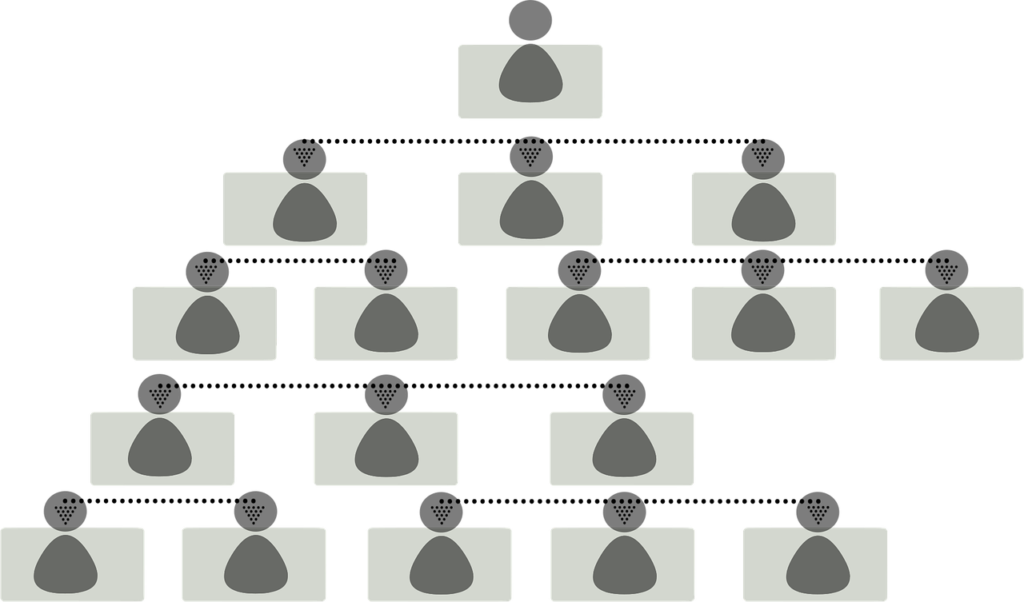
- A structure: who does what, who reports to whom, and how decisions are made.
- Roles and responsibilities: clear tasks for different people or teams (finance, operations, marketing, support).
- Processes and rules: agreed ways of doing things so work is consistent and fair (policies, procedures, job descriptions).
This organising makes it easier to coordinate actions, avoid duplication, and keep moving toward the shared goals.
Why organisations matter
Organisations shape much of daily life: they provide work, products, services, and community.
Understanding them as people, working together, on a purpose, with some agreed structure, makes it easier to see how to fit in, influence change, or even start a new one.
Further Reading
https://dictionary.cambridge.org/us/dictionary/english/organization
https://www.timechamp.io/blogs/what-is-organization-characteristics/
https://www.keka.com/glossary/organization
https://management.org/organizations/definition.htm
https://ibrecap.com/DP/Types%20of%20Organizations
https://www.bbc.co.uk/bitesize/guides/zpx7gdm/revision/1
https://en.wikipedia.org/wiki/Nonprofit_organization
https://www.bbc.co.uk/bitesize/guides/zdc6mfr/revision/5
https://www.gov.uk/set-up-a-social-enterprise
https://www.merriam-webster.com/dictionary/organization
https://icesba.eu/ocs/index.php/icesba2019/icesba2019/paper/view/241
https://nfil.net/resources/glossary/organization/
https://vest.rea.ru/jour/article/view/1254
https://www.semanticscholar.org/paper/c7717cf8fa565dec4a5d84ff208d8c6215fd3c1d
https://assajournal.com/index.php/36/article/view/453
https://academic.oup.com/cje/article-lookup/doi/10.1093/cje/bet067
https://www.frontiersin.org/articles/10.3389/fphys.2023.1234214/full
https://academic.oup.com/bioinformatics/article/23/2/207/204437
https://www.semanticscholar.org/paper/1b13ad4606af16bcbcc3e1848a87fdf1fb5f9746
https://onlinelibrary.wiley.com/doi/10.1111/j.1467-8543.2010.00779.x
https://ieeexplore.ieee.org/document/130789/
https://link.springer.com/10.1007/978-3-642-30284-8_25
https://arxiv.org/pdf/2501.10847.pdf
https://pmc.ncbi.nlm.nih.gov/articles/PMC2801529/
https://mutiara.al-makkipublisher.com/index.php/al/article/download/142/212
https://arxiv.org/abs/2503.03950
https://academic.oup.com/ppmg/article-pdf/3/2/109/33346664/gvaa005.pdf
https://en.wikipedia.org/wiki/Organization
https://dictionary.cambridge.org/dictionary/english/organization
https://www.vocabulary.com/dictionary/organization
https://www.resourcecentre.org.uk/information/legal-structures-for-community-and-voluntary-groups/
https://www.ncvo.org.uk/help-and-guidance/setting-up/choosing-your-legal-structure/