Contents
- 1 What Is Intuition?
- 1.1 Introduction
- 1.2 Intuition Can Feel Sudden
- 1.3 Intuition Uses Information
- 1.4 Intuition Can Develop Through Experience
- 1.5 Intuition Is Not the Same as Instinct
- 1.6 Intuition Can Contribute to Judgement
- 1.7 A Gut Feeling May Really Feel Bodily
- 1.8 Intuition Is Not Always Correct
- 1.9 Experience Alone Does Not Guarantee Good Intuition
- 1.10 Intuition Can Save Time
- 1.11 Intuition and Deliberate Thought Can Work Together
- 1.12 An Intuition Can Become Explainable
- 1.13 Intuition Is Another Provisional Signal
- 2 References
 What Is Intuition?
Introduction
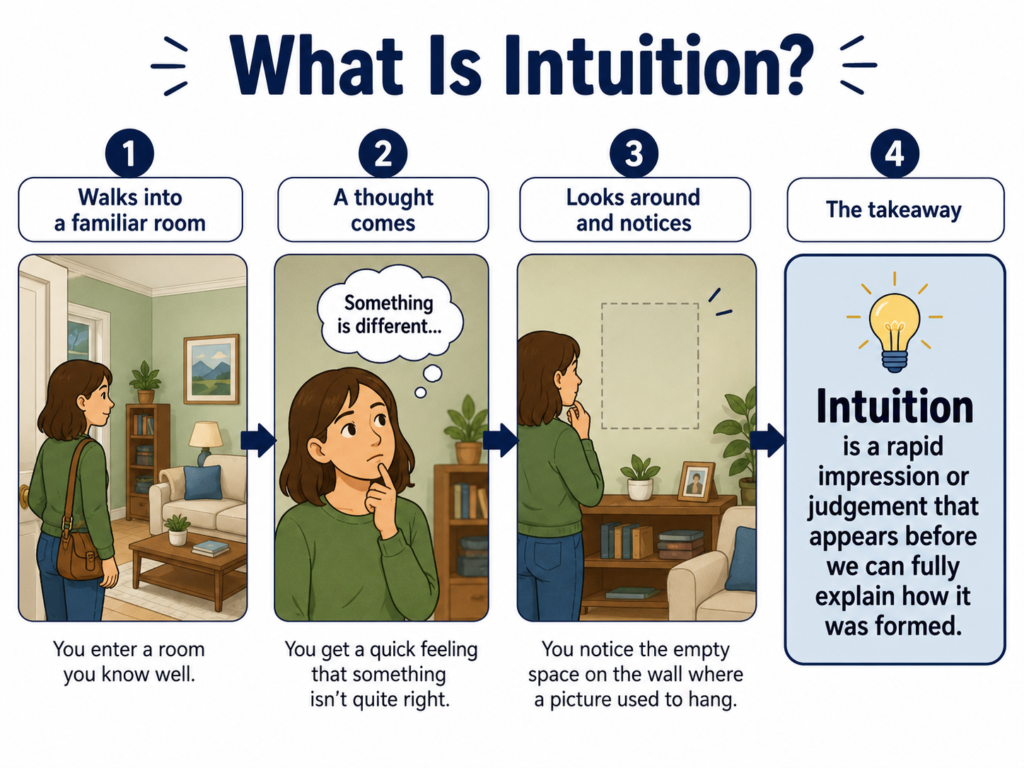
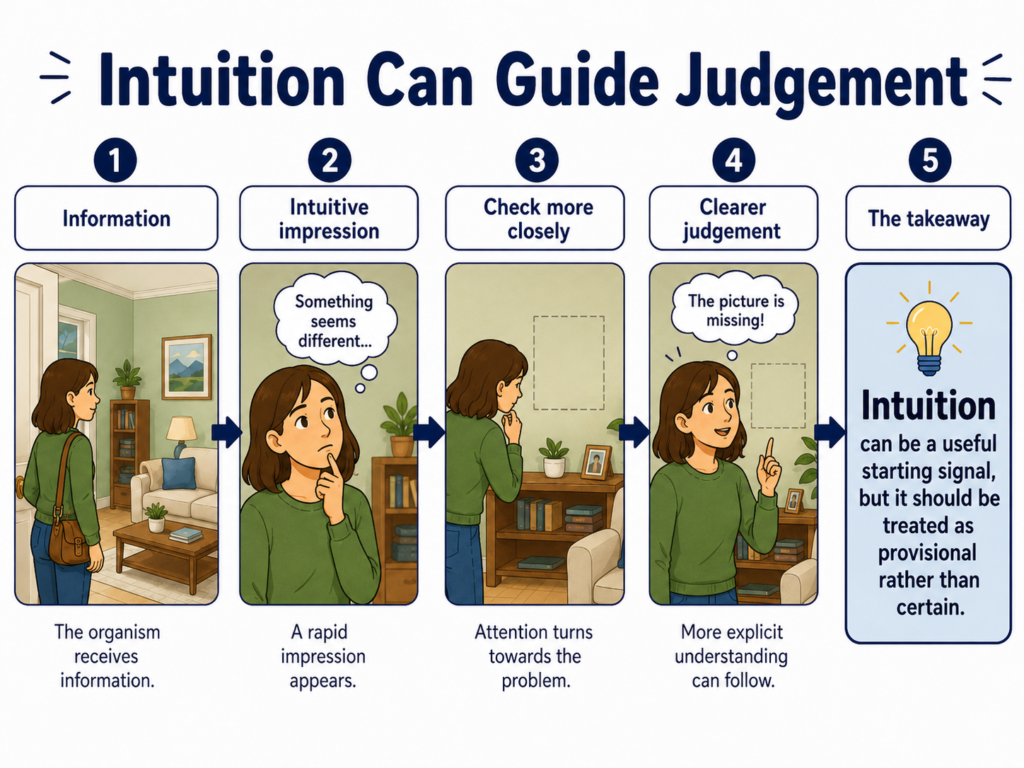
Imagine that you walk into a familiar room and immediately feel that something is different. You cannot yet say what has changed, so you look around, and you notice that a picture which normally hangs on the wall has been removed.
For a few moments, you appeared to know that something was different before you could explain how you knew. We commonly describe experiences like this as intuition.
Intuition can be difficult to define because the word is used in several different ways. People may talk about a hunch, a gut feeling, an immediate impression or simply “knowing” something without being able to explain why.
At this introductory level, we can use a cautious working definition:
Intuition is a judgement, impression or sense of what may be happening that becomes available without us consciously working through all of the steps that produced it.
This does not require anything mysterious to have happened.
The nervous system continually processes information, compares present situations with previous experience and detects patterns. Some of that processing may influence our judgement before we can describe exactly what information produced the result. Research has found circumstances in which people become sensitive to patterns or coherence before they can explicitly identify the relationship they have detected (Bowers et al., 1990).
Intuition Can Feel Sudden
Suppose somebody gives you a puzzle, and you examine it for several minutes but cannot find the answer. But then, apparently from nowhere:
I think I’ve got it!
The solution may seem to have appeared suddenly, but the sudden appearance of an idea does not necessarily mean that nothing was happening beforehand.
Experiments investigating intuition have suggested that information can gradually activate related knowledge until a possible pattern becomes strong enough to enter conscious awareness as a hunch or hypothesis (Bowers et al., 1990).
The experience of intuition may therefore be sudden even when some of the processing behind it has been developing for longer. This gives us an important distinction:
Not knowing how a judgement was formed
does not necessarily mean:
Nothing produced the judgement.
Intuition Uses Information
Intuition is sometimes described as though it means knowing something without information, that would be misleading.
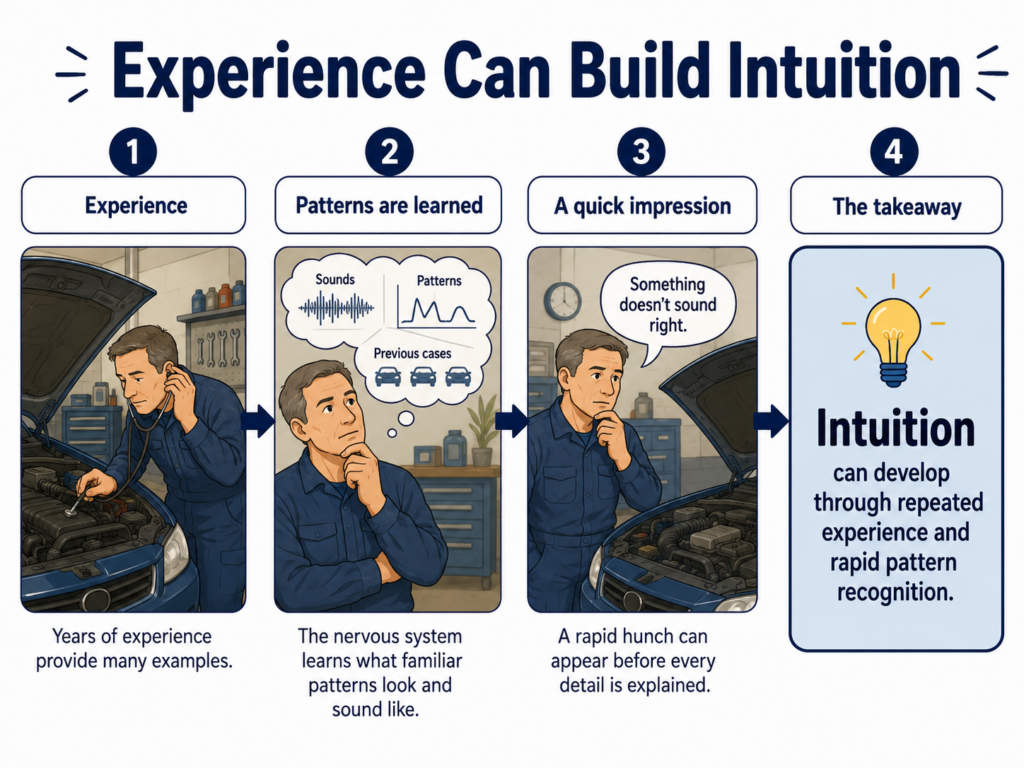
If we consider an experienced mechanic listening to an engine, after only a few seconds, they might say:
Something doesn’t sound right with the timing.
A person who knows very little about engines may hear exactly the same sound and notice nothing unusual.
The experienced mechanic may not initially be able to explain every feature that produced the impression. Nevertheless, years of experience may have allowed them to become sensitive to patterns that a novice has not yet learned.
Research on naturalistic decision-making describes expert intuition in similar terms: extensive experience can produce large stores of patterns and tacit knowledge that allow familiar situations to be recognised rapidly (Klein, 2015; Harteis & Billett, 2013).
So intuition can still depend upon information, the difference may be that we cannot yet give a complete conscious account of how that information produced the judgement.
 Intuition Can Develop Through Experience
Imagine learning to drive.
At first, almost everything requires deliberate attention.
You may consciously think about:
- the position of the car,
- the mirrors,
- the pedals,
- the speed,
- other vehicles,
- when to change gear,
- when to brake.
With sufficient experience, some of these assessments can become much faster.
An experienced driver may notice another vehicle and immediately feel:
That driver is going to pull out.
They may not consciously calculate the exact speed, angle, distance and movement of the other vehicle.
They may simply recognise a familiar pattern.
This is one reason expertise can sometimes produce useful intuition. Experienced people may have encountered many examples from which relevant patterns can be learned. Reviews of intuitive expertise emphasise that such abilities develop through substantial experience and learning rather than appearing independently of knowledge (Harteis & Billett, 2013).
We might therefore describe one route to intuition as:
Many experiences > patterns are learned > a new situation resembles previous patterns > a judgement appears quickly
Again, the person may experience the final judgement more clearly than the many comparisons that helped to produce it.
Intuition Is Not the Same as Instinct
The words intuition and instinct are sometimes used as though they mean the same thing.
For our purposes, it is useful to separate them.
An instinct usually refers to behavioural tendencies that arise substantially from evolved biological organisation without requiring the particular learning history that produced an expert judgement:
- Intuition can depend heavily upon learning.
- An experienced mechanic was not born knowing how an engine should sound.
- The experienced driver was not born recognising subtle traffic patterns.
Their intuitive responses may have developed through repeated interaction with those environments.
This does not mean intuition can contain no biological influence. Perception, emotion, attention and bodily regulation all depend upon biological systems.
It simply means that intuition should not automatically be treated as an inborn answer.
 Intuition Can Contribute to Judgement
In a previous article, we placed judgement inside a simple loop:
Information > judgement > decision > action > consequence > new information
Intuition gives us another small piece of that picture, a judgement does not always have to appear after deliberate step-by-step reasoning.
Sometimes the organism may reach an initial assessment rapidly:
Something is wrong.
That looks familiar.
I don’t trust this situation.
This seems like the right answer.
This intuitive impression can enter the judgement process. The organism may then act on it immediately, or it may examine the intuition more carefully before making a decision.
So we might provisionally add:
Information > rapid pattern recognition or other processing > intuitive impression > judgement > decision
This is deliberately simplified. Intuition and judgement may overlap considerably rather than occupying perfectly separate boxes. The important idea is simply that some judgements can become available before we can consciously explain the reasoning behind them.
A Gut Feeling May Really Feel Bodily
Sometimes intuition is described as a gut feeling, and that phrase may not be entirely accidental.
Information about the state of the body can contribute to human decision-making. In a well-known experiment, Bechara and colleagues found physiological changes associated with risky choices before participants could clearly report the strategy involved in the task (Bechara et al., 1997).
However, this finding needs to be treated cautiously. Later researchers argued that participants in that task may have possessed more consciously accessible knowledge than the original interpretation suggested (Maia & McClelland, 2004).
For our present purpose, we do not need to decide that debate, it is enough to recognise that an intuitive experience may include bodily information:
Something feels wrong
without assuming that every bodily feeling contains an accurate hidden answer.
The feeling itself is information available to the organism, and its meaning still has to be judged.
Intuition Is Not Always Correct
This distinction is essential: An intuition can feel convincing and still be misleading. Suppose you meet somebody who strongly reminds you of a person you previously disliked.
You might immediately feel:
I don’t trust them.
That feeling may genuinely have arisen from previous learning, but that new person is not the previous person. A pattern match can be useful without guaranteeing that the situations are actually equivalent.
This is one reason researchers disagree about intuition when it is discussed too generally. Some research traditions emphasise intuitive errors and biases, while research on expertise demonstrates circumstances in which rapid intuitive judgements can be highly effective. Kahneman and Klein concluded that both observations can be true: intuitive expertise is most trustworthy when the environment contains learnable regularities and the person has had sufficient opportunity to learn them through experience and feedback (Kahneman & Klein, 2009).
So:
I feel certain
does not mean:
I am certainly correct.
Our confidence in an intuition is itself another judgement.
Experience Alone Does Not Guarantee Good Intuition
Someone can do something for many years and still learn unreliable patterns.
One can imagine trying to predict the result of a completely random coin toss: After thousands of attempts, we would have enormous experience. But there is no reliable pattern in the sequence for us to learn.
Experience becomes useful for intuition when the environment contains meaningful regularities and when the organism receives sufficiently useful feedback to learn them.
This is why Kahneman and Klein argued that the quality of expert intuition depends partly upon both the predictability of the environment and the opportunity to learn from it (Kahneman & Klein, 2009).
A firefighter, mechanic or chess player may repeatedly encounter patterns whose later consequences provide feedback. However, other situations may be much less predictable.
Intuition therefore deserves neither automatic trust nor automatic dismissal.
We need to ask:
What might this intuition have learned from?
Intuition Can Save Time
Why would a system like this be useful?
Deliberately analysing everything would be extremely slow, sometimes too slow for the response or action that the situation demanded. Sometimes the issue may have too many unknowns for certainty, and also, some situations can be estimated to be too complex to ever be resolved.
Imagine consciously calculating every movement required to walk through a doorway, recognise a familiar face or respond to every minor change in traffic. Organisms often need to make workable judgements using limited time and information, and often under pressure and stress.
Research into heuristics describes efficient cognitive processes that can reach useful judgements while ignoring some available information rather than analysing everything (Gigerenzer & Gaissmaier, 2011).
This does not mean that intuition and heuristics are identical, it suggests a broader principle:
Fast judgement may sometimes be possible precisely because the organism does not consciously analyse everything.
That efficiency has advantages, but it also creates opportunities for error.
Intuition and Deliberate Thought Can Work Together
We should therefore avoid creating another rigid division:
intuition OR reasoning
An intuitive judgement can be the beginning of further thought.
For example, a doctor might think:
Something about this patient worries me.
Instead of treating the intuition as the final answer, they can ask:
What am I noticing?
They may check observations, gather more information and reconsider the situation.
Research on expertise increasingly treats intuitive and deliberate processes as capable of interacting rather than requiring one to replace the other completely.
This gives intuition a useful place in our developing loop, it can sometimes act as a signal for attention:
Something here may deserve a closer look.
The resulting judgement can then be tested against additional information.
An Intuition Can Become Explainable
Return to our room from the beginning, you may first experience:
Something is different.
You do not know why, so you look around, and notice the empty space on the wall.
Now you can explain:
The picture has been removed.
The original intuition has become a more explicit judgement, no longer vague, something that can be tested. Similar things can happen in many situations.
First:
This doesn’t seem right.
Then:
Why doesn’t it seem right?
More information becomes available, and eventually:
Now I can see what I noticed.
The intuition has not necessarily been replaced, instead, conscious examination has revealed some of the information that may have contributed to it. This suggests another useful sequence:
Information is processed > an intuitive impression appears > attention is directed towards the problem > more information is examined > a more explicit judgement may form
Experiments by Bowers and colleagues provide one example of this possibility: participants showed sensitivity to patterns before being able to explicitly identify the coherence they were detecting (Bowers et al., 1990).
Intuition Is Another Provisional Signal
We can now fit intuition into our developing picture without giving it mysterious powers. We can suggest that the organism receives more information than it can consciously describe at every moment. That experience can produce learned patterns and that present information can activate those patterns. Sometimes the result enters awareness as a rapid impression:
Familiar
Wrong
Promising
Dangerous
Try this
That impression may be useful, it may also be mistaken, it may not see the whole picture, and may not always be as certain as the strength of it feels.
The intuition therefore does not have to be treated as either an unquestionable truth or meaningless noise. And it can be treated as another provisional source of information for judgement.
We might see :
Information > previous experience and learned patterns > an intuitive impression may arise > judgement > decision > action > consequence > new information and learning
The consequence matters because it can help determine whether the intuition was useful. Repeating that experience can strengthen useful pattern recognition. And it can also reveal that an apparent pattern was unreliable. Perhaps the simplest conclusion is therefore:
Intuition is a rapid sense or judgement whose underlying processing is not yet fully available to conscious explanation.
It can draw upon experience, learned patterns, present information and bodily signals.
- Sometimes it can guide us remarkably well.
- Sometimes it can mislead us.
And because the intuitive result often arrives before its explanation, it naturally raises our next question:
How can we tell when an intuition deserves our trust?
References
Bechara, A., Damasio, H., Tranel, D., & Damasio, A. R. (1997). Deciding advantageously before knowing the advantageous strategy. Science, 275(5304), 1293–1295. doi:10.1126/science.275.5304.1293.
Bowers, K. S., Regehr, G., Balthazard, C., & Parker, K. (1990). Intuition in the context of discovery. Cognitive Psychology, 22(1), 72–110. doi:10.1016/0010-0285(90)90004-N.
Gigerenzer, G., & Gaissmaier, W. (2011). Heuristic decision making. Annual Review of Psychology, 62, 451–482. doi:10.1146/annurev-psych-120709-145346.
Harteis, C., & Billett, S. (2013). Intuitive expertise: Theories and empirical evidence. Educational Research Review, 9, 145–157. doi:10.1016/j.edurev.2013.02.001.
Kahneman, D., & Klein, G. (2009). Conditions for intuitive expertise: A failure to disagree. American Psychologist, 64(6), 515–526. doi:10.1037/a0016755.
Klein, G. (2015). A naturalistic decision making perspective on studying intuitive decision making. Journal of Applied Research in Memory and Cognition, 4(3), 164–168. doi:10.1016/j.jarmac.2015.07.001.
Maia, T. V., & McClelland, J. L. (2004). A reexamination of the evidence for the somatic marker hypothesis: What participants really know in the Iowa gambling task. Proceedings of the National Academy of Sciences, 101(45), 16075–16080.