Contents
- 1 What Is Operant Conditioning?
- 1.1 Introduction
- 1.2 Learning From Consequences
- 1.3 What Is Reinforcement?
- 1.3.1 What Is Positive Reinforcement?
- 1.3.2 What Is Negative Reinforcement?
- 1.3.3 What Is Punishment?
- 1.3.4 Positive and Negative Punishment
- 1.3.5 Intention Does Not Decide the Effect
- 1.3.6 The Same Consequence Can Affect Different Organisms Differently
- 1.3.7 Operant Conditioning and Defensive Behaviour
- 1.3.8 Behaviour Changes What Happens Next
- 1.3.9 Does Operant Conditioning Require Conscious Choice?
- 1.3.10 Operant Conditioning Is Not Just Animal Training
- 1.3.11 Does Operant Conditioning Explain All Behaviour?
- 1.3.12 Learning What Our Actions Do
- 1.4 References
- 1.5 Knowledge Quiz
What Is Operant Conditioning?
Introduction
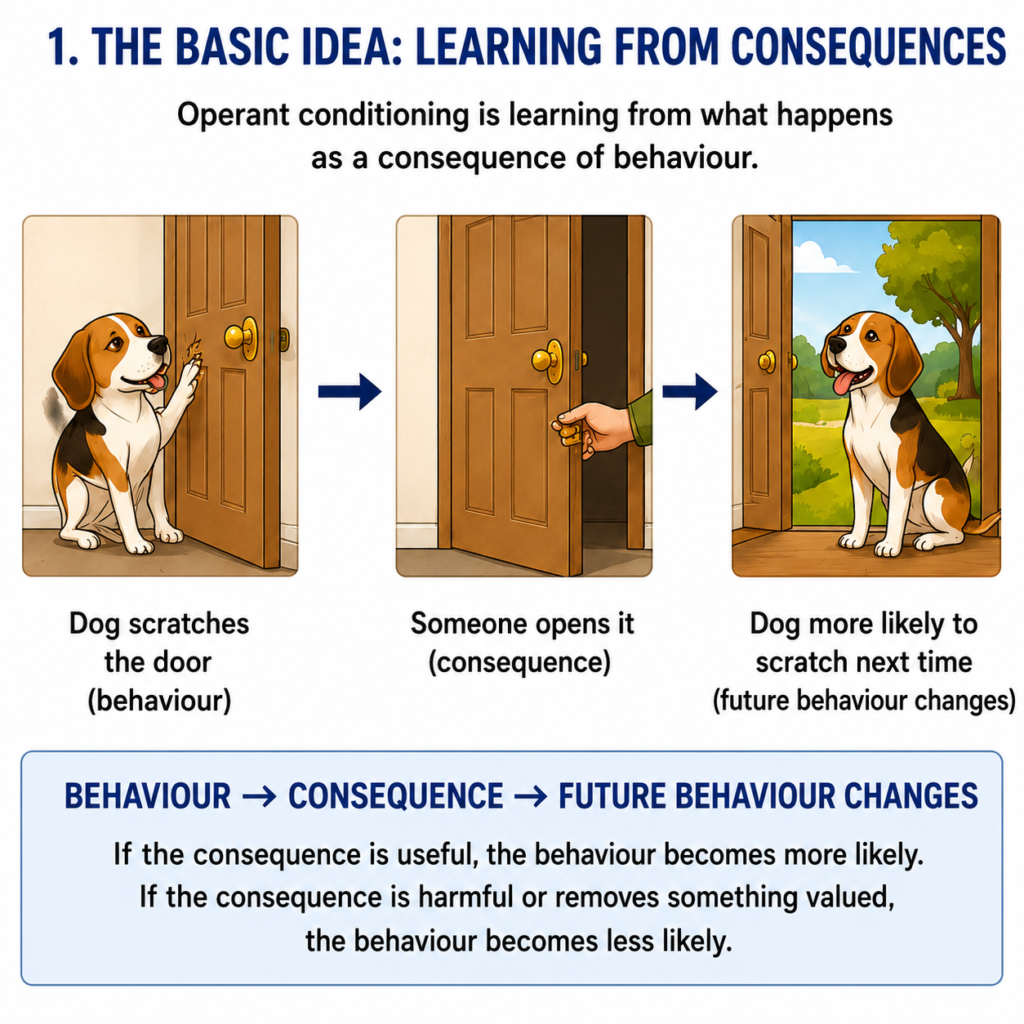
Imagine that a dog is standing beside a closed door. The then dog scratches at the door, and someone opens it.
Later, when the dog wants to go outside again, it scratches at the door, and something may have been learned.
The dog’s own behaviour produced a consequence. If that consequence makes the dog more likely to scratch at the door in similar circumstances in the future, this is an example of operant conditioning.
Operant conditioning is a form of learning in which the consequences of behaviour influence how likely similar behaviour is to occur again (Skinner, 1938; Staddon & Cerutti, 2003).
In its simplest form:
behaviour > consequence > future behaviour changes
This gives an organism a useful way of discovering what its own actions do.
Learning From Consequences
Organisms do not simply observe their environments; they act within them.
An animal approaches something, moves away from it, pushes it or calls to another animal. Human beings ask questions, press buttons, speak to people, open doors and make thousands of other actions every day.
Some actions have useful consequences, others do not:
Imagine a hungry animal encounters a lever. It touches the lever accidentally, and food appears.
Later, it touches the lever again, and if receiving food makes touching the lever more likely, the consequence has changed the animal’s future behaviour.
The organism of the dog has learned something approximately like:
When I do this, something important happens.
It does not necessarily have to think those words consciously. We can instead observe that experience has changed the probability of the behaviour occurring again.
This relationship between behaviour and its consequences is central to operant conditioning (Skinner, 1938; Staddon & Cerutti, 2003).
 What Is Reinforcement?
A consequence that makes a behaviour more likely to occur again is called reinforcement.
Suppose a dog sits and is then given some food. If receiving the food makes the dog more likely to sit in similar circumstances in the future, the food has acted as a reinforcer.
The important point is not simply that the dog received something pleasant, what matters is what happened to the behaviour afterwards.
If the consequence makes the behaviour more likely, it has reinforced that behaviour.
This is why reinforcement is normally defined by its effect upon subsequent behaviour rather than simply by whether the consequence looks pleasant to an observer (Skinner, 1938).
Something that reinforces one organism’s behaviour may not have the same effect upon another.
Food, for example, may strongly influence behaviour when an animal is hungry but have much less effect after it has eaten. The context and the current state of the organism therefore matter.
What Is Positive Reinforcement?
The word positive has a special meaning in the traditional terminology of operant conditioning.
It does not mean good. It normally means that something has been added following the behaviour.
Suppose a child completes some schoolwork and receives praise. If the praise makes completing similar work more likely in the future, this would conventionally be described as positive reinforcement.
Something was added:
work completed > praise added > behaviour becomes more likely
Likewise:
dog sits > food added > sitting becomes more likely
Positive reinforcement therefore conventionally describes a situation in which something is added and the relevant behaviour subsequently increases.
What Is Negative Reinforcement?
Negative reinforcement is often confused with punishment, but they are not the same thing. In the traditional terminology, negative means that something is removed.
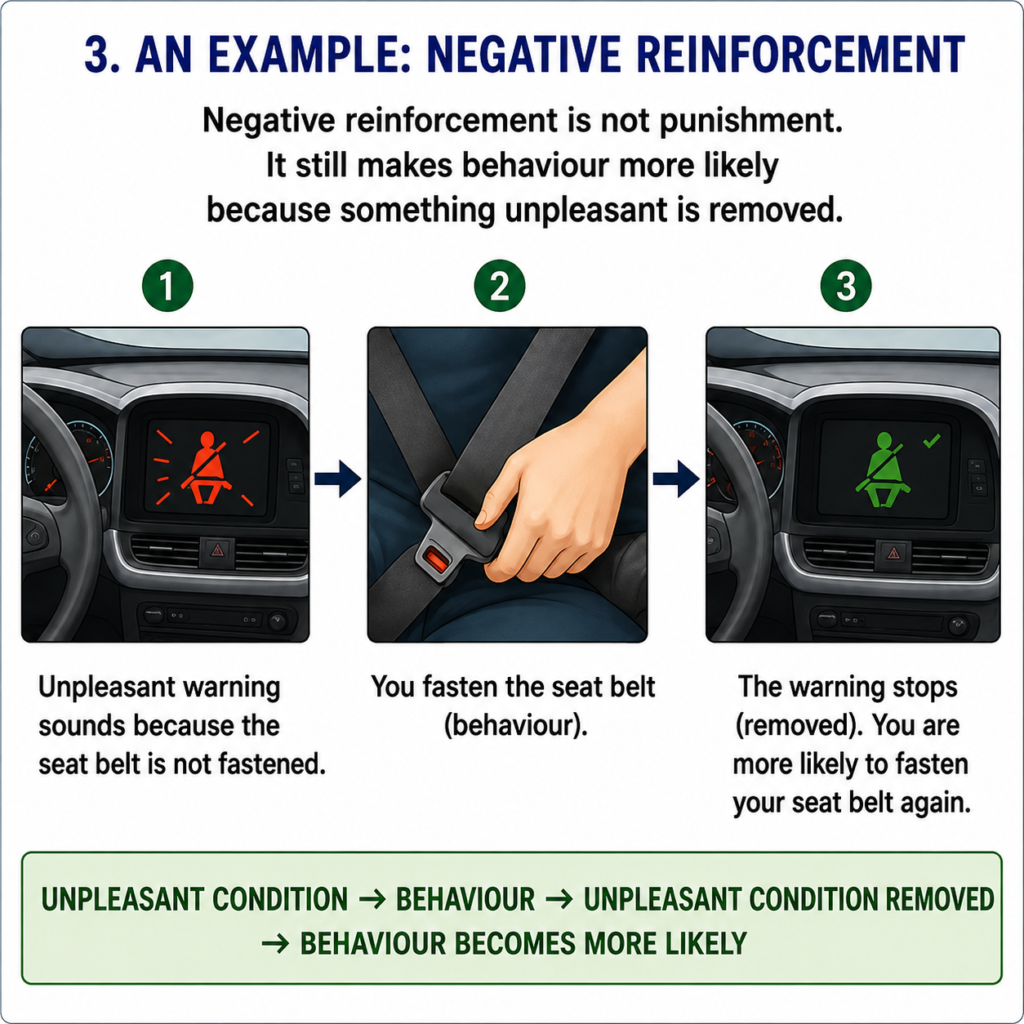
Imagine that you enter a car and an irritating warning sound begins because your seat belt is not fastened. So you fasten the belt, and the sound stops.
If removing the unpleasant sound makes you more likely to fasten your seat belt quickly in the future, fastening the belt has been negatively reinforced.
The sequence is:
Unpleasant condition > behaviour > unpleasant condition removed > behaviour becomes more likely
Negative reinforcement therefore still makes behaviour more likely, the traditional distinction is:
Positive reinforcement = something added, behaviour increases
Negative reinforcement = something removed, behaviour increases
The words positive and negative, in the context of behavioural conditioning do not mean good and bad.
There is some technical debate about whether addition and removal always provide a completely satisfactory way of dividing reinforcement into two categories, so these terms are best treated as useful introductory descriptions rather than fundamental laws of nature (Baron & Galizio, 2005, 2006).
What Is Punishment?
Punishment also has a more precise meaning in learning theory than it often has in everyday speech. A consequence functions as punishment when it makes the behaviour that preceded it less likely to occur again (Jean-Richard-Dit-Bressel et al., 2018).
Suppose an animal performs a behaviour and an unpleasant consequence follows. If that behaviour subsequently becomes less likely, the consequence may have functioned as punishment.
Something desirable can also be removed following a behaviour. If the behaviour then decreases, that removal can also function as punishment. The important distinction at this level is therefore:
Reinforcement makes behaviour more likely
Punishment makes behaviour less likely
These terms describe relationships between behaviour and consequences. They do not tell us whether an action is morally good or bad.
Positive and Negative Punishment
The same traditional positive and negative terminology can also be applied to punishment.
Positive punishment means something is added following a behaviour and the behaviour becomes less likely.
Behaviour > something added > behaviour decreases
Negative punishment means something is removed following a behaviour and the behaviour becomes less likely.
Behaviour > something removed > behaviour decreases
This gives us a useful introductory table:
| Something added | Something removed | |
|---|---|---|
| Behaviour becomes more likely | Positive reinforcement | Negative reinforcement |
| Behaviour becomes less likely | Positive punishment | Negative punishment |
A simple way of remembering the conventional terminology is:
positive = add
negative = remove
reinforcement = behaviour increases
punishment = behaviour decreases
The last two distinctions are particularly important: Something is not reinforcement simply because somebody intended it as a reward, and something is not punishment simply because somebody intended it to discourage behaviour.
We have to look at what happens to the behaviour.
Intention Does Not Decide the Effect
Suppose a pupil makes jokes during a lesson, and the teacher repeatedly tells the pupil off. The teacher intends the reprimand to stop the behaviour, but suppose the pupil enjoys receiving attention and making classmates laugh. And so the pupil begins making even more jokes.
The teacher intended the consequence to punish the behaviour, but the behaviour has increased rather than decreased. From an operant perspective, we therefore ask:
What did the consequence actually do to the future behaviour?
rather than simply:
What did somebody intend it to do?
This functional emphasis is an important feature of the experimental analysis of operant behaviour (Skinner, 1938; Staddon & Cerutti, 2003).
The Same Consequence Can Affect Different Organisms Differently
People and other animals do not all respond to the same consequences in the same way.
Suppose somebody receives public praise. One person may enjoy the attention and become more likely to repeat the behaviour, but another person may find public attention uncomfortable.
The event is similar, but its significance to the organism is different.
Food is therefore not automatically a reinforcer in every circumstance, and neither is attention automatically reinforcing. Being left alone is not automatically unpleasant.
Whether something functions as a reinforcer or punisher depends upon its relationship with the organism’s subsequent behaviour and the circumstances in which that behaviour occurs.
Research on operant learning also shows that context can influence whether learned behaviour is expressed, reminding us that behaviour cannot always be understood independently of the circumstances in which it was learned (Bouton & Todd, 2014).
This will become important later when we look more closely at motivation and value.
Operant Conditioning and Defensive Behaviour
Operant conditioning also connects with the defensive responses we have explored elswhere.
Imagine that somebody enters a situation that they experience as threatening, so they leave. This may result in a reduction in their anxiety. If that consequence makes leaving similar situations more likely in the future, escape behaviour may have been reinforced.
Avoidance and escape learning have been extensively studied, and research suggests that behaviour which prevents or terminates anticipated aversive events can be maintained through learning processes involving their consequences (Dinsmoor, 2001; Krypotos et al., 2015).
That does not mean escaping is necessarily mistaken, if there really is danger, escape can be extremely useful. It simply shows that defensive actions can themselves be influenced by what happens after the organism performs them.
The organism can learn something approximately like:
When this happens, doing this helps me get away.
Behaviour Changes What Happens Next
Operant conditioning therefore introduces something particularly important into the model we have been developing.
So far, we have often considered information travelling towards the organism:
- Something happens.
- The organism notices it.
- Previous learning helps give it meaning.
- The organism predicts what may happen next.
But organisms can also act, and that behaviour changes what happens afterwards. Those consequences then become part of their next experience.
We therefore have a continuing loop:
Situation > organism acts > something happens as a consequence > the organism learns from that consequence > future behaviour changes
This is why operant behaviour is often described in terms of behaviour being influenced or maintained by its consequences (Staddon & Cerutti, 2003).
The organism is not simply a passive receiver of information: It participates in producing some of the circumstances from which it subsequently learns.
Does Operant Conditioning Require Conscious Choice?
Not necessarily, a person can certainly understand a relationship between behaviour and consequences consciously. Someone might think:
Whenever I prepare properly for this task, it goes much better. I should do that again next time.
But operant conditioning is not defined by the presence of that conscious explanation. Individual behaviour can change through experience whether or not the organism verbally describes the relationship.
This is particularly obvious in experiments with non-human animals, but humans can also acquire behavioural patterns without continuously analysing every consequence consciously.
Human reasoning nevertheless adds another layer of complexity. People can think about future consequences, follow instructions and deliberately decide whether or not to repeat behaviour.
Operant conditioning therefore describes one influence upon behaviour rather than providing a complete account of human decision-making.
Operant Conditioning Is Not Just Animal Training
Operant conditioning is often associated with laboratory animals or teaching pets, but the underlying learning relationship is much broader.
Organisms naturally act within their environments and experience consequences:
- A child discovers that calling for a caregiver may bring attention.
- A person discovers that asking a particular colleague for help often produces useful information.
- Someone discovers that taking a different route avoids heavy traffic.
- An animal discovers that searching in one location often produces food.
In each case, experience can alter future behaviour because of what happened after the organism acted.
Psychologists can create controlled experiments to investigate these relationships, but the learning process itself is not restricted to laboratories (Skinner, 1938; Staddon & Cerutti, 2003).
Does Operant Conditioning Explain All Behaviour?
No, it does not. Human behaviour is considerably more complicated than simply repeating whatever previously produced a useful consequence.
- People can follow instructions.
- We can learn by watching others.
- We can imagine consequences that have never happened to us.
- We can choose difficult actions because they serve longer-term goals.
- We can refuse an immediate reward because something else matters more to us.
Language, memory, reasoning, social relationships, culture and personal values can all influence behaviour.
Operant conditioning therefore describes one important kind of learning:
learning from what happens after we act.
It should not be treated as a complete explanation of the organism.
Learning What Our Actions Do
The simplest useful definition is therefore:
Operant conditioning is learning from the consequences of behaviour.
An organism acts, and something happens. The consequence of this can influence how likely similar behaviour is to occur again.
- If the behaviour becomes more likely, we describe the consequence as reinforcement.
- If it becomes less likely, we describe the consequence as punishment.
And whether something functions as reinforcement or punishment depends upon its relationship with subsequent behaviour, not merely upon what an outside observer calls the consequence.
We can therefore extend our developing picture:
The organism perceives > the organism predicts > the organism acts > the action has consequences > the organism learns > future behaviour changes
Learning is therefore not only concerned with discovering what events in the world might predict.
It can also involve discovering:
What happens when I do something?
And this gives us an important question for later: If the same consequence can matter greatly to one organism, very little to another, or differently to the same organism at different times:
What makes something valuable?
References
Baron, A., & Galizio, M. (2005). Positive and negative reinforcement: Should the distinction be preserved? The Behavior Analyst, 28(2), 85–98. https://doi.org/10.1007/BF03392107
Baron, A., & Galizio, M. (2006). The distinction between positive and negative reinforcement: Use with care. The Behavior Analyst, 29, 141–151. https://doi.org/10.1007/BF03392127
Bouton, M. E., & Todd, T. P. (2014). A fundamental role for context in instrumental learning and extinction. Behavioural Processes, 104, 13–19. https://doi.org/10.1016/j.beproc.2014.02.012
Dinsmoor, J. A. (2001). Stimuli inevitably generated by behavior that avoids electric shock are inherently reinforcing. Journal of the Experimental Analysis of Behavior, 75(3), 311–333. https://doi.org/10.1901/jeab.2001.75-311
Jean-Richard-Dit-Bressel, P., Killcross, S., & McNally, G. P. (2018). Behavioral and neurobiological mechanisms of punishment: Implications for psychiatric disorders. Neuropsychopharmacology, 43, 1639–1650.
Krypotos, A.-M., Effting, M., Kindt, M., & Beckers, T. (2015). Avoidance learning: A review of theoretical models and recent developments. Frontiers in Behavioral Neuroscience, 9, 189. https://doi.org/10.3389/fnbeh.2015.00189
Skinner, B. F. (1938). The Behavior of Organisms: An Experimental Analysis. Appleton-Century.
Staddon, J. E. R., & Cerutti, D. T. (2003). Operant conditioning. Annual Review of Psychology, 54, 115–144. https://doi.org/10.1146/annurev.psych.54.101601.145124