Contents
- 1 How Can Anxiety Turn Into Fear?
- 1.1 Introduction
- 1.2 What Is Threat Imminence?
- 1.3 Anxiety Watches the Horizon
- 1.4 When Possibility Becomes Probability
- 1.5 There May Not Be a Single Switch Between Anxiety and Fear
- 1.6 The Threat Does Not Actually Have to Move
- 1.7 One New Piece of Information Can Change Everything
- 1.8 Fear Can Change What the Body Is Preparing to Do
- 1.9 Fear Can Arrive Before Certainty
- 1.10 The Process Can Also Run Backwards
- 1.11 What If the Threat Comes From Inside the Body?
- 1.12 Anxiety Can Help Create the Evidence That Produces Fear
- 1.13 Context Changes Imminence Too
- 1.14 Anxiety Does Not Inevitably Become Fear
- 1.15 Perhaps Anxiety Does Not “Turn Into” Fear at All
- 1.16 A Continuously Updating Defensive System
- 1.17 Sources
 How Can Anxiety Turn Into Fear?
Introduction
In the previous articles, we have made a useful distinction between anxiety and fear.
Anxiety commonly concerns something that might happen. Fear is more commonly associated with danger that appears to be happening, or about to happen, now.
Someone who hears that their employer may make redundancies next year might become anxious. Someone who suddenly sees a car coming directly towards them is much more likely to experience fear.
But real life does not always divide itself neatly into these categories.
What happens when something that might happen begins to look increasingly as though it is going to happen?
Can anxiety become fear?
The answer appears to be yes, although describing this as anxiety simply being converted into fear would probably be too simplistic. Research increasingly suggests that defensive responding changes dynamically as the organism’s understanding of a threat changes. Anxiety and fear may therefore be better understood as overlapping parts of a continuously adjusting defensive process rather than two entirely separate systems (Grupe & Nitschke, 2013; Cornwell et al., 2025).
To understand how this can happen, we need to introduce a new idea:
threat imminence.
What Is Threat Imminence?
Imminent means something is close to happening.
- A possible thunderstorm next week is not very imminent.
- Lightning striking the field beside you is extremely imminent.
The same distinction can be applied to danger.
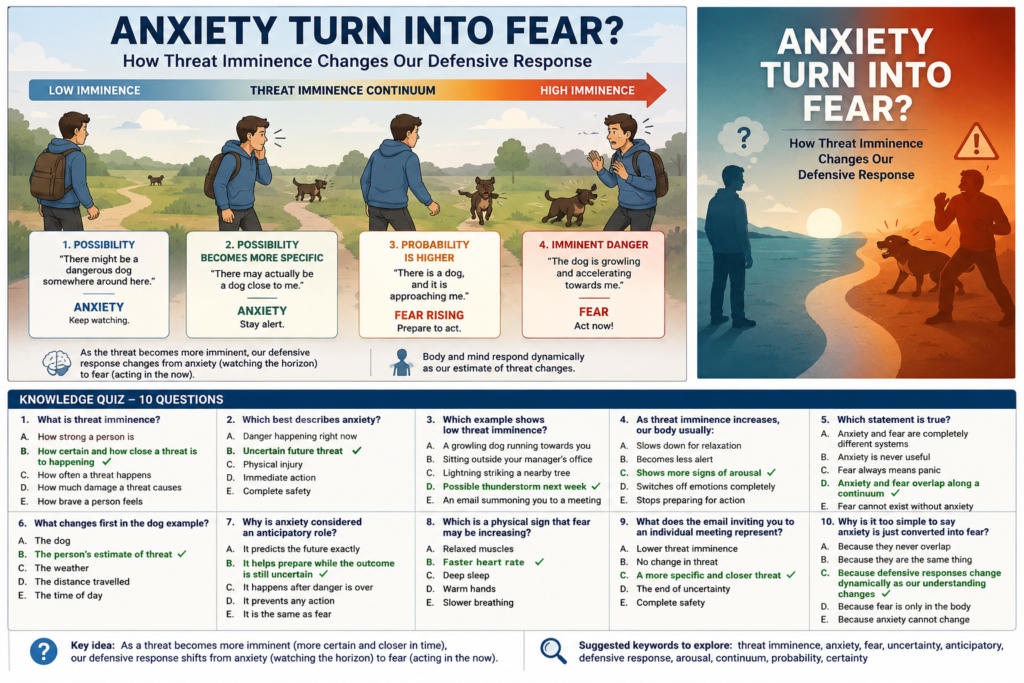
Imagine that you are walking through countryside where somebody has warned you that aggressive dogs are occasionally seen.
At first, there is only a possibility:
There might be a dangerous dog somewhere around here.
You may become more watchful. You might listen for barking or look ahead more carefully.
Then you hear barking nearby.
The possibility has become more specific:
There may actually be a dog close to me.
Then you see an unfamiliar dog running towards you.
Now the situation has changed again:
There is a dog, and it is approaching me.
Then it begins growling and accelerating towards you.
At every stage, the basic subject – a possible dangerous dog – is similar.
What changes is the organism’s estimate of how real, certain and immediate the threat has become.
Research into defensive behaviour suggests that this matters enormously. Both animal and human studies indicate that defensive behaviour changes according to how close a perceived threat is to harming the organism, an idea often described as the threat-imminence continuum (Fanselow, 2018; Mobbs et al., 2007).
Anxiety and fear begin to make more sense when placed somewhere along this changing continuum.
Anxiety Watches the Horizon
Suppose somebody tells you:
There may be redundancies at your workplace sometime this year.
Nothing has happened yet.
You can still do your job.
You do not know whether redundancies will actually occur.
You certainly do not know whether you personally will lose your job.
Nevertheless, something important has changed.
A possible future danger now exists.
You might begin paying more attention to company announcements. You might wonder whether certain meetings are significant. You might think about your savings or quietly look at other jobs.
This resembles the anticipatory role we discussed in the defensive responding article.
Research into anxiety repeatedly highlights the importance of uncertain future threat. Grupe and Nitschke proposed that uncertainty about potentially negative future events is particularly important because the organism cannot yet know whether avoidance or other protective action is required (Grupe & Nitschke, 2013).
Anxiety therefore allows the organism to remain prepared while the answer is still uncertain.
In simple terms:
Something might happen, so keep watching.
But now suppose the information changes.
When Possibility Becomes Probability
A month later, your employer announces:
Your department is being considered for redundancies.
The feared possibility has moved closer.
There is still uncertainty, but considerably less of it.
Then you learn that half of your department will lose their jobs.
Again the threat estimate changes.
Then an email arrives:
Please attend an individual meeting with your manager at 10:00 tomorrow morning.
The threat has become increasingly specific.
Finally, at 9:59 the next morning, you are sitting outside your manager’s office waiting to be called inside.
Your body may now feel quite different from how it felt when you first heard that redundancies might happen sometime during the year.
- Your heart may beat faster.
- Your stomach may feel unsettled.
- Your muscles may tense.
- Your attention may narrow.
- You may find it difficult to think about anything else.
The feared event has moved from:
perhaps, sometime
towards:
possibly, very soon.
Experimental research indicates that defensive responding changes as threatening events become increasingly imminent. In a well-known human brain-imaging experiment, Mobbs and colleagues allowed participants to experience pursuit by a virtual predator capable of administering an unpleasant shock. As the predator came closer, patterns of brain activity shifted towards systems associated with more immediate defensive responding (Mobbs et al., 2007).
The organism appears to behave differently when danger is on the horizon than when danger is almost upon it.
There May Not Be a Single Switch Between Anxiety and Fear
It would be tempting at this point to imagine a simple switch.
Perhaps the brain first activates its anxiety system and then, once some threshold is crossed, switches anxiety off and activates its fear system.
That picture is probably too tidy.
Research increasingly suggests considerable overlap between the systems involved in anticipating certain and uncertain threats.
A particularly informative 2025 human neuroimaging study by Cornwell and colleagues compared anticipation of threats whose timing was certain with threats whose timing was uncertain. Rather than finding two completely independent systems corresponding neatly to fear and anxiety, the researchers found substantial involvement of a shared threat-anticipation circuit, whose activity changed dynamically during anticipation (Cornwell et al., 2025).
That does not mean fear and anxiety are identical.
It suggests something subtler.
Instead of imagining:
ANXIETY > switch > FEAR
we might imagine:
uncertain possible threat > increasing evidence > increasing imminence > changing defensive state
The labels anxiety and fear can still be very useful. They describe recognisably different experiences.
But the biological process underneath them may be more continuous than our vocabulary suggests.
The Threat Does Not Actually Have to Move
There is another important complication: when we talk about threat getting “closer”, it sounds as though something physically has to approach us.
Sometimes it does.
- A predator can move closer.
- A speeding car can approach.
- A threatening person can advance towards us.
But perceived imminence can change even when nothing physically moves at all.
Imagine waking during the night and hearing an unfamiliar noise downstairs.
At first:
What was that?
There are many possible explanations.
- Perhaps something fell over.
- Perhaps the heating made a noise.
- Perhaps somebody else in the house got up.
The uncertainty itself might produce anxiety.
Then you hear what sounds like a door closing.
Your interpretation changes:
That sounded like a door.
Then you hear footsteps.
Now:
Somebody may be downstairs.
Then the footsteps begin climbing the stairs.
At each stage, new information changes what you think is happening. The transition towards fear is therefore not produced merely by physical distance, it can be produced by information.
The organism is continually revising its estimate of the situation.
This is consistent with models of threat imminence in which defensive behaviour depends not merely on objective distance but on information that allows the organism to estimate how close it is to a harmful outcome (Fanselow, 2018).
That distinction is extremely important.
The defensive system responds to the danger as the organism currently understands it.
One New Piece of Information Can Change Everything
Suppose you are walking alone at night and hear footsteps behind you.
- You become alert.
- You do not yet know what the footsteps mean.
- Then you notice that they seem to be getting closer.
- Anxiety might increase.
- You cross the road.
- The person crosses too.
That provides new information.
- You speed up.
- They speed up.
Again, the apparent meaning changes.
At some point you may stop thinking primarily:
Could this person be dangerous?
and begin thinking:
This person is following me.
The possible future danger has become an apparent present danger, and anxiety may consequently give way to, or become accompanied by, a much more acute fear response.
The important event is not necessarily an alteration in the outside world itself: It is a change in the organism’s estimate of what the outside world means.
That estimate can sometimes change extremely quickly.
Fear Can Change What the Body Is Preparing to Do
Why should increasing imminence produce a different state?
Because different stages of danger require different behaviour.
If a predator might be somewhere in the area, immediately sprinting away would waste energy and might even attract attention, and it makes more sense to gather information.
- If the predator has noticed you, remaining vigilant or becoming still may be useful.
- If it suddenly charges, however, the time for gathering information is disappearing.
Immediate action becomes more important.
Threat-imminence theories therefore propose that defensive responses change as the organism moves through different relationships with danger. Fanselow’s work describes transitions between defensive modes depending upon the perceived proximity of threat, while human studies by Mobbs and colleagues have found corresponding changes in behaviour and neural processing as simulated danger approaches (Fanselow, 2018; Mobbs et al., 2007).
This also connects directly to the fight, flight and freeze responses with which we began this series.
- Freeze can be useful while additional information is being gathered.
- Flight may become useful when escape is necessary.
- Fight may become relevant when danger is immediate and escape is impossible.
These are not necessarily isolated buttons. Defensive behaviour can shift flexibly as the perceived relationship between organism and threat changes (Roelofs, 2017).
Anxiety may therefore be helping to maintain readiness while the organism does not yet know which immediate defensive behaviour will be required.
Fear Can Arrive Before Certainty
There is an important caution here: That the defensive system does not wait for scientific proof.
Suppose the footsteps behind you really do belong to somebody simply walking in the same direction.
You do not know that, and the nervous system has to make decisions using incomplete information.
Waiting until an attacker actually grabs you before deciding that you are threatened would clearly be a poor defensive strategy, the important transition is not necessarily:
possible danger > proven danger
It may instead be:
possible danger > danger now seems sufficiently likely and imminent to justify immediate preparation
This distinction is crucial because defensive systems have to operate under uncertainty; they continually face the possibility of two kinds of error.
One is:
I thought something was dangerous, but it wasn’t.
The other is:
I thought something was safe, but it was dangerous.
The consequences of those two mistakes are not necessarily equal.
From a survival perspective, responding unnecessarily to a possible predator may be costly, but failing to respond to a real predator could be catastrophic.
Defensive systems therefore cannot be expected to respond only when danger has been objectively demonstrated. Their job is to act upon available evidence while the outcome remains uncertain. Research into uncertain threat and anticipation describes precisely this problem of preparing adaptive responses when the future cannot yet be known (Grupe & Nitschke, 2013).
The Process Can Also Run Backwards
Now return to our night-time noise.
You hear footsteps approaching.
Fear increases.
Then you switch on the light.
Your teenage child appears and says:
Sorry, I was getting a drink.
Something important happens.
The evidence supporting the threatening interpretation suddenly collapses.
- The footsteps have not changed.
- The sound has not changed.
What has changed is their meaning.
The prediction:
an intruder may be approaching
has been replaced by:
someone I know is walking upstairs.
Defensive activation can consequently begin to reduce defensive responses simply as automatic reactions to particular objects or sounds. And also that the same sound can mean very different things depending upon context and information.
A footstep is not inherently frightening, its significance depends upon what the organism thinks the footstep predicts.
What If the Threat Comes From Inside the Body?
The same process may also help us connect anxiety with the panic attacks discussed earlier in this series.
Imagine somebody who has become worried about their heart.
Their anxiety might initially concern a future possibility:
What if I have heart disease?
That is an uncertain anticipated threat.
Then they notice their heart beating unusually strongly.
The situation changes:
Is something happening?
Then they feel dizzy.
Another piece of apparent evidence has appeared.
They may now think:
I’m having a heart attack.
The feared event has moved psychologically from:
something might happen to me
to:
something is happening to me now.
Acute fear may follow.
If the resulting defensive activation further increases heart rate, breathing changes or dizziness, those additional sensations may themselves appear to confirm the threatening interpretation.
This connects the anxiety process directly with the feedback loop we examined in the panic article.
Research supports the possibility that bodily sensations can themselves acquire threatening significance and participate in learned fear. Experimental work has demonstrated that internal sensations such as breathlessness can become conditioned predictors of frightening outcomes and subsequently evoke anxiety or fear (Pappens et al., 2015).
The threat-imminence principle therefore appears capable of operating both externally and internally.
The organism may conclude:
something dangerous is approaching me.
Or:
something dangerous is happening inside me.
In either case, the important change is the perceived proximity of harm.
Anxiety Can Help Create the Evidence That Produces Fear
This produces another interesting possibility.
Anxiety changes us: Someone who is anxious may become more watchful. Their attention may increasingly search for signs connected with the anticipated danger.
- If you are anxious about losing your job, an ordinary closed-door meeting might suddenly appear significant.
- If you are anxious about illness, a bodily sensation that you previously ignored might attract your attention.
- If you are anxious about being rejected, a delayed reply might acquire considerable importance.
This does not mean the person is imagining the meeting, sensation or delayed message.
Those events really occurred; the question is what they predict.
Anxiety can therefore influence which information attracts attention, while newly noticed information can influence the estimate of danger.
Again, we find a loop rather than a simple straight line:
possible threat > anxiety > increased monitoring > new information > revised threat estimate > changed defensive response
Sometimes that new information reduces anxiety, sometimes it increases it, and sometimes it may make the threat appear sufficiently immediate that acute fear develops.
The defensive system is therefore not merely waiting passively for the world to tell it what to do.
It is actively gathering information about a possibility that already matters.
Context Changes Imminence Too
Imagine seeing someone running towards you.
That information alone tells us very little.
- If you are standing beside the finishing line of a race, it probably means nothing threatening.
- If you have just heard somebody shout, “Stop, thief!”, it may acquire another meaning.
- If you are alone in a dark car park and the person is staring directly at you, it may acquire another meaning again.
The physical stimulus – somebody running – is broadly similar: The estimated threat is different because the context is different, and this tells us that threat imminence cannot simply mean physical distance.
It involves a relationship between information, context, previous learning, available actions and the anticipated consequences of what is happening, and this helps explain why two people can experience the same event differently.
One person may interpret a situation as:
uncertain but probably harmless.
Another may interpret it as:
a serious threat is developing.
Their defensive states can therefore diverge before anything else in the external environment changes.
Anxiety Does Not Inevitably Become Fear
This needs stating clearly: Most anxiety does not simply escalate until it becomes fear.
Often the opposite happens.
- We worry about something and then receive reassuring information.
- We prepare for something and discover that we can cope with it.
- The anticipated event occurs and proves less difficult than expected.
- Or nothing happens at all.
Anxiety may consequently rise, fall, remain relatively stable, or disappear. Likewise, somebody can experience fear with very little preceding conscious anxiety. If a vehicle suddenly crosses into your path, there may be no lengthy period of anticipation. The threat is immediately present.
So anxiety and fear should not be imagined as compulsory stages:
anxiety > fear > panic
Human defensive responding is much more flexible than that.
Instead, each describes a pattern that may become prominent under particular circumstances.
A useful approximation is:
anxiety – possible or uncertain future danger
fear – danger perceived as increasingly certain or imminent
panic – an exceptionally intense acute state that may involve powerful fear and defensive activation
Even these distinctions remain approximations rather than rigid biological boundaries.
Research supports substantial overlap in the neural systems responding to certain and uncertain threats, reinforcing the idea that defensive states are dynamically organised rather than wholly separate categories (Cornwell et al., 2025).
Perhaps Anxiety Does Not “Turn Into” Fear at All
We can now reconsider the question with which we began.
How can anxiety turn into fear?
Perhaps that wording is useful for describing the experience but slightly misleading biologically.
The organism may not possess one thing called anxiety that is chemically transformed into another thing called fear.
Instead, both experiences may emerge from a defensive organism whose understanding of its situation is continually changing.
At one moment:
Something bad might happen.
The organism prepares and monitors.
Then:
There are signs that it may actually happen.
Preparation increases.
Then:
It appears to be happening now.
Immediate defensive action becomes increasingly relevant, and that we experience these changing states and give them names such as anxiety and fear.
The names remain useful, but underneath them may lie a much more continuous process:
the organism repeatedly estimating how much danger there is, how close it is, and what should be done about it.
A Continuously Updating Defensive System
We can therefore extend our developing model.
Previously we had:
something is noticed > its possible meaning is assessed > an undesirable future is predicted > defensive preparation increases > anxiety may be experienced
Now we can continue it:
new information arrives > the predicted danger becomes more or less likely > the predicted danger becomes more or less imminent > the defensive state changes > if harm appears sufficiently immediate, acute fear may emerge
This is still deliberately simplified, but it gives us a much more useful picture than imagining anxiety and fear as unrelated emotions.
Anxiety appears particularly suited to the problem:
What if something happens?
Fear becomes increasingly relevant to:
What do I do if it is happening now?
And the transition between them may occur because the organism has changed its answer to a more fundamental question:
How close am I to danger?
That is an important advance in our developing understanding, because it reveals that defensive responses depend upon something we have so far discussed without examining directly.
The organism somehow takes sensory information, bodily information, memories, context, expectations and uncertainty and uses them to reach a provisional judgement about danger.
That judgement can change from one moment to the next.
Which gives us the next question:
How does the nervous system decide how dangerous something is?
Sources
- Cornwell, B. R. et al. (2025). A shared threat-anticipation circuit is dynamically engaged by certain and uncertain threat. Study of the moment-to-moment neural dynamics of certain and uncertain threat anticipation.
- Fanselow, M. S. (2018). The role of learning in threat imminence and defensive behaviors. Examination of defensive behaviour, learned threats and the threat-imminence continuum.
- Grupe, D. W. & Nitschke, J. B. (2013). Uncertainty and anticipation in anxiety: an integrated neurobiological and psychological perspective. Nature Reviews Neuroscience, 14, 488–501. doi:10.1038/nrn3524.
- Mobbs, D., Petrovic, P., Marchant, J. L. et al. (2007). When fear is near: threat imminence elicits prefrontal-periaqueductal gray shifts in humans. Science, 317, 1079–1083.
- Pappens, M. et al. (2015). Interoceptive fear learning to mild breathlessness as a laboratory model for unexpected panic attacks. Experimental investigation of bodily sensations as learned predictors of fear.
-
Roelofs, K. (2017). Freeze for action: neurobiological mechanisms in animal and human freezing. Philosophical Transactions of the Royal Society B, 372, 20160206.