Contents
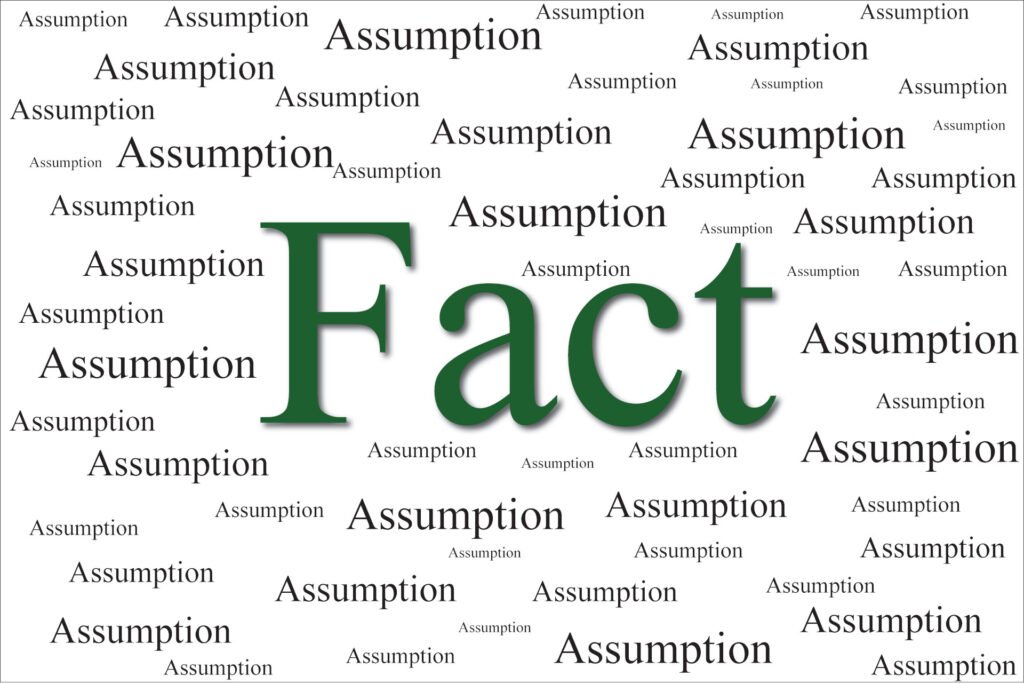 Assumptions as facts
Lesson Fourteen
An assumption is a belief you accept as true without actually having proof or evidence for it. Assumptions are mental shortcuts – your brain’s way of filling in gaps in knowledge so you can make decisions without analysing every detail from scratch.
But that can cause problems, if those assumptions turn out, to not be true.
How Assumptions Work
When you encounter a situation, your brain draws on past experiences, emotions, expectations, and beliefs to make sense of it. For example, if you see dark clouds, you might assume it’s going to rain – not because you know for certain, but because past experience has linked dark clouds with rain. This can be useful; it helps you plan and act quickly.
The trouble begins when assumptions stop being recognised as guesses and start being treated as certainties.
“Assumptions Dressed as Facts”
This phrase describes what happens when untested beliefs become so ingrained that you mistake them for truth. Instead of recognising “I think this might be true,” you act as though “this is definitely true.”
Common ways this happens:
- Mind reading – Assuming you know what someone else is thinking without evidence (e.g., “They didn’t reply, so they must be angry with me”).
- Emotional reasoning – Believing that because you feel something, it must be true (e.g., “I feel stupid, therefore I must be stupid”). Believing someone, for fear of being embarrassed, if you feel they must know more than you, and are scared to ask.
- Jumping to conclusions – Making interpretations without checking the facts.
- Confirmation bias – Noticing only evidence that supports what you already believe, while ignoring evidence that contradicts it.
Once assumptions gain momentum, they become incredibly believable – you may even struggle to tell what is real versus what you have constructed in your mind.
Why This Matters
When you confuse assumptions with facts, you react to a mental version of events rather than to what is actually happening. This can:
- Damage relationships by causing misunderstandings
- Increase anxiety and low mood
- Lead to poor decisions based on incomplete or distorted information
- Create self-fulfilling prophecies where you act in ways that confirm your false belief
How to Separate Assumptions from Facts
Pause and notice
When you feel a strong emotional reaction, stop and ask: “What am I assuming here?” This creates space between your reaction and your response.
Distinguish what you know from what you’re speculating
A fact is something you can verify through observation or evidence. An assumption is an interpretation you’ve added. For example, “They gave me a look” is a fact; “They’re upset with me” is an assumption.
Ask for evidence
Challenge yourself: “What is the actual evidence for this belief?” Often, when you examine an assumption closely, you realise it rests on very little.
Consider alternative explanations
Your first interpretation is rarely the only possible one. Deliberately generate other explanations for what you’ve observed.
Check your assumptions with others
Rather than guessing what someone thinks or feels, ask them directly. This grounds your understanding in reality rather than speculation.
The core insight is this: the problem is not that we make assumptions—that is unavoidable. The problem is forgetting they are assumptions and treating them as though they were proven facts.
Lesson Affirmation
Set yourself a firm intention, to always be able to understand what are assumptions, and what you have seen enough evidence, to be able to hold it to be true. This is a good thing to always do.
Lesson Video
Further Reading
https://ltamh.com/2024/08/11/assumptions/
https://library.louisville.edu/ekstrom/criticalthinking/assumptions
https://olianderson.co.uk/assumptions-shape-your-reality-life-through-a-veiled-veil/
https://marciasirotamd.com/psychology-popular-culture/problem-making-assumptions
https://www.mindmypeelings.com/blog/cognitive-distortions
https://grishastewart.com/hh12
https://www.psychologytools.com/articles/unhelpful-thinking-styles-cognitive-distortions-in-cbt
https://www.kimegel.com/blog/tag/assumptions+vs.+facts
https://www.harleytherapy.co.uk/counselling/making-assumptions.htm
https://www.linkedin.com/pulse/facts-assumptions-values-managing-unconscious-bias-b-kim-barnes
https://positivepsychology.com/cognitive-distortions/
https://academic.oup.com/painmedicine/article/19/4/793/3583229
https://link.springer.com/10.1007/s10584-019-02425-6
https://drive.google.com/uc?export=download&id=1IMMhlwUKgz6D2zIuT-mjPPNpfFE672OF
https://jhss-khazar.org/2022/07/culture-vs-stereotypical-thinking-vs-language-facts/
https://www.frontiersin.org/articles/10.3389/fpsyg.2022.861493/full
https://link.springer.com/10.1007/s12144-022-03030-0
https://link.springer.com/10.1007/s12124-022-09708-1
https://compass.onlinelibrary.wiley.com/doi/10.1111/spc3.12938
https://journals.sagepub.com/doi/10.1177/09637214231217663
https://doi.apa.org/doi/10.1037/h0086894
https://www.ac-psych.org/en/download-pdf/volume/6/issue/6/id/79
https://pmc.ncbi.nlm.nih.gov/articles/PMC9337700/
https://pmc.ncbi.nlm.nih.gov/articles/PMC3019985/
https://pmc.ncbi.nlm.nih.gov/articles/PMC8902028/
https://dx.plos.org/10.1371/journal.pone.0310216
https://pmc.ncbi.nlm.nih.gov/articles/PMC11463766/
https://pure.uva.nl/ws/files/68675990/1745691621991838.pdf
https://pmc.ncbi.nlm.nih.gov/articles/PMC3303139/
https://neurodivergentinsights.com/feelings-are-not-facts/
https://minnstate.pressbooks.pub/ctar2/chapter/what-about-assumptions/
https://www.criticalthinking.org/pages/distinguishing-between-inferences-and-assumptions/484
https://www.instagram.com/p/CWw6mE2oiP7/
https://www.simplypsychology.org/cognitive-distortions-in-cbt.html
https://www.assessmentday.co.uk/free/watson-glaser/freetest1/Assumptions/index.php
https://cogbtherapy.com/cbt-blog/cognitive-distortions-all-or-nothing-thinking