 Avoiding Self-Limiting Beliefs
Lesson Thirteen
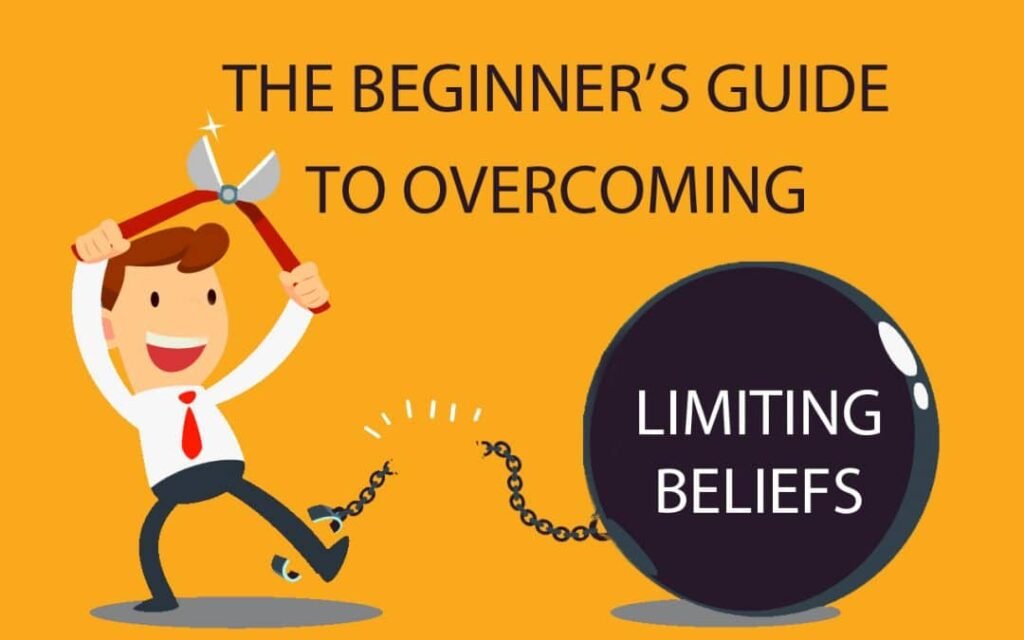
Self-limiting beliefs are thoughts you repeatedly tell yourself that gradually become so ingrained they shape your behaviour and expectations – often acting as self-fulfilling prophecies. These beliefs restrict what you feel you can accomplish, even when they have little basis in fact.
They may also be based on false assumptions of facts. Some might tell you that they think something that they know is a fact, for example. It is important to understand that thinking something is true, doe’s not always mean that it is true.
Where Self-Limiting Beliefs Come From
These beliefs often originate in early life – through experiences with family, school, friends, media, and culture. Over time, they become unconscious habits of mind, running in the background without your awareness. Even people who present a positive outward self-image can carry hidden negative beliefs that influence their choices.
Common examples include thoughts like:
- “I’m not good enough”
- “I’ll never be able to do that”
- “I’m not ready”
- “People like me don’t succeed at this”
These mental habits create an endless loop, leading you to doubt your abilities and view goals as impossible.
Taking Assumptions as Facts
A key error underlying self-limiting beliefs is treating assumptions as though they were proven facts. This is called jumping to conclusions – making interpretations without actual evidence. Two common forms are:
- Mind reading – Assuming you know what others are thinking (e.g., “They think I’m incompetent”) without evidence.
- Emotional reasoning – Believing that because you feel something is true, it must be true (e.g., “I feel like a failure, so I must be one”).
Mental health experts call these patterns distortions—systematic errors in thinking that bias how you interpret situations. These distortions are more likely when a situation is uncertain or unclear, and are driven by deeper underlying assumptions such as “always expect the worst” or “I should be perfect”.
How to Avoid Limiting Your Own Thinking
Identify the belief
Notice your inner chatter. When you catch yourself thinking “I can’t” or “I’m not,” write it down. This interrupts the automatic pattern.
Question its validity
Ask: “What if I’m wrong?” Challenge yourself to find evidence for and against the belief. Often, limiting beliefs collapse once you examine them closely.
Reframe the thought
Replace negative self-talk with more balanced statements. Instead of “I’m not good enough,” try “I may not know everything yet, but I can learn and improve”.
Test it with action
Set small, achievable goals that directly challenge the belief. Each success becomes evidence that undermines the old assumption.
Seek outside perspective
Mentors, coaches, people that you know are wise or trusted friends can help you see blind spots and offer alternative viewpoints that you might not consider on your own.
Recognise the filter
Accept that everyone views reality through a filter of past experiences and assumptions. By acknowledging this, you give yourself permission to try a different filter.
The core insight is this: your beliefs about yourself are not necessarily facts, they are interpretations, and sometimes just opinions. The one to watch out for, is the fact that got out of date, and was updated!
Once you learn to spot and question them, they lose much of their power.
Lesson Affirmation
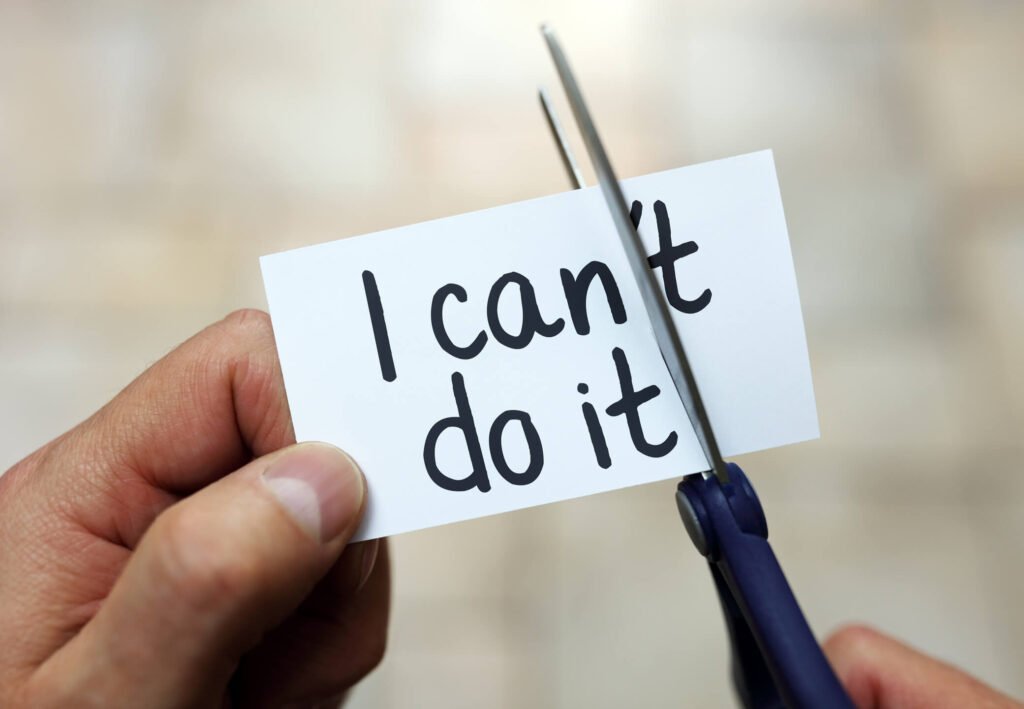
Set yourself the firm intent, to remind yourself that you allow yourself to think anything, and do anything, that you want to think and do. Ask yourself to avoid saying “I can’t, I might, I should, or I would”. Not everything might be possible, right now. But stay open to it happening, and there is every chance that it will.
Lesson Video
Further Reading
https://believeandcreate.com/62-beliefs-that-limit-your-happiness-and-success/
https://www.open.edu/openlearn/health-sports-psychology/psychology/reframing-self-limiting-beliefs
https://www.mindmypeelings.com/blog/cognitive-distortions
https://www.simplypsychology.org/cognitive-distortions-in-cbt.html
https://www.psychologytools.com/articles/unhelpful-thinking-styles-cognitive-distortions-in-cbt
https://markmanson.net/limiting-beliefs
https://guider-ai.com/blog/overcoming-limiting-beliefs/
https://prosper.liverpool.ac.uk/postdoc-resources/reflect/overcoming-limiting-beliefs/
https://psyche.co/guides/how-philosophy-can-help-change-the-beliefs-that-hold-you-back
https://www.semanticscholar.org/paper/62ef0da5c2878894ae71925ef7a2898d9282c69d
https://link.springer.com/10.1007/s11199-023-01406-5
https://www.semanticscholar.org/paper/38b852f31181a27642fc18bcec7caa4e3e494b55
https://www.semanticscholar.org/paper/520e3181f5d343fb5f6a19879bbeca4107a03042
https://www.mdpi.com/2813-9844/7/4/92
https://link.springer.com/10.1007/s10608-018-9985-7
https://www.tandfonline.com/doi/full/10.1080/08870446.2023.2300037
https://rjep.ru/jour/index.php/rjep/article/view/524
https://bpspsychub.onlinelibrary.wiley.com/doi/10.1111/bjhp.12474
https://pmc.ncbi.nlm.nih.gov/articles/PMC12078305/
https://pmc.ncbi.nlm.nih.gov/articles/PMC4559656/
https://europepmc.org/articles/pmc4076324?pdf=render
https://pmc.ncbi.nlm.nih.gov/articles/PMC10623621/
https://pmc.ncbi.nlm.nih.gov/articles/PMC11218963/
https://arxiv.org/pdf/1309.5670.pdf
https://www.scirp.org/journal/PaperDownload.aspx?paperID=53183
https://www.frontiersin.org/articles/10.3389/fpsyg.2025.1593089/full
https://www.psychologytoday.com/gb/blog/empower-your-mind/202311/overcoming-self-limiting-beliefs
https://positivepsychology.com/false-beliefs/
https://positivepsychology.com/cognitive-distortions/
https://hbr.org/2023/06/how-to-overcome-self-limiting-beliefs
https://www.therapistaid.com/therapy-worksheet/cognitive-distortions
https://asana.com/resources/limiting-beliefs
https://cogbtherapy.com/cbt-blog/cognitive-distortions-all-or-nothing-thinking
https://arfamiliesfirst.com/wp-content/uploads/2013/05/Cognitive-Distortions.pdf