Contents
- 1 Two Explanations of the Human Condition
- 1.1 Introduction
- 1.2 Griffith’s human condition begins with two forms of guidance
- 1.3 Adam Stork and the problem of being unable to explain oneself
- 1.4 Why Griffith believes the inherited system was moral
- 1.5 Anger, egocentricity and alienation
- 1.6 Griffith’s model is ultimately a theory of reconciliation
- 1.7 The plural starting point
- 1.8 Difference does not automatically indicate dysfunction
- 1.9 Multiplicity as a wider organisational principle
- 1.10 Schema Mask Theory adds an information architecture
- 1.11 Absolute Democracy asks who governs the multiplicity
- 1.12 The first major convergence: destructive behaviour need not reveal an evil core
- 1.13 The second convergence: condemnation can create further dysfunction
- 1.14 The central disagreement: is multiplicity original or produced by conflict?
- 1.15 Griffith’s two-system model may be too coarse for the phenomena he identifies
- 1.16 The meaning of alienation changes considerably
- 1.17 A different account of psychological wholeness
- 1.18 Griffith’s great strength may also be his greatest limitation
- 1.19 A methodological difference worth preserving
- 1.20 What Griffith may already add to the developing framework
- 1.21 A possible first integration: from the condemning instinct to the condemning constituency
- 1.22 This suggests a different origin for the inner critic
- 1.23 Another extrapolation: Griffith’s conflict may be fractal rather than singular
- 1.24 A third extrapolation: defence may be a governance failure
- 1.25 Provisional comparison
- 1.26 Where the comparison currently leaves us
- 1.27 The first candidate merge-point
- 1.28 Conclusion
- 1.29 References
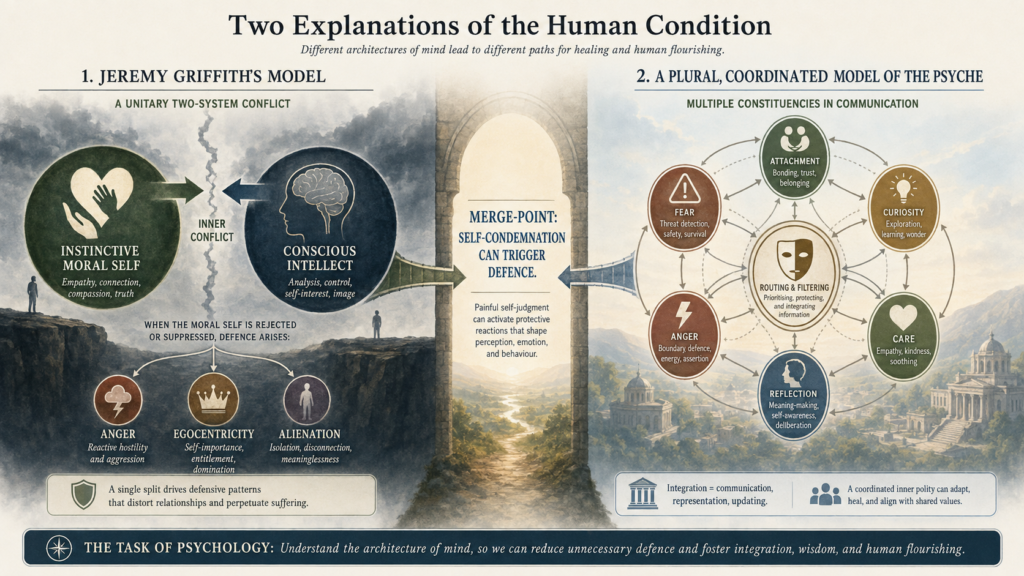 Two Explanations of the Human Condition
Jeremy Griffith’s instinct-intellect conflict compared with a plural systems model of psychological organisation.
Plural Theory of Psychological Integration: Paper One.
Introduction
Jeremy Griffith’s work and the developing Self-Transcendence Research framework begin from a strikingly similar dissatisfaction. Both reject the idea that apparently destructive human behaviour can adequately be explained by simply declaring human beings selfish, defective, irrational or morally bad.
Both instead ask whether behaviour that appears destructive at one level may have developed for intelligible reasons at another. That shared starting point can make the two approaches initially appear closer than they are.
Griffith proposes a highly specific and ultimately unitary explanation. He argues that humanity developed an inherited cooperative and loving instinctive orientation before the emergence of a sufficiently self-managing conscious intellect. Consciousness then had to experiment independently of those instincts in order to acquire understanding.
Because the instinctive system could not understand why its guidance was being disobeyed, the conscious intellect experienced its inherited moral orientation as condemnation. Unable initially to explain its own behaviour, it responded defensively through anger, egocentric self-validation and alienation.
Griffith identifies this conflict as the underlying human condition and argues that explaining it finally removes the need for those defences (Griffith & Conway, 2026 ed., pp. 21–23).
The developing Self-Transcendence framework has moved towards a different architecture. Its newer Human Multiplicity Theory begins from the proposition that one continuing person can contain several psychologically differentiated positions without requiring those positions to be separate persons or evidence of dysfunction. Different motives may represent different legitimate concerns, and higher-level unity need not imply lower-level psychological uniformity (Barra, 2026a, pp. 1–2).
That argument is subsequently widened beyond psychology. Biological and organisational systems repeatedly produce higher-order unity through relationships among differentiated lower-level components.
The comparison is explicitly not intended to equate psychological parts with cells, colonies or other biological units. Rather, it establishes a narrower systems principle: being one organised system at one level does not require being one undifferentiated thing at every level below it (Barra, 2026b, pp. 1–2).
The difference is therefore fundamental.
Griffith asks:
What single historical conflict produced humanity’s psychological division?
The developing multiplicity model increasingly asks:
Given that differentiation is normal, under what conditions do differentiated systems cease to communicate, update and coordinate effectively?
These questions overlap, but they are not interchangeable.
This article will first reconstruct both positions on their own terms. It will then examine where they genuinely converge, where their explanations separate, and which parts of Griffith’s thinking might productively be incorporated into the developing framework.
The purpose is deliberately neither conversion nor refutation. The method used throughout this series will be:
compare > extract > test compatibility > integrate where justified > extrapolate cautiously.
An observation can therefore be borrowed from Griffith without adopting the explanation Griffith gives for it. Equally, resemblance to an existing concept in the Self-Transcendence framework will not be treated as proof that the two concepts are identical.
Griffith’s human condition begins with two forms of guidance
Griffith distinguishes what he regards as two fundamentally different methods of acquiring behavioural information.
The older mechanism is genetic. Natural selection progressively establishes behavioural orientations across generations. An organism does not need to understand why the inherited response is useful; the genetic system has already biased behaviour in a direction that historically promoted survival or reproduction.
The second mechanism is a nervous-system-based learning system capable of remembering experience, comparing events, recognising recurring relationships and eventually predicting consequences.
Griffith treats this capacity for understanding relationships between events as central to consciousness. In FREEDOM, he describes remembered experiences becoming associated through neural networks until regularities become identifiable and usable in prediction (Griffith, 2016, pp. 276–278).
Whatever reservations may later be raised about the completeness of this account of consciousness, the distinction performs an important function within Griffith’s argument.
A genetically established orientation already possesses an answer:
behave this way.
An understanding-based system instead needs to know:
why should I behave this way?
Once the second system becomes capable of modifying behaviour independently, conflict becomes possible.
Adam Stork and the problem of being unable to explain oneself
Griffith’s Adam Stork analogy is intended to show why that conflict would be psychologically consequential.
A bird possesses an inherited migratory orientation. A newly developed conscious intelligence notices something away from its established route and decides to investigate. The instinctive orientation continues attempting to return the bird to its inherited course.
From Griffith’s perspective, neither system initially understands the other.
The instinct cannot say:
“I recognise that you are experimenting in order to acquire causal understanding.”
It can only continue issuing the orientation established genetically.
But the intellect cannot yet answer:
“I know why my departure is necessary.”
It has only just begun discovering its world.
Griffith therefore describes the conscious system as beginning to feel not merely that its behaviour is incorrect, but that it is somehow bad. In THE Interview, the decisive transition occurs when Adam cannot yet explain why he has defied his instincts and consequently begins to experience himself as morally wrong or even evil (Griffith & Conway, 2026 ed., p. 21).
This is one of Griffith’s most important psychological moves.
The original problem is a difference between systems of guidance, and it becomes pathological when the difference acquires the meaning of self-condemnation.
Why Griffith believes the inherited system was moral
The argument depends upon another major proposition. Griffith does not believe humanity inherited merely ordinary survival-oriented instincts.
He proposes that prolonged nurturing in human evolutionary history produced unusually cooperative, selfless and loving moral instincts. Bonobos occupy an important place in this argument because Griffith interprets their extensive nurturing and comparatively cooperative social relationships as evidence of the sort of evolutionary pathway that could eventually produce strongly altruistic human instincts (Griffith & Conway, 2026 ed., pp. 37–39).
The resulting human conflict is therefore much more severe than a disagreement about direction.
The inherited orientation effectively represents:
cooperation, love and selflessness.
The experimental intellect necessarily produces mistakes, selfishness, rivalry and sometimes aggression while attempting to understand its environment.
Because consciousness cannot yet explain why that departure was necessary, Griffith argues that it experiences the moral instinct as a profoundly condemning presence.
In his later formulation, the human condition is almost synonymous with the guilt and shame generated by believing that consciousness has corrupted humanity’s original loving “soul” (Griffith, 2022a, p. 13).
This is the central wound in Griffith’s system.
Anger, egocentricity and alienation
Griffith then derives three major defensive responses.
The first is anger. The condemned conscious system fights against the source of criticism.
The second is egocentricity. Unable to prove theoretically that it is worthwhile, the person attempts to demonstrate worth through success, victory, status, possession, influence or recognition.
The third is alienation. Where the condemning material cannot be answered, awareness is increasingly separated from it.
Griffith repeatedly presents these as the fundamental defensive architecture of the human condition. Humanity had to become “angry, egocentric and alienated” while pursuing knowledge because it lacked the explanation required to defend its departure from instinctive guidance (Griffith & Conway, 2026 ed., p. 23).
The defensive structure then becomes recursive.
An angry response can itself violate the moral standard that generated the original condemnation.
Status-seeking may temporarily reassure the threatened self but leaves its worth increasingly dependent upon further validation.
Alienation protects the person from painful information while simultaneously making the original conflict harder to understand.
Griffith therefore sees civilisation as the accumulation and elaboration of these strategies across an approximately two-million-year human journey.
Griffith’s model is ultimately a theory of reconciliation
The solution follows from the cause.
If the problem arose because consciousness could not explain why it had to depart from instinct, then obtaining that explanation should finally reconcile the two systems.
Griffith therefore regards his instinct–intellect account not merely as one possible description of human psychology but as the long-awaited explanation capable of psychologically rehabilitating humanity. Once the conscious system understands that its struggle for knowledge was necessary rather than evil, the original moral condemnation supposedly loses its legitimacy. Anger, egocentricity and alienation are consequently described as obsolete defences (Griffith & Conway, 2026 ed., pp. 57–59).
This is the strongly monistic feature of Griffith’s theory.
That a great diversity of human behaviours ultimately flows from one original explanatory problem, and one correct understanding can therefore potentially reconcile the division at its source.
The newer Self-Transcendence framework takes a different route.
The plural starting point
The revised Human Multiplicity Theory begins much more modestly, it suggests that people ordinarily experience several psychological positions at once.
Someone may simultaneously want intimacy and fear it. They may want to spend money while also wanting to protect future security. Or they may love somebody and resent something that person has done. They may be having these seemingly oppositional thoughts at the same time, and that causes friction, frustration, and a tendency to act rashly.
The theory does not infer from this that several complete personalities exist inside one body. Instead, the phrase part of me is treated as useful ordinary language indicating that a psychological position belongs genuinely to the person while not exhausting everything that person thinks or values (Barra, 2026a, p. 1).
This leads to a fundamental distinction:
one embodied person does not require one homogeneous psychological process.
A decision can correctly be described as:
“I decided.”
While still having emerged from several evaluations involving emotion, memory, anticipated consequences, attachment, bodily states and competing values (Barra, 2026a, p. 2).
That substantially changes the meaning of psychological conflict.
Difference does not automatically indicate dysfunction
Human Multiplicity Theory makes another distinction that becomes particularly important when comparing it with Griffith.
A psychological position can be legitimate without being correct.
- Fear may be responding to something genuinely relevant while overestimating the level of danger.
- Anger may correctly detect a violated boundary while proposing an excessive response.
- Desire may represent a legitimate need while recommending behaviour that would create unacceptable consequences.
The informational contribution therefore deserves consideration without receiving automatic authority over behaviour (Barra, 2026a, p. 2).
This produces a very different interpretation of disagreement.
Conflict between two systems does not necessarily mean:
one is good and one is corrupted;
or even:
one is accurate and the other is mistaken.
The two may simply be evaluating different dimensions of the same situation.
- One evaluates immediate pleasure, while another evaluates long-term security.
- One evaluates attachment, while another evaluates personal autonomy.
The disagreement can therefore improve judgement by preventing one narrow concern from representing the entire problem. This is already a substantial divergence from Griffith.
Multiplicity as a wider organisational principle
The later Human Multiplicity work then widens the argument beyond psychology.
A multicellular organism consists of differentiated cells. Colonial organisms may integrate repeated units. Social insects coordinate specialised individuals. Flocks and schools can generate organised behaviour through interactions among distinguishable organisms.
The thesis explicitly warns against converting these comparisons into identity claims. A psychological part is not therefore claimed to be a cell, colony or computer module.
The narrower principle is that complex organisation repeatedly depends upon difference plus relationship, rather than difference being something organisation must eliminate (Barra, 2026b, pp. 1–2).
This reframes the psychological problem, instead of asking:
Why does the psyche contain different positions?
the more useful question may be:
How does differentiation become coordinated, and what happens when coordination fails?
That question begins to move the framework away from pathology-as-fragmentation toward pathology as relationship failure within multiplicity.
Schema Mask Theory adds an information architecture
Schema Mask Theory develops this further by asking how psychological differentiation becomes functionally maintained.
Its central proposal is that psychologically organised information may be selectively available, transformed, inhibited, summarised, prioritised or redirected between functional domains and conscious representation.
A “mask” in this model is therefore not merely something performed socially, iIt is proposed as part of an information-processing architecture (Barra, 2026c, pp. 1–2).
The model distinguishes the larger Organismic self-schema from the narrower information currently available to conscious self-representation. Developmental experience can alter the routing relationship between them. A response that becomes socially dangerous or attachment-threatening may be suppressed, redirected or made more difficult to access.
This is the context in which the theory introduces core-self pruning: not necessarily biological deletion of a capacity, but restriction, redirection or exclusion of that capacity from conscious self-representation (Barra, 2026c, p. 1).
Two further concepts are especially important.
Provenance loss occurs when successive transformations obscure where consciously experienced information originally came from.
Compartmentalisation confusion occurs when consciousness attributes information produced by one local process to some inappropriate higher-level source, such as the ego-model or the whole self (Barra, 2026c, p. 1).
These ideas offer a very different possible explanation for psychological alienation.
Alienation may not require the psyche to have lost contact with one singular original moral self.
It may occur because information can no longer travel accurately between differentiated systems.
Absolute Democracy asks who governs the multiplicity
Once psychological plurality is accepted, another problem emerges.
Who makes the final decision?
Absolute Democracy of the Psyche explicitly develops this problem out of Hillman’s psychological polytheism and its tension with more centrally governed models such as IFS. It rejects the assumption that the conscious ego, a superior Self, or whichever activated part is strongest should automatically possess sovereign authority (Barra, 2026d, pp. 1–3).
The model instead distinguishes unity from unification. Unification places the many beneath one ruling centre, whilst unity can arise when differentiated authorities voluntarily authorise one shared action.
The resulting formulation is:
“The psyche can be unified in action without being unified in sovereignty” (Barra, 2026d, p. 1).
Later axioms propose that parts can possess legitimate but domain-specific authority; system-wide decisions require participation across affected constituencies; and the conscious self remains publicly responsible without necessarily being the sole source of the intelligence that produced the decision (Barra, 2026d, pp. 5–6).
This is almost the inverse of Griffith’s explanatory structure. Griffith ultimately seeks reconciliation between two foundational systems.
Absolute Democracy assumes an irreducibly differentiated internal polity and asks how many legitimate systems can coordinate without being subordinated to a monarch?
The first major convergence: destructive behaviour need not reveal an evil core
Despite these differences, the two approaches share an important ethical and psychological intuition. Both reject the move:
destructive behaviour > intrinsically bad person.
Griffith interprets anger, egocentricity and alienation as historically necessary defences produced by an unresolved conflict. Their consequences may be destructive, but their origin is not intrinsic wickedness.
The developing multiplicity framework similarly treats defensive organisations as potentially intelligible adaptations. A response may be obsolete, disproportionate or damaging while still carrying legitimate information concerning safety, attachment, dignity, bodily need or social consequence.
This is a significant shared foundation.
Both frameworks move away from simple moral condemnation and towards functional explanation, yet they do so differently.
Griffith seeks the one original reason the defence became necessary.
The plural framework asks what this particular constituency is protecting, what information it contains, and what relationships presently keep its strategy in place.
The second convergence: condemnation can create further dysfunction
There is another important intersection.
Griffith identifies condemnation as a central escalatory mechanism. That the conscious system does something inconsistent with the moral instinct, experiences itself as bad, becomes defensive, and then produces further behaviour capable of generating additional condemnation.
The newer Self-Transcendence work similarly gives considerable importance to self-blame. The concise 2025 Human Condition: Problem Statement argues that children may internalise rejection of their needs and subsequently overwrite natural responses with socially acceptable coping behaviours. The later result is described as a loss of access to authenticity and an increasingly distorted system organised around learned replacement strategies (Barra, 2025, pp. 1–2).
The accounts of origin differ, but both identify a possible recursive loop:
experience > negative interpretation of self > defensive adaptation > further internal conflict.
That looks like a genuine merge-point worthy of much closer treatment later in the series.
The central disagreement: is multiplicity original or produced by conflict?
Here the theories separate sharply.
Griffith’s architecture begins with something close to a primordial polarity:
instinctive moral self versus conscious intellect.
Psychological division is therefore fundamentally a consequence of conflict between those systems.
The revised Human Multiplicity Theory instead treats differentiated processing as ordinary organisation. A person does not first begin as one psychologically homogeneous agent and then become multiple because something has gone wrong.
Multiplicity is already there in the existence of distinguishable systems of valuation, memory, motivation, emotion, bodily regulation, attachment, caution, curiosity and other functions.
Pathology therefore cannot simply be:
there is more than one voice.
It must concern what has happened between those voices.
This is one of the most important conceptual differences in the entire comparison.
Griffith’s two-system model may be too coarse for the phenomena he identifies
Griffith’s anger–egocentricity–alienation triad itself hints at the difficulty.
If all three were simply consequences of one instinct–intellect conflict, we would still need to explain why different people, and different situations within the same person, recruit them differently.
- Why does one person attack?
- Why does another seek approval?
- Why does another withdraw?
Why does the same person attack in one relationship, appease in another and become emotionally numb in a third?
A plural architecture provides an obvious possible extension.
Instead of regarding anger, validation-seeking and alienation merely as three outputs of one conflict, they might represent specialised protective organisations, each possessing different historical learning, predictions and functional domains.
Griffith’s theory identifies the possible family resemblance among the behaviours.
Multiplicity may help explain their differentiation.
The meaning of alienation changes considerably
Griffith defines alienation primarily through separation from humanity’s original instinctive moral self or soul.
The repression is vertically organised:
conscious intellect
becomes separated from
instinctive moral self.
The developing Schema Mask model permits something more distributed:
- One system can lose accurate access to another.
- A conscious judgment may receive the result of an emotional or pattern-recognition process without access to its origin.
- A social self-representation may omit capacities that still remain available elsewhere in the organism.
- An attachment-related system may continue predicting danger while the reflective system consciously believes that danger has passed.
Alienation therefore becomes less like one great wall and more like a problem of routing, selective access and degraded provenance across a network.
This does not necessarily disprove Griffith’s concept. It may reveal that his term alienation contains several psychologically different processes that should not be collapsed into one.
That possibility will deserve a full article of its own.
A different account of psychological wholeness
Griffith’s wholeness is essentially reconciliatory.
The divided instinct and intellect finally understand one another. The conscious self is redeemed from the accusation that its historical struggle demonstrates evil. The old defensive system becomes unnecessary.
The multiplicity framework increasingly treats wholeness differently. Wholeness does not require the many to become one voice. It requires the many to remain sufficiently connected that legitimate information can participate in organism-level decisions.
That distinction is clearly visible in Absolute Democracy. A fearful constituency need not be factually correct about current danger to retain standing. An angry constituency may recommend excessive behaviour while correctly identifying a boundary violation. Its proposal can be rejected while the information behind it remains represented (Barra, 2026d, pp. 5–6).
Wholeness consequently becomes representational completeness plus functional relationship, not uniformity, and this gives the emerging framework a somewhat different goal:
not the cessation of inner disagreement, but the cessation of coercive or informationally isolated disagreement.
Griffith’s great strength may also be his greatest limitation
There is considerable explanatory power in asking whether many apparently unrelated behaviours share a common underlying mechanism. Griffith’s theory gains much of its psychological force from doing exactly that:
- Anger.
- Status-seeking.
- Shame.
- Alienation.
- Denial.
- Meaninglessness.
- Social competitiveness.
He draws these into one narrative in which humanity has been trying to defend its worth while lacking an explanation for its own departure from moral instinct. That kind of integration can reveal relationships that specialised psychological theories sometimes miss.
But the same strength creates a serious risk.
Once one mechanism becomes capable of explaining almost everything, observations stop having much power to discriminate between alternative explanations.
- Anger confirms the theory.
- Alienation confirms the theory.
- Resistance to the theory can be interpreted through the Deaf Effect and therefore also confirm the theory.
- Agreement naturally confirms it as well.
A plural framework must avoid reproducing this problem in another form, it would be equally unsatisfactory to announce:
everything is really attachment;
or
everything is really schema masks;
or
everything is really psychological multiplicity.
The point of multiplicity is partly that different mechanisms may genuinely remain different.
A methodological difference worth preserving
There is another important contrast in epistemic style.
Griffith repeatedly presents the instinct-intellect account as the definitive explanation humanity has finally discovered. THE Interview describes understanding of this conflict as making the old defensive behaviours obsolete and providing the basis for psychological rehabilitation of the human race (Griffith & Conway, 2026 ed., p. 23).
Schema Mask Theory takes a more provisional position. Its abstract explicitly describes SMT as a theoretical, integrative and falsifiable architecture rather than an established neuropsychological mechanism. It acknowledges that existing findings may support component propositions without demonstrating one literal biological structure corresponding to a “schema mask” (Barra, 2026c, pp. 1–2).
That difference should be preserved during any merger. A Griffith insight can become a candidate mechanism, it should not become true merely because it fits elegantly.
What Griffith may already add to the developing framework
Several potentially useful contributions become visible even at this first comparative level.
The first is the importance of unexplained self-condemnation.
The multiplicity framework already describes defensive adaptation, masking and pruning, but Griffith repeatedly asks what happens when a developing system cannot explain why it is acting differently from an established standard.
That suggests an additional causal step:
discrepancy does not become psychologically toxic merely because two systems disagree; it may become toxic when the discrepancy is interpreted as evidence of defect.
That distinction could sharpen our developmental theory considerably. Transactional analysis has the concept of life positions, it’s therapists speak of people seeking help, in order to prove the therapist useless, to reinforce their own helpless inner self-position.
The second contribution is Griffith’s insistence that a defence may originally be legitimate in function even when destructive in expression.
Human Multiplicity Theory already moves strongly in this direction through its distinction between legitimate information and factual or behavioural correctness. Griffith may help give that principle a more explicit developmental history.
The third is recursion.
A defensive response can create the very conditions that make further defence necessary:
- Anger generated to repel condemnation can generate additional social rejection.
- Achievement used to stabilise self-worth can make worth increasingly dependent upon achievement.
- Alienation used to reduce pain can reduce access to corrective information.
That recursive quality should probably become more explicit within the developing information architecture.
The fourth is meaning as de-condemnation.
Griffith’s most therapeutically interesting operation is repeatedly:
“This happened because you were bad”
becoming
“This happened for an intelligible reason.”
The revised framework may be able to use that without accepting his prehistoric origin story.
A schema or protector that appears irrational in the present may become understandable once its original informational context is recovered.
A possible first integration: from the condemning instinct to the condemning constituency
Here we reach the first genuinely productive extrapolation.
Suppose Griffith is correct that self-condemnation is an important driver of defensive psychology, but incorrect or incomplete in locating it in one inherited moral instinct confronting one conscious intellect.
Human Multiplicity Theory allows another possibility.
A regulatory constituency may carry a deeply established model of:
what maintains attachment;
what counts as moral;
what keeps the person safe;
what prevents humiliation;
what secures social belonging.
Another constituency proposes behaviour that conflicts with that model.
The first does not need to be the whole inherited moral soul.
It may simply be one strongly established regulatory authority.
The second does not need to be “the intellect.”
It may be curiosity, sexuality, anger, independence, creativity, play, bodily need or another domain-specific system.
The Griffith conflict can therefore recur many times:
existing authority
versus
emerging or newly expressed capacity.
If the disagreement becomes:
“That proposal is unsafe”
the system can negotiate.
If it becomes:
“The fact that you want this means there is something wrong with you,”
a protector conflict may begin.
That is a much broader developmental mechanism.
This suggests a different origin for the inner critic
The extrapolation can be taken one step further.
A critic need not originate as an alien punitive force.
It may originally be a legitimate regulatory system attempting to protect some relationship, value or safety condition.
Repeated social experience can teach it:
“If this other constituency is expressed, something bad happens.”
The critic therefore acquires inhibitory authority and over time, provenance may be lost.
The person no longer experiences:
“A part of me predicts that expressing anger may threaten this relationship because previous anger was punished.”
They experience simply:
“My anger is bad.”
Later still:
“I am bad for being angry.”
This would combine Griffith’s emphasis upon self-condemnation with Schema Mask Theory’s information routing and provenance loss. It is not yet established, but it is a clear new hypothesis generated by the comparison.
Another extrapolation: Griffith’s conflict may be fractal rather than singular
Griffith places the foundational conflict approximately two million years ago, but the plural model suggests something potentially more interesting.
Even if some analogous evolutionary conflict occurred, its psychological form could be repeated at many organisational levels:
- A species learns.
- A culture learns.
- A family learns.
- A child learns.
- A psychological constituency learns.
At each level, established regulation can encounter novel information.
The crucial variable may not be the existence of difference but whether the larger system has enough flexibility to allow novelty without interpreting novelty as existential threat.
That produces a possible general principle:
Healthy systems permit differentiated exploration while maintaining enough relationship for the resulting information to be reintegrated.
Under this model, psychological breakdown is not caused by exploration itself.
It occurs when exploration becomes incompatible with continued membership of the system.
That proposition has obvious future connections to attachment, self-determination, innovation, social conformity and even organisational culture.
A third extrapolation: defence may be a governance failure
Absolute Democracy adds another possibility: If every legitimate domain possesses some informational authority, then chronic psychological defence might sometimes be understood politically.
One constituency acquires disproportionate control, while others lose representation.
And the conscious spokesperson begins treating the dominant coalition’s model as though it were the whole self. Dissent will then appear irrational, shameful or dangerous.
This resembles Griffith’s alienation, but the explanation is different.
Instead of:
intellect suppresses the moral soul,
we obtain:
one coalition monopolises organism-level representation.
That suggests a powerful future question:
Is some psychological suffering better understood not as fragmentation, but as failed internal governance?
That possibility will become especially important when Griffith is compared directly with Schema Mask Theory and Absolute Democracy later in the series.
Provisional comparison
At this stage, the contrast can be stated relatively tightly.
Griffith’s model:
- Humanity possessed a cooperative moral instinct.
- A newly self-managing conscious intellect had to disobey it.
- The intellect could not explain why.
- The resulting condemnation produced anger, egocentricity and alienation.
- Humanity became progressively psychologically “upset.”
- The correct explanation reconciles instinct and intellect and renders the old defences unnecessary.
The developing plural model:
- The human organism is ordinarily differentiated.
- Different systems represent different domains of information, motivation and value.
- Difference is not itself pathology.
- Developmental conditions can alter access, routing and representation among those systems.
- Parts of the organism may become inhibited, overrepresented, misattributed or isolated.
- Protective systems can remain legitimate in function while being mistaken about current conditions.
- Psychological integration consists increasingly in restoring representation, communication and updating without abolishing useful differentiation.
The two models therefore meet at defence, self-condemnation, alienation and reconciliation, but diverge over the architecture beneath those phenomena.
Where the comparison currently leaves us
It would be premature to say that one theory simply replaces the other.
Griffith may have identified a powerful recurring psychological sequence:
unexplained departure from an important standard > self-condemnation > defensive adaptation.
The developing framework may provide a richer architecture within which that sequence can occur. If so, Griffith’s error may not be that the mechanism is imaginary. It may be that he has taken one important instance of a much more general systems problem and made it the single origin of the entire human condition.
Conversely, the danger for the multiplicity model is almost the opposite. By allowing many systems, many histories and many mechanisms, it could become descriptively rich but causally diffuse.
Griffith continually forces the question:
What actually drives the conflict?
That challenge is useful.
Multiplicity should not become an excuse for merely cataloguing voices. A mature plural theory still needs to explain why certain coalitions form, why certain constituencies become threatening, why self-condemnation appears, why information becomes inaccessible, why old defences persist and what permits genuine reorganisation.
In that sense, Griffith may provide something the developing framework needs: pressure towards causal explanation.
The developing framework may provide something Griffith needs in return: an architecture capable of preserving legitimate differentiation without reducing every conflict to the same cause.
The first candidate merge-point
The most productive provisional synthesis from this opening comparison is therefore:
Psychological differentiation is normal. Conflict becomes particularly damaging when a legitimate difference between psychological systems is interpreted as evidence that one of those systems-or the person containing it-is unacceptable, dangerous or bad. That condemnation can recruit defensive organisations whose protective behaviour progressively alters information access and representation. The resulting alienation may then persist long after the original conditions have changed.
This is not Griffith’s theory., and it is not yet an established proposition of Human Multiplicity Theory either.
It is the first hypothesis generated by placing them together, and later articles can test its components separately.
- Was the original difference associated with attachment threat?
- How does shame enter?
- How does a defence gain control over information routing?
- What becomes pruned?
- How does the Persona or mask become reinforced?
- Why does conscious insight fail to update an older protective organisation?
- And what exactly would count as integration rather than simply another imposed solution?
Those questions lead directly into the next stage of the series.
Conclusion
Jeremy Griffith and the developing Self-Transcendence framework agree on an important premise: the apparent destructiveness of human psychology does not necessarily demonstrate an intrinsically destructive human nature.
Griffith explains the contradiction through one foundational evolutionary conflict. A cooperative instinctive self encountered an understanding-seeking conscious intellect; the latter had to depart from instinctive guidance but could not explain why. Condemnation produced defensive anger, egocentricity and alienation, and human history became the prolonged search for the understanding capable of finally reconciling the two.
The developing multiplicity framework has arrived at a different starting point. Differentiation is not regarded as a fall from psychological unity. One embodied person can contain numerous legitimate systems of evaluation, motivation and response. Higher-level unity can coexist with lower-level multiplicity, as occurs repeatedly in complex biological organisation. The central problem therefore becomes not multiplicity but coordination, representation and information exchange within multiplicity.
Schema Mask Theory adds a proposed mechanism through which access between differentiated domains can become selectively altered. Absolute Democracy then asks how such differentiated authorities can participate in coherent organism-level action without requiring a psychologically sovereign ruler.
The theories consequently make different predictions about what psychological healing should accomplish.
Griffith ultimately seeks reconciliation with a lost instinctive moral orientation.
The plural model increasingly seeks the recovery of functional relationship among differentiated constituencies.
The comparison nevertheless produces something new.
Griffith’s emphasis upon unexplained self-condemnation may identify an important mechanism missing from an otherwise structural multiplicity model. A difference between internal systems may remain workable until the difference becomes a verdict upon legitimacy: this desire, emotion, thought, capacity or person should not exist. Once that transition occurs, protective inhibition, masking, exclusion and alienation become easier to understand.
That candidate merge-point deserves investigation rather than immediate adoption.
And this establishes the methodology for the remainder of the series.
We will not ask merely whether Griffith is right or wrong.
We will ask which observations survive when removed from his master theory, where they fit within the developing architecture, what contradictions appear when they are combined, and-most importantly-whether the combination allows us to predict something that neither theory could see alone.
References
Barra. (2025). Humanity: Problem Statement – Thinking Ourselves to Death. Self-Transcendence Research, pp. 1–2.
Barra. (2026a). Human Multiplicity Theory: Personal Multiplicity – Chapter 1: The Ordinary Experience of Multiplicity. Self-Transcendence Research, especially pp. 1–2.
Barra. (2026b). Human Multiplicity Theory: From Fragmentation to Psychological Polytheism – Chapter 3. Self-Transcendence Research, especially pp. 1–2.
Barra. (2026c). Schema Mask Theory: A Developmental Information-Architecture Model of Psychological Compartmentalisation, Masking, Self-Organisation and Internal Conflict. Self-Transcendence Research, especially pp. 1–2.
Barra. (2026d). Absolute Democracy of the Psyche: A Constitutional Solution to Hillman’s Polytheistic Dilemma. Self-Transcendence Research, especially pp. 1–6.
Griffith, J. (2016). FREEDOM: The End of the Human Condition. WTM Publishing and Communications. See especially the discussion of consciousness and associative learning around pp. 276–278, and the account of psychological rehabilitation around p. 133.
Griffith, J. (2022a). The Great Guilt That Causes the Deaf Effect. WTM Publishing and Communications, especially p. 13.
Griffith, J. (2022b). The Shock of Change That Understanding the Human Condition Brings. WTM Publishing and Communications, especially pp. 22–25.
Griffith, J. (2023). Therapy for the Human Condition. Draft edition, WTM Publishing and Communications, especially pp. 10–20.
Griffith, J., & Conway, C. (2026 ed.). THE Interview That Solves the Human Condition and Saves the World! WTM Publishing and Communications, especially pp. 17–23 and 57–59.
