Personal Multiplicity Theory
Plural Theory of Psychological Integration: Two Explanations of the Human Condition
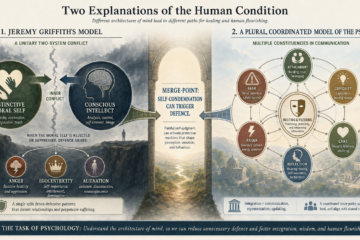
A comparison of positions with regard to the Human Condition, between Jeremy Griffith and the Human Multiplicity Theory.
A comparison of positions with regard to the Human Condition, between Jeremy Griffith and the Human Multiplicity Theory.

Jeremy Griffith’s FREEDOM: The End of the Human Condition attempts something much larger than an ordinary theory of personality or psychological disorder. Griffith proposes a biological explanation for what he regards as the central contradiction of human existence.
Personal Multiplicity Theory: Chapter 2. This chapter explores the development of plural thinking by psychology, in order to provide an understanding of that cross bed of support.
This thesis extends the Human Multiplicity Theory. In Chapter 1, we introduce Personal Multiplicity.

James Hillman’s archetypal psychology presents the psyche as fundamentally plural, or or of multiple minds. Human beings do not possess only one psychological voice, value system or centre of intelligence.
The Internal Multiplicity of the AI Devolved Authority System A Framework for Adaptive AI Resilience, Evolution, and Scalable Intelligence Introduction Traditional AI systems are designed as monolithic entities, processing information in a centralized manner. While this allows for powerful computation…

In this article, we will look at the growing body of evidence that many of our chronic physical ailments may well be caused by psychological dysfunction.

The multiple self theory of the mind is a psychological perspective that proposes that the human mind is not a single, unified entity, but rather a collection of different selves or subpersonalities that interact, conflict, and cooperate with each other.

The multiplicity of the mind school is a philosophical approach that rejects the idea of a single, unified self and instead proposes that each person has multiple selves or aspects of the self that may be in conflict or harmony with each other.
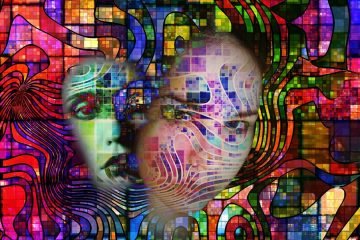
In this thesis, we will describe our concept that humans are multiplicities, meaning that they are composed of multiple selves, identities, perspectives, and experiences that coexist and interact within a single person.