Personal Multiplicity Theory
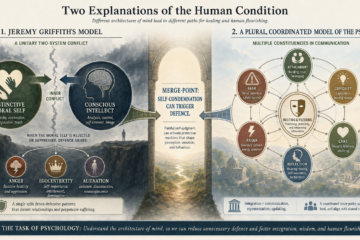
Plural Theory of Psychological Integration: Two Explanations of the Human Condition
A comparison of positions with regard to the Human Condition, between Jeremy Griffith and the Human Multiplicity Theory.
A comparison of positions with regard to the Human Condition, between Jeremy Griffith and the Human Multiplicity Theory.
If one world can possess an anima, it then follows, that a plurality of worlds may also possess a soul appropriate to their collective form. And that in addition, all objects/structures and visible aspects of that universe are part of that universal soul
Part three of Personal Multiplicity Theory: psychological multiplicity might be another instance of a much more general organisational principle: complexity produced through differentiation, relationship and selective integration.

The first ten entries established the foundations of archetypal psychology. Those concepts describe how psyche presents itself and how psychological attention may respond. Part Two follows the consequences.

James Hillman’s archetypal psychology presents the psyche as fundamentally plural, or or of multiple minds. Human beings do not possess only one psychological voice, value system or centre of intelligence.
The absolute democracy of the psyche is a constitutional arrangement in which every psychological part possesses equal sovereignty, every part governs its own proper domain, and no system-wide action can be authorised unless every participating authority consents.