Contents
The Human Brain
The human brain is the control centre of the body and the place where your mind lives. It is a soft organ, about the size of two fists, that sits in your skull and runs everything you do: breathing, moving, sensing, thinking, remembering, and feeling.
The brain as a body controller
The brain constantly receives information from your senses (eyes, ears, skin, etc.), makes sense of it, then sends signals back out to your muscles and organs.
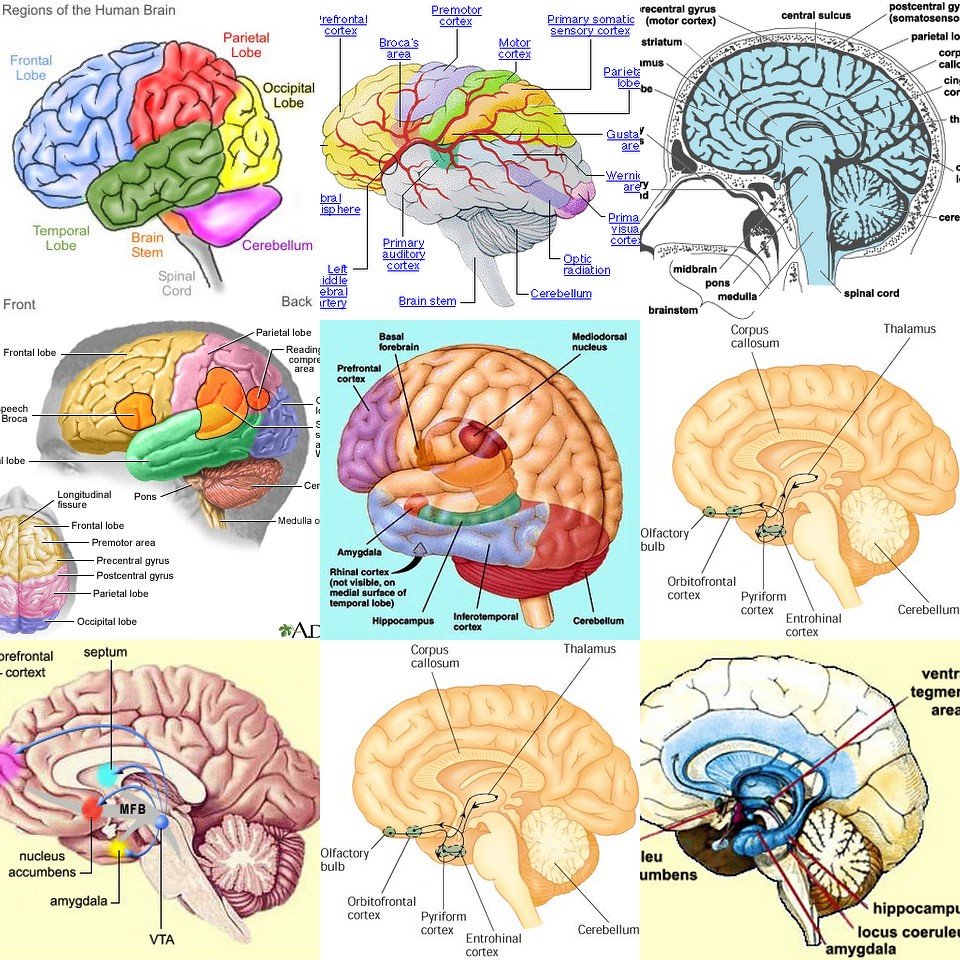
- The brainstem handles automatic life‑support functions like breathing, heart rate, and sleep-wake cycles.
- The cerebellum helps with balance and coordination, letting you walk, write, or play sports smoothly.
The “thinking” part: cerebrum and lobes
The largest part, the cerebrum, is the wrinkled outer part you usually picture when you think of a brain. It is split into two halves (left and right) and four main lobes on each side.
- Frontal lobes – decision‑making, planning, self‑control, voluntary movement, and aspects of personality.
- Parietal lobes – touch, body position, and integrating different senses.
- Occipital lobes – vision and recognising what you see.
- Temporal lobes – hearing, language, and many aspects of memory.
The emotional and memory centres
Deep inside sits the limbic system, which is crucial for emotion and memory.
- The amygdala helps detect threat and generates fear and other strong emotions.
- The hippocampus helps form and retrieve memories.
- The hypothalamus helps regulate hunger, temperature, hormones, and stress responses.
How it all works together
The basic working units are neurons (nerve cells) that communicate using tiny electrical and chemical signals. Trillions of connections between neurons form networks that support everything from simple reflexes to complex thoughts.
In short: Your brain is your body’s command centre and your mind’s home. It takes in information, makes sense of it based on past experience, and chooses responses from moment by moment; so you can stay alive, learn, adapt, and be yourself.
Further Reading
https://my.clevelandclinic.org/health/body/22638-brain
https://en.wikipedia.org/wiki/Human_brain
https://www.ncbi.nlm.nih.gov/books/NBK234157/
https://www.mayoclinic.org/diseases-conditions/epilepsy/in-depth/brain/art-20546821
https://www.aans.org/patients/conditions-treatments/anatomy-of-the-brain/
https://www.youtube.com/watch?v=WiLhAOaBkSA
https://www.simplypsychology.org/anatomy-of-the-brain.html
https://mayfieldclinic.com/pe-anatbrain.htm
https://www.youtube.com/watch?v=0-8PvNOdByc
https://biorxiv.org/lookup/doi/10.1101/2020.07.28.225631
https://link.springer.com/10.1007/s11682-024-00894-7
https://onlinelibrary.wiley.com/doi/10.1002/hbm.26575
https://pnas.org/doi/full/10.1073/pnas.1912034117
https://onlinelibrary.wiley.com/doi/10.1002/hbm.24866
https://link.springer.com/10.1007/s00429-017-1539-3
https://link.springer.com/10.1007/s00429-024-02824-1
https://link.springer.com/10.1007/s00429-025-02988-4
https://eaapublishing.org/journals/index.php/hb/article/view/2028
https://link.springer.com/10.1007/s11682-025-01036-3
https://pmc.ncbi.nlm.nih.gov/articles/PMC5402334/
https://biomedres.us/pdfs/BJSTR.MS.ID.004415.pdf
https://www.matec-conferences.org/articles/matecconf/pdf/2018/14/matecconf_imet2018_01050.pdf
https://www.frontiersin.org/articles/10.3389/fnbeh.2011.00005/pdf
https://pmc.ncbi.nlm.nih.gov/articles/PMC3118634/
https://pmc.ncbi.nlm.nih.gov/articles/PMC5054943/
https://downloads.hindawi.com/journals/tswj/2008/576793.pdf
https://pmc.ncbi.nlm.nih.gov/articles/PMC1239902/