Contents
Feelings of Inadequacy
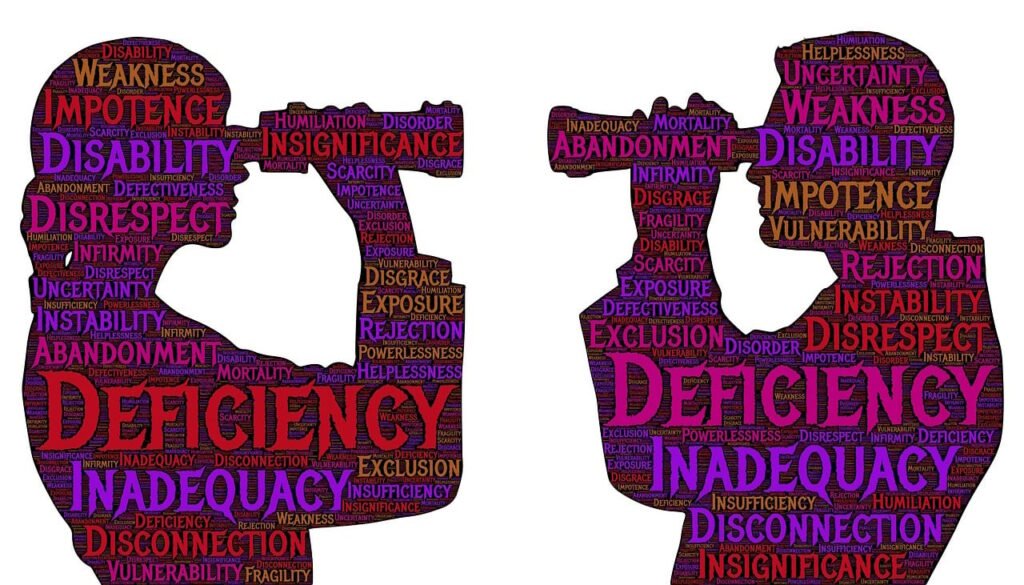
Feelings of inadequacy are those deep-down thoughts and emotions that say, “I’m not enough,” “I’m less than other people,” or “I can’t cope / don’t measure up.” Psychologically, they sit close to ideas like low self‑esteem, worthlessness, or an “inferiority complex”: a persistent sense of being somehow smaller, weaker, or less capable than others. These feelings can be about your abilities, your body, your personality, or your worth as a person overall.
What feelings of inadequacy are like
- A strong sense of not being good enough, even when there’s no clear evidence you’re failing.
- Frequent comparisons where you come out worse: “Everyone else is more confident / attractive / successful than me.”
- Thoughts such as “I’ll mess this up,” “They’ll see I’m a fraud,” or “People are just being polite.”
- Emotions like shame, embarrassment, hopelessness, and a kind of inner “smallness.”
Over time, this can turn into a more stable belief: “There is something wrong with me.”
Where they often come from
Common contributors include:
- Early experiences – Repeated criticism, harsh comparisons with siblings or peers, bullying, or punitive parenting can teach a child that they are “less than” or hard to love. Persistence of that trauma, can cause those thoughts to become an embedded, and often self-fulfilling belief.
- Social comparison & achievement culture – Constant exposure to idealised images and high pressure to perform (especially on social media) pushes people to compare themselves upward and feel that they never measure up.
- Perfectionism – If your standards are unrealistically high, ordinary human mistakes can feel like proof that you’re fundamentally inadequate.
- Setbacks and misfortune – Repeated failures or bad breaks can lower self‑esteem and foster beliefs like “I deserve bad outcomes” or “I can’t do anything right.”
In depression, feelings of inadequacy and worthlessness are not just side‑effects; they’re central symptoms that cluster closely with hopelessness and self‑blame.
How they affect behaviour
Feelings of inadequacy can lead to two opposite‑looking patterns (sometimes in the same person):
- Pulling back – Avoiding challenges, relationships, or opportunities because “why bother, I’ll fail or be rejected.” This can look like procrastination, social withdrawal, or giving up early.
- Overcompensating – Trying to “prove” worth through overwork, showing off, or constant achievement, which may look confident from the outside but is driven by fear underneath.
Both behaviours are attempts to escape the pain of feeling not enough.
Helpful directions
- Name it – Instead of “I am inadequate,” try “I’m having a feeling of inadequacy.” That small shift leaves room for doubt about the feeling’s truth.
- Check the evidence – Ask: “What would I say to a friend in my position? What facts support and contradict this belief about me?”
- Reduce toxic comparison – Limit environments (online and offline) that constantly push you to measure yourself against carefully polished images.
- Practise self‑compassion – Research suggests that responding to your own struggles with kindness rather than contempt reduces shame and helps build healthier self‑worth over time.
- Seek support if it’s heavy and constant – Therapy can help uncover where these beliefs came from and replace them with more balanced, reality‑based views of yourself.
In simple terms: Feelings of inadequacy are the internal story that you are “less than.” They feel very real, but they are stories learned from experience and comparison, and not fixed facts about who you are.
Further Reading
https://invergejournals.com/index.php/ijss/article/view/102
https://www.semanticscholar.org/paper/a41e45c8efef4840d8844f50bacda1e8f027d195
https://www.semanticscholar.org/paper/372ffc3b99c03c5286c0c0705e7bebd40aa8625f
https://www.tandfonline.com/doi/full/10.1080/01443410.2021.1994305
https://www.tandfonline.com/doi/abs/10.1080/00405847709542717
https://www.semanticscholar.org/paper/c669088c714a1a212e9f16b6893bd132735ca035
https://www.semanticscholar.org/paper/1001e547a9670a47e50375f071e5fe2faecab71a
https://link.springer.com/10.1007/BF01532164
https://journals.sagepub.com/doi/10.1177/0145482X4001300201
https://www.semanticscholar.org/paper/65a1d27edcc0fd495449040552b94bb619d92208
https://pmc.ncbi.nlm.nih.gov/articles/PMC10897692/
https://pmc.ncbi.nlm.nih.gov/articles/PMC3914013/
https://pmc.ncbi.nlm.nih.gov/articles/PMC9160466/
https://journals.sagepub.com/doi/pdf/10.1177/07342829211050544
https://pmc.ncbi.nlm.nih.gov/articles/PMC4573463/
https://europepmc.org/articles/pmc4076324?pdf=render
https://journals.asianresassoc.org/index.php/ajir/article/download/625/495
https://www.berkeleywellbeing.com/inadequacy.html
https://en.wikipedia.org/wiki/Inferiority_complex
https://www.asteroidhealth.com/blog/the-impact-of-social-comparison-on-mental-health
https://pmc.ncbi.nlm.nih.gov/articles/PMC11389274/
https://www.apa.org/monitor/2024/10/antidote-achievement-culture
https://en.wikipedia.org/wiki/Perfectionism_(psychology)
https://pmc.ncbi.nlm.nih.gov/articles/PMC4562912/
https://pmc.ncbi.nlm.nih.gov/articles/PMC8549076/