Contents
- 1 A Biography of James Hillman
- 1.1 Introduction
- 1.2 Early life: Atlantic City and the Second World War
- 1.3 Zürich and the Jungian world
- 1.4 The intellectual influences behind Hillman’s psychology
- 1.5 The emergence of archetypal psychology
- 1.6 Re-Visioning Psychology
- 1.7 Spring Publications and the return to the United States
- 1.8 From private therapy to cultural criticism
- 1.9 Major publications
- 1.10 Emotion (1960–61)
- 1.11 Suicide and the Soul (1964)
- 1.12 Insearch: Psychology and Religion (1967)
- 1.13 The Myth of Analysis (1972)
- 1.14 Pan and the Nightmare (1972)
- 1.15 Re-Visioning Psychology (1975)
- 1.16 Loose Ends (1975)
- 1.17 The Dream and the Underworld (1979)
- 1.18 Anima: An Anatomy of a Personified Notion (1985)
- 1.19 A Blue Fire (1989)
- 1.20 The Thought of the Heart and the Soul of the World (1992)
- 1.21 We’ve Had a Hundred Years of Psychotherapy – and the World’s Getting Worse (1992–93)
- 1.22 Kinds of Power (1995)
- 1.23 The Soul’s Code (1996)
- 1.24 The Force of Character and the Lasting Life (1999)
- 1.25 A Terrible Love of War (2004)
- 1.26 Influence on psychology
- 1.27 Influence beyond psychology
- 1.28 Criticism and limitations
- 1.29 Death and legacy
- 1.30 Selected further reading
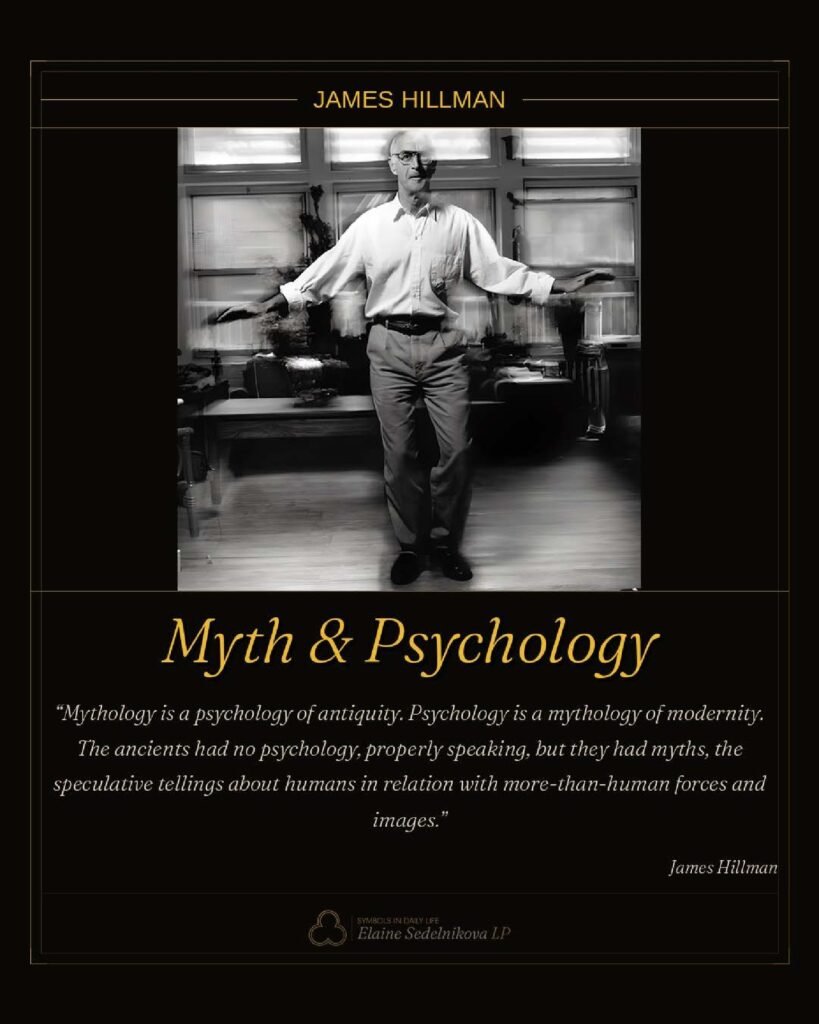 A Biography of James Hillman
The Psychologist Who Sought to Restore Soul to the World
Introduction
James Hillman was an American psychologist, Jungian analyst, writer, teacher and cultural critic whose work challenged many of the assumptions underlying twentieth-century psychology. He is principally associated with archetypal psychology, a post-Jungian approach that places imagination, metaphor, mythology and what Hillman called “soul” at the centre of psychological inquiry.
Hillman did not establish a conventional scientific theory of human behaviour. Nor did he produce an experimentally testable model comparable to those found in cognitive, behavioural or biological psychology. His importance lies elsewhere: in his attempt to reconsider what psychology studies, how psychological knowledge is expressed, and whether human suffering can be understood adequately through diagnostic, medical and developmental categories alone.
For Hillman, psychology had become increasingly concerned with explaining, correcting and managing the individual. He wanted it instead to recover its original concern with psyche: a Greek word conventionally translated as “soul.” He used this term not to describe an immortal substance or a religious doctrine, but a way of experiencing life through depth, imagination, emotional resonance and meaning. His work therefore stands at the intersection of psychology, philosophy, mythology, literature, religion, aesthetics and cultural criticism.
Early life: Atlantic City and the Second World War
James Hillman was born on 12 April 1926 in Atlantic City, New Jersey. He grew up during the period in which Atlantic City was a major American resort: a highly theatrical environment of hotels, entertainment, commerce, tourism and social display. Although it would be too simple to derive his later psychology directly from his childhood surroundings, his mature work repeatedly examined the relationship between appearance and reality, public performance and private experience, beauty and commercial culture.
Hillman briefly attended Georgetown University’s School of Foreign Service before joining the United States Navy Hospital Corps in 1944. He served for approximately two years during the closing stages of the Second World War. This placed him in contact with illness, injury and psychological suffering before he had received any formal clinical education.
After the war, Hillman did not immediately pursue psychology. He travelled to Europe and studied English literature at the Sorbonne in Paris. He subsequently enrolled at Trinity College Dublin, where he studied mental and moral science – a curriculum encompassing areas that would now be divided among philosophy, psychology and ethics, he graduated in 1950.
His literary formation was important. While in Dublin, he became a founding associate editor of Envoy: A Review of Literature and Art, an influential but short-lived literary journal whose contributors included Samuel Beckett, Brendan Behan, Patrick Kavanagh and Brian O’Nolan. Hillman therefore entered psychology through philosophy and literature rather than through laboratory science or medicine. His later psychological prose retained the qualities of the essayist: rhetorical, allusive, metaphorical and deliberately resistant to rigid systematisation.
Zürich and the Jungian world
In 1953 Hillman moved to Zürich, where he entered the intellectual world surrounding the Swiss psychiatrist Carl Gustav Jung. He studied at the University of Zürich while also undertaking analytic training at the C. G. Jung Institute.
In 1959 he received both his doctorate from the University of Zürich and his diploma as a Jungian analyst. In the same year, he became the Jung Institute’s Director of Studies, a position he held until 1969. This was a significant role: Hillman was not merely a reader or distant interpreter of Jung, but a teacher and institutional figure within the first generation of post-Jungian psychology.
Hillman nevertheless became an increasingly unorthodox Jungian. Jung’s analytical psychology had emphasised individuation: the long process through which the conscious and unconscious aspects of the personality are brought into a more integrated relationship, conventionally organised around the archetype of the Self. Hillman gradually questioned whether integration, unity and the Self should be treated as psychology’s central goals.
Instead of attempting to unify the personality, he became interested in its multiplicity. Human beings, he suggested, are not governed by one coherent identity but inhabited by many voices, images, moods, fantasies and partially independent patterns. Greek gods and mythological figures provided him with a language for describing this plurality.
His first major publications were still recognisably situated within analytical psychology. Emotion: A Comprehensive Phenomenology of Theories and Their Meanings for Therapy appeared in 1960–61. It was followed by Suicide and the Soul in 1964 and Insearch: Psychology and Religion in 1967. These works already displayed what would become characteristic of Hillman: a refusal to treat difficult psychological experiences only as errors requiring correction.
In Suicide and the Soul, for example, Hillman did not advocate suicide or deny the need to protect life. He instead argued that psychology must try to understand the meanings and fantasies associated with suicidal experience rather than treating the subject solely as a behavioural emergency or diagnostic symptom. The book exemplified his conviction that psychology should enter imaginatively into human suffering without reducing it immediately to pathology.
The intellectual influences behind Hillman’s psychology
Jung was Hillman’s most immediate psychological predecessor, but Hillman constructed a much longer intellectual ancestry for his work. He situated archetypal psychology within a tradition extending through Freud, Wilhelm Dilthey, Samuel Taylor Coleridge, Friedrich Schelling, Giambattista Vico, Marsilio Ficino, Plotinus, Plato and Heraclitus.
Among the other major influences identified in his writings were the poets John Keats and Percy Bysshe Shelley; the philosopher Friedrich Nietzsche; the alchemist and physician Paracelsus; the philosopher of imagination Gaston Bachelard; and the French scholar of Islamic philosophy Henry Corbin.
Several broad traditions can therefore be distinguished.
Greek philosophy and mythology
From Plato and Plotinus, Hillman inherited the idea that visible events participate in deeper formative patterns. From Greek mythology he took a language of psychological plurality. Aphrodite, Ares, Hermes, Dionysus, Hades, Pan and other figures were not, in his work, simply obsolete gods or fixed personality types. They represented recurring styles of perception, desire, conflict and imagination.
Hillman called his approach “polytheistic” because it resisted the attempt to subordinate psychological life to a single principle. Psychological health did not necessarily mean that every part of the person had been unified under the ego or Self.
Renaissance Neoplatonism
Marsilio Ficino, the fifteenth-century Florentine philosopher, was especially important. Ficino’s vision of an animated cosmos helped Hillman recover the idea of the anima mundi—the “soul of the world.” This suggested that psychological qualities do not exist exclusively inside individual human beings. Places, buildings, objects, cities and landscapes can also be experienced as expressive, disturbing, attractive, neglected or alive.
Romanticism
Hillman’s phrase “soul-making” came from John Keats. Romantic poets and philosophers gave him an account of imagination as something more profound than escapism or fabricated fantasy. Imagination was a means through which reality became psychologically meaningful.
Henry Corbin and the imaginal
Corbin’s study of Persian and Islamic philosophy distinguished the imaginal from the merely imaginary. The imaginal world was not simply a collection of unreal inventions inside the individual mind. It was an intermediate domain encountered through dreams, visions, symbols, stories and revelatory images.
This helped Hillman argue that psychological images should not always be translated into something supposedly more real. A dream image, for example, need not be reduced immediately to a childhood cause, a sexual drive, an adaptive function or a neurological process. Psychology could first remain with the image and investigate its qualities, setting, emotional atmosphere and relationships.
The emergence of archetypal psychology
During the late 1960s and early 1970s, Hillman’s differences from established Jungian psychology developed into a recognisable movement. This became known as archetypal psychology, although Hillman sometimes regarded “imaginal psychology” as an equally appropriate description.
Archetypal psychology is built around several connected propositions.
First, psyche is fundamentally imaginative. Human beings do not merely receive neutral facts and then add subjective interpretations. Experience is already organised through images, narratives, metaphors, expectations and fantasies.
Second, the psyche is plural rather than unitary. The ego is one psychological perspective among others, not the absolute ruler of the personality.
Third, psychological images should be approached phenomenologically. Hillman’s frequently repeated instruction was to “stick with the image”: to examine what appears before converting it into a theoretical explanation.
Fourth, psychological disturbance is not necessarily meaningless. Depression, anxiety, obsession, failure and conflict may contain meanings that would be lost if the sole objective were rapid normalisation. Hillman referred to the psyche’s tendency to generate disturbance and abnormality as pathologizing. He did not mean that suffering should be encouraged, but that the ability to suffer, break down and imagine through distortion belongs to psychological life rather than existing entirely outside it.
Finally, psychology should be concerned with the world as well as the individual. If cities, institutions, workplaces and landscapes are degrading, then distress cannot be understood solely as a malfunction within private persons.
Re-Visioning Psychology
Hillman’s defining work emerged from the Terry Lectures he delivered at Yale University in 1972. These lectures became Re-Visioning Psychology, published in the mid-1970s and nominated for a Pulitzer Prize in 1975.
The book organised archetypal psychology around four central activities:
Personifying treats psychological events as having voices and intentions rather than as impersonal mechanisms. A mood may be approached almost as a character with its own viewpoint.
Pathologising describes the psyche’s production of illness, fragmentation, disturbance and suffering. Hillman argued that these experiences should not automatically be regarded as meaningless deviations from normality.
Psychologising means seeing through literal explanations to the fantasies and images operating within them. It asks what image of humanity, authority, nature, success or normality is concealed inside an apparently factual statement.
Dehumanising, despite its alarming name, means loosening the assumption that humanity is the centre and measure of all existence. Hillman wanted psychology to recognise animals, objects, places, gods and non-human nature as psychologically significant presences.
Re-Visioning Psychology was both a continuation of Jung and a rebellion against him. It retained archetypes, dreams, images and mythology while weakening the privileged position Jung had given to the Self, individuation and psychological integration.
Spring Publications and the return to the United States
In 1970 Hillman became editor of Spring Journal. He subsequently played a central role in the development of Spring Publications, which became the principal publishing home of archetypal psychology. The press deliberately crossed disciplinary boundaries, publishing work on Jungian psychology, philosophy, mythology, religion, classics, art, literature and ecology.
Spring was more than a vehicle for Hillman’s own books. It helped create an intellectual network in which psychologists, philosophers, artists, classicists and writers could address one another. In this sense, Hillman’s career was partly institutional: he created or supported spaces in which psychology could remain connected with the humanities.
After spending much of his adult life in Europe, Hillman returned to the United States. He became Dean of Graduate Studies at the University of Dallas and in 1978 helped establish the Dallas Institute of Humanities and Culture. He also held teaching or distinguished lecturing positions associated with Yale, Princeton, Chicago and Syracuse.
The Dallas period expanded his interests beyond clinical psychology. He considered architecture, streets, civic life, political language, public space and urban design to be legitimate psychological subjects. The question was no longer merely, “What is happening inside this person?” but also, “What kind of world is this person being required to inhabit?”
From private therapy to cultural criticism
Hillman became increasingly critical of what he regarded as the excessive inwardness of psychotherapy. In his view, therapy could unintentionally encourage people to explain distress almost entirely through their parents, childhoods, relationships and internal conflicts. This could conceal the effects of political power, economic insecurity, degrading work, environmental destruction and badly designed communities.
This position was expressed provocatively in We’ve Had a Hundred Years of Psychotherapy – and the World’s Getting Worse, a series of conversations with journalist Michael Ventura. Hillman was not simply arguing that psychotherapy had failed. His deeper claim was that therapy could become socially conservative when it helped individuals adapt to conditions that themselves required criticism.
His later cultural commentary ranged across war, masculinity, aging, political power, environmental damage, beauty, economics and American public life. Contemporary accounts therefore describe him not only as a psychologist but as a radical critic of modern culture.
During the 1980s and early 1990s, Hillman also participated in the mythopoetic men’s movement alongside figures such as the poet Robert Bly and the storyteller Michael Meade. These gatherings used mythology, poetry, ritual and discussion to examine male identity, fathers, sons, grief and emotional development. Hillman’s involvement increased his public visibility, although it also associated him with a movement subsequently criticised for romanticising supposedly timeless forms of masculinity.
Major publications
Hillman wrote more than twenty books, together with a very large number of lectures, essays, interviews, introductions and occasional pieces. His most important publications include the following.
Emotion (1960–61)
Hillman’s doctoral-era examination of theories of emotion. It demonstrated his early use of phenomenology and his dissatisfaction with explanations that reduced feelings to physiological events or behavioural functions.
Suicide and the Soul (1964)
An examination of suicidal experience, death and the responsibilities of psychotherapy. It established Hillman’s willingness to approach disturbing psychological material without immediately translating it into medical language.
Insearch: Psychology and Religion (1967)
A study of psychology, religion and pastoral care that explored the recovery of soul within the helping professions.
The Myth of Analysis (1972)
Three essays reconsidering the assumptions of psychoanalysis and analytical psychology, particularly their treatment of femininity, creativity, instinct and psychological development.
Pan and the Nightmare (1972)
A mythological investigation of panic, sexuality, instinct and the figure of the Greek god Pan.
Re-Visioning Psychology (1975)
Hillman’s major theoretical statement and the foundational text of archetypal psychology.
Loose Ends (1975)
A collection of early papers addressing myth, psychological types, betrayal, femininity and archetypal interpretation.
The Dream and the Underworld (1979)
A radical revision of dream interpretation. Hillman argued that dreams belong to an underworld imagination and should not simply be converted into advice for improving waking life.
Anima: An Anatomy of a Personified Notion (1985)
An extensive examination of the Jungian concept of anima. Rather than treating anima merely as a man’s internal feminine side, Hillman explored its history as a complex mode of imagination.
A Blue Fire (1989)
A selection of Hillman’s writings edited and introduced by Thomas Moore. It remains one of the most accessible routes into Hillman’s thought.
The Thought of the Heart and the Soul of the World (1992)
Two essays connecting imagination, aesthetic perception and the anima mundi. This work is central to Hillman’s influence on ecological and environmental thought.
We’ve Had a Hundred Years of Psychotherapy – and the World’s Getting Worse (1992–93)
Conversations with Michael Ventura criticising the privatisation of psychological suffering.
Kinds of Power (1995)
An attempt to distinguish multiple forms of power rather than treating power only as domination or control.
The Soul’s Code (1996)
Hillman’s most widely read popular work. It presented the “acorn theory”: the proposition that a person’s life may express an innate image, calling or daimon that cannot be explained entirely through heredity, upbringing and social circumstance.
The Force of Character and the Lasting Life (1999)
A reconsideration of aging. Hillman opposed the tendency to regard old age only as decline, emphasising the emergence of character, eccentricity, memory and psychological distinction.
A Terrible Love of War (2004)
A mythological and psychological examination of warfare. Hillman asked why war repeatedly possesses human societies and why accounts based only on strategy, economics or individual aggression remain incomplete.
Spring Publications began issuing a thematic Uniform Edition of the Writings of James Hillman in 2004. It brings together books, essays, lectures, clinical papers and interviews that had previously appeared in widely scattered publications.
Influence on psychology
Hillman’s influence is strongest in Jungian, post-Jungian, depth, humanistic and existentially oriented psychology. Archetypal psychology became recognised as one of the major post-Jungian approaches, alongside more classical and developmental schools.
His work influenced analysts and writers including Patricia Berry, Thomas Moore, Rafael López-Pedraza, Robert Sardello and Stanton Marlan. Thomas Moore’s internationally successful books on the “care of the soul” helped translate Hillman’s ideas into a more accessible language for a general readership.
Hillman’s principal psychological contributions included:
- challenging the idea that the ego should dominate psychological life;
- treating images and fantasies as primary psychological phenomena;
- recovering mythology as a language for psychological multiplicity;
- questioning whether symptoms should be understood only as defects;
- extending psychology from the individual into culture, politics and the physical environment;
- arguing that beauty and aesthetic perception are psychological necessities rather than luxuries.
His influence within mainstream research psychology has been considerably more limited. Archetypal psychology does not readily produce operational definitions, controlled trials or falsifiable predictions. Its questions concern meaning, image and interpretation rather than statistical regularities or measurable mechanisms.
Hillman is therefore better understood as a philosopher and reformer of psychological thought than as an experimental psychologist. His work asks what may be excluded when psychology defines itself exclusively as a natural science.
Influence beyond psychology
Philosophy and the history of ideas
Hillman helped renew interest in Renaissance Neoplatonism, especially Ficino’s conception of the world as ensouled. He also connected psychology with phenomenology, Romanticism, ancient philosophy and traditions of philosophical imagination.
Literature, mythology and the arts
Because he treated myths and images as modes of thought rather than as decorative illustrations, Hillman became influential in literary criticism, religious studies, mythology, art theory and cultural studies. His psychology is often closer in style to interpretive humanities scholarship than to clinical manuals.
Architecture and civic life
Through his work in Dallas and his writings on city and soul, Hillman encouraged architects and urban thinkers to consider how streets, buildings, materials, noise and public spaces affect psychological life. A neglected or hostile environment, in this view, is not merely an external setting around the psyche; it participates in psychic experience.
Ecopsychology and environmental thought
Hillman’s recovery of the anima mundi was important to ecopsychology. His essay “A Psyche the Size of the Earth” argued against locating psyche exclusively inside human beings. Environmental destruction could therefore be understood not only as a technical or economic problem but as evidence of a damaged relationship between imagination and the more-than-human world.
Popular ideas of character and vocation
The Soul’s Code introduced many general readers to the idea that biography may contain patterns of vocation that cannot be explained wholly by childhood conditioning. Its language of calling, character and the daimon has influenced education, career reflection, coaching and popular spirituality.
Criticism and limitations
Hillman’s originality does not make his work beyond criticism.
One problem is empirical accountability. Concepts such as soul, daimon, archetypal image and anima mundi are difficult to define in ways that permit scientific testing. Admirers may regard this as a necessary resistance to reductionism; critics may regard it as insulation from evidence.
A second difficulty concerns Hillman’s treatment of pathology. Finding meaning in symptoms can protect patients from dehumanising labels, but it may also risk aestheticising severe suffering. Acute psychosis, suicidal crisis, trauma and disabling depression may require protection, practical assistance and medical treatment as well as imaginative interpretation.
A third criticism concerns development. By challenging individuation, psychological integration and progressive models of maturation, Hillman sometimes appeared to offer a psychology with no clear account of growth. Critics within the Jungian tradition have argued that his emphasis on autonomous images can detach psychological life from history, development and ethical responsibility.
A fourth issue is cultural scope. Although Hillman drew on a wide intellectual range, his central symbolic vocabulary remained heavily Greek, European, Renaissance and Romantic. These traditions may illuminate human experience, but they should not automatically be treated as a universal map of every culture.
Finally, the acorn theory can be interpreted too literally. As a metaphor, it invites attention to vocation and individuality. Treated as a factual doctrine, however, it could encourage essentialism: the belief that each person possesses a predetermined destiny that social conditions merely reveal or obstruct.
Scholarly assessments consequently tend to regard Hillman as both generative and controversial. Sanford Drob identified the richness of Hillman’s ideas about myth, image, narrative, psychopathology and the world soul while also subjecting several of his claims to criticism. David Tacey has similarly questioned the viability of archetypal psychology as a complete psychological model, particularly its attitude toward development and psychological maturation.
Death and legacy
Hillman died at his home in Thompson, Connecticut, on 27 October 2011, aged eighty-five, following metastatic bone cancer. His papers, including correspondence, manuscripts, lectures, notes and unpublished materials are preserved by the OPUS Archives and Research Center in California.
His legacy is unusually dispersed. He did not leave behind a standardised therapy, diagnostic instrument or experimental research programme. He left a body of questions:
What happens when psychology loses the concept of psyche?
Can symptoms be meaningful without being romanticised?
Does imagination merely distort reality, or is it one of the means by which reality becomes perceptible?
Can a society make individuals psychologically ill while defining their distress as a private disorder?
Are beauty, place, architecture, animals and landscapes properly psychological concerns?
Should psychological maturity mean unity, or the ability to live responsibly among many conflicting parts?
Hillman’s most lasting achievement may therefore be less a particular theory than a change of perspective. He asked psychology to look again at phenomena it had classified too quickly: dreams, symptoms, myths, failures, fantasies, cities, war, old age and the natural world.
To his supporters, this restored imagination and depth to a discipline becoming increasingly technical and medicalised. To his critics, it replaced psychological explanation with poetic metaphor. The productive tension between those two assessments explains why Hillman remains important. His work occupies an unstable boundary between psychology and philosophy, clinical thought and cultural criticism, scholarly analysis and imaginative literature.
He should neither be treated as a substitute for scientific psychology nor dismissed merely because his work does not conform to experimental method. He is best approached as a major twentieth-century critic of psychology: a thinker who asked whether the discipline could understand human beings while excluding mythology, beauty, history, environment, imagination and soul.
Selected further reading
Primary works by Hillman
- Re-Visioning Psychology — the essential theoretical starting point.
- A Blue Fire, edited by Thomas Moore — the most accessible general selection.
- The Dream and the Underworld — Hillman’s distinctive approach to dreams.
- The Thought of the Heart and the Soul of the World — aesthetics, environment and anima mundi.
- The Soul’s Code — character, vocation and the acorn theory.
- We’ve Had a Hundred Years of Psychotherapy—and the World’s Getting Worse — his cultural critique.
- The Force of Character and the Lasting Life — aging and character.
- A Terrible Love of War — mythology, violence and collective psychology.
Biographical and critical studies
Dick Russell’s three-volume biography is the most extensive account of Hillman’s life:
- The Life and Ideas of James Hillman, Volume I: The Making of a Psychologist
- Volume II: Re-Visioning Psychology
- Volume III: Soul in the World
The three volumes cover Hillman’s early formation, the emergence of archetypal psychology and his later engagement with culture, ecology, politics, art and public life.
For critical academic orientation, useful starting points include Sanford L. Drob’s “The Depth of the Soul: James Hillman’s Vision of Psychology” and David Tacey’s two-part assessment, “James Hillman: The Unmaking of a Psychologist.”


0 Comments