Contents
- 1 What Are Defensive Responses?
- 2 Why Do We Have Defensive Responses?
- 3 What Happens Inside the Body?
- 4 What Is the Fight Response?
- 5 What Is the Flight Response?
- 6 What Is the Freeze Response?
- 7 Does the Person Choose the Response?
- 8 Does There Have to Be Real Danger?
- 9 Fight, Flight and Freeze Are a Starting Point
- 10 Sources
 What Are Defensive Responses?
Introduction
Imagine that you are crossing a road and suddenly notice a car coming towards you much faster than you expected. You probably do not stand still and carefully think through all the possibilities. Your attention snaps towards the danger, your body changes, and you may move out of the way before you have had time to describe consciously what is happening.
This is an example of a defensive response.
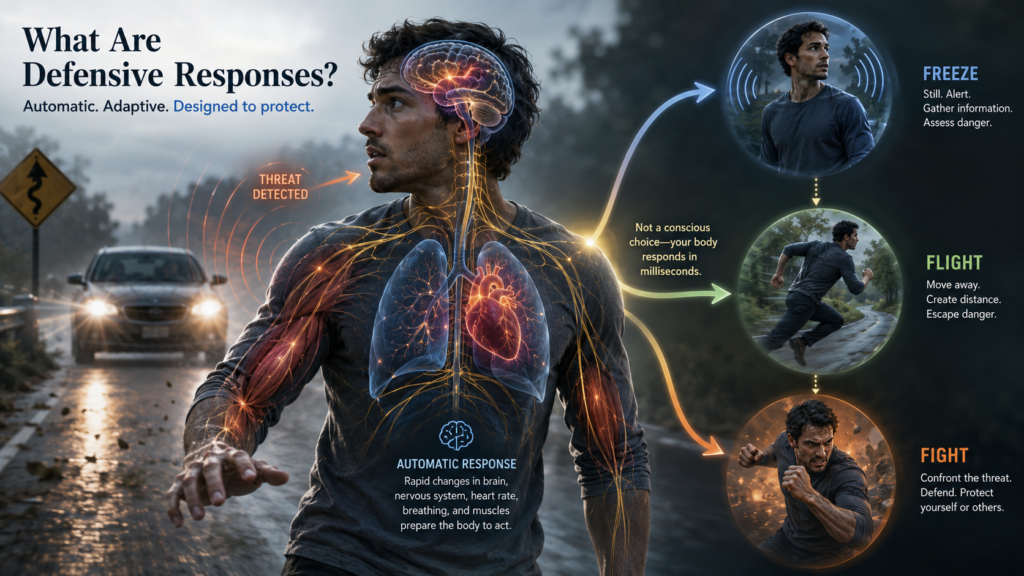
Defensive responses are coordinated changes in the brain, body and behaviour that help an organism deal with possible danger. They are found throughout the animal world and are part of the biological systems that have evolved to help organisms survive threats. Human beings have inherited many of the same basic defensive mechanisms, although our larger capacity for learning, prediction and conscious thought can make human responses considerably more complicated (Mobbs et al., 2015; LeDoux, 2012).
The best-known defensive responses are usually described as fight, flight and freeze. These three words are useful introductions, but they should not be mistaken for three rigid boxes into which every response must fit. Research increasingly describes defence as a flexible collection, or cascade, of possible responses that can change as the situation changes (Kozlowska et al., 2015; Roelofs, 2017).
Why Do We Have Defensive Responses?
For an animal to survive, detecting danger is not enough. It must also do something useful about it.
An animal that notices a predator might need to become still so that it is less easily detected. If the predator approaches, it might need to escape. If escape becomes impossible, it might need to defend itself. Different situations therefore favour different kinds of defensive behaviour.
Similar principles remain present in humans. The threats we encounter are not usually predators, but the biological systems involved in identifying and responding to danger are still active. Modern human beings may respond defensively to a speeding vehicle, an aggressive person, a sudden loud noise or many other situations that the nervous system interprets as potentially important or dangerous.
Researchers consequently describe defensive responses as adaptive: their normal function is protective. They are not, by themselves, signs that something has gone wrong. Problems can arise when defensive systems are repeatedly activated, remain active for too long, or respond strongly to situations that do not actually require such protection, but that is a different question from what the responses themselves are (McEwen, 2007; Abend et al., 2023).
What Happens Inside the Body?
A defensive response is not simply a thought such as I am frightened. The body itself begins preparing for action.
The brain communicates rapidly with the autonomic nervous system, which helps control bodily functions such as heart rate, breathing and blood pressure. Stress-response systems can also release chemical messengers including adrenaline, noradrenaline and, over a somewhat longer timescale, cortisol. These changes help redistribute the body’s resources so that it can meet an immediate challenge (Ulrich-Lai & Herman, 2009).
This can produce familiar sensations. The heart may beat faster, breathing may change, muscles may tighten, attention may become more strongly focused on what is happening, and digestion or other activities that are less urgent at that moment may receive lower priority.
These changes make sense if we think about their purpose. Escaping from danger requires muscles to work quickly. Detecting where danger is coming from requires attention. Defending yourself requires rapid movement and energy.
The body is temporarily changing its priorities.
Importantly, the exact pattern is not identical in every defensive state. Freeze, for example, is not simply a weaker version of fight or flight and can involve a different balance of autonomic activity (Roelofs, 2017).
What Is the Fight Response?
Fight describes defensive behaviour that attempts to confront, resist or remove a threat.
The word can be misleading because it immediately suggests physical violence. Physical fighting is certainly one possible example, particularly in other animals or in an immediate physical confrontation, but the underlying principle is broader: the organism is moving towards the problem rather than escaping from it.
When escape is difficult or when confrontation offers the better chance of protection, defensive systems can prepare the body for active resistance. Muscles are prepared for action, attention becomes strongly directed towards the threat, and physiological arousal can increase.
The important point at this introductory stage is not that the brain contains a simple “fight switch”. Defensive behaviour depends upon the circumstances, what the organism has learned previously and what possible actions appear to be available. Human defensive responses therefore involve interaction between rapid automatic reactions and more flexible decision-making systems (Livermore et al., 2021).
What Is the Flight Response?
Flight means increasing the distance between yourself and a threat.
Running away from an attacking animal is the obvious example, but flight does not always mean literally running. The essential defensive goal is escape or avoidance.
When rapid escape is required, sympathetic nervous-system activity can help prepare the cardiovascular and muscular systems for movement. Attention may narrow towards routes of escape and immediate dangers while activities unrelated to survival temporarily become less important.
Again, this should not be interpreted as a consciously selected programme that always occurs in the same way. Defensive behaviour changes according to factors such as how close the danger appears to be, whether an escape route exists and what previous experience (memory), suggests might work. Research on human threat behaviour supports the idea that increasing threat imminence can change the kind of defensive action that becomes likely (Mobbs et al., 2015).
What Is the Freeze Response?
Freeze is perhaps the most easily misunderstood of the three.
It is tempting to imagine freezing as the failure to fight or run away. Research suggests something much more interesting.
During a freeze response, bodily movement can reduce while attention towards the possible threat increases. Human experimental studies have found characteristic reductions in movement together with changes in heart rate when people are confronted with threatening information. Rather than simply representing helplessness, freezing may help an organism gather information and prepare its next action (Roelofs, 2017).
A useful way of thinking about ordinary defensive freezing is therefore pause, assess and prepare.
Suppose you hear an unexpected noise downstairs at night. Immediately running could take you towards the danger rather than away from it. Immediately attacking would make even less sense because you do not yet know what produced the sound.
Becoming still and listening may provide useful information.
This is why Roelofs describes freezing as being important for both perception and preparation for action. It can precede fight or flight rather than being merely what happens when those responses fail.
There are also more extreme forms of defensive immobility, including tonic immobility, which researchers distinguish from ordinary freezing. We do not need to explore those yet, but recognising that distinction prevents the word freeze from becoming an explanation for every situation in which somebody becomes immobile (Kozlowska et al., 2015).
Does the Person Choose the Response?
Not necessarily.
One of the most important features of defensive systems is that parts of them can operate very quickly and without waiting for conscious deliberation. Neural systems involved in detecting and responding to threats can generate bodily and behavioural changes without requiring the person first to experience and consciously analyse the emotion we call fear (LeDoux, 2012, 2014).
That does not mean human beings have no control over their behaviour. It means that the beginning of a defensive response and the behaviour that eventually follows it are not necessarily the same thing.
Your heart can accelerate before you decide what to do. Your muscles can tense before you understand why. You can automatically become still and orient towards an unexpected sound, then consciously decide that there is no danger.
Defensive responses therefore illustrate an important distinction between reaction and action. The nervous system can begin changing the state of the organism automatically; subsequent perception, learning and conscious decision-making can then influence what happens next (Livermore et al., 2021).
Does There Have to Be Real Danger?
The defensive system cannot wait until danger has been proved beyond doubt.
If an animal waited until it was absolutely certain that the movement in the grass was a predator, it might discover the answer too late. Defensive systems therefore operate using available sensory information, previous experience and predictions about what might happen.
This means that a defensive response can occur even when the suspected danger turns out to be harmless.
A sudden movement in a dark room may make you jump before you realise that it was only a curtain. Your body has responded to the possibility of danger.
Learning also matters. Previous experiences can alter how organisms respond to later situations, allowing environmental cues to acquire defensive significance. The ability to learn which situations predict danger is itself an important survival mechanism (Mobbs et al., 2015).
This becomes particularly important as we move deeper into the subject, because it raises a new question: if defensive responses depend partly upon what the nervous system has learned, how does it decide that something is dangerous in the first place?
Fight, Flight and Freeze Are a Starting Point
Fight, flight and freeze therefore give us a useful first map of human defence, but the map should not be confused with the territory.
They describe different ways in which an organism can protect itself: confronting a threat, escaping from it, or temporarily reducing movement while assessing and preparing to respond. Behind these visible behaviours lies a coordinated biological system involving perception, attention, autonomic regulation, hormones, muscles, learning and decision-making.
Nor does defence begin only when someone consciously feels afraid. Some defensive processes can begin automatically, with conscious understanding arriving afterwards.
Perhaps the most useful conclusion is therefore also the simplest:
A defensive response is the organism changing itself because something may require protection.
Fight, flight and freeze describe some of the things that protected organism may then do.
The next question follows naturally from that definition: how does the nervous system decide that something is a threat?
Sources
- Abend, R., Gold, A. L., Britton, J. C. et al. (2023). Understanding anxiety symptoms as aberrant defensive responding to anticipated threat. Nature Reviews Psychology.
- Kozlowska, K., Walker, P., McLean, L. & Carrive, P. (2015). Fear and the defense cascade: Clinical implications and management. Harvard Review of Psychiatry, 23(4), 263–287. doi: 10.1097/HRP.0000000000000065.
- LeDoux, J. E. (2012). Rethinking the emotional brain. Neuron, 73(4), 653–676. doi: 10.1016/j.neuron.2012.02.004.
- LeDoux, J. E. (2014). Coming to terms with fear. Proceedings of the National Academy of Sciences, 111(8), 2871–2878.
- Livermore, J. J. A., Klaassen, F. H., Bramson, B. et al. (2021). Approach-avoidance decisions under threat: The role of autonomic psychophysiological states. Frontiers in Neuroscience, 15, 621517.
- McEwen, B. S. (2007). Physiology and neurobiology of stress and adaptation: Central role of the brain. Physiological Reviews, 87(3), 873–904. doi: 10.1152/physrev.00041.2006.
- Mobbs, D., Hagan, C. C., Dalgleish, T., Silston, B. & Prévost, C. (2015). The ecology of human fear: Survival optimization and the nervous system. Frontiers in Neuroscience, 9, 55. doi: 10.3389/fnins.2015.00055.
- Roelofs, K. (2017). Freeze for action: Neurobiological mechanisms in animal and human freezing. Philosophical Transactions of the Royal Society B, 372, 20160206. doi: 10.1098/rstb.2016.0206.
-
Ulrich-Lai, Y. M. & Herman, J. P. (2009). Neural regulation of endocrine and autonomic stress responses. Nature Reviews Neuroscience, 10(6), 397–409. doi: 10.1038/nrn2647.