Contents
- 1 What is Classical Conditioning?
- 2 Introduction
- 3
- 4 Learning That One Thing Predicts Another
- 5 What Do “Conditioned” and “Unconditioned” Mean?
- 6 What Has the Organism Actually Learned?
- 7 Conditioning Is Therefore About Prediction
- 8 The Conditioned Response Does Not Have to Be a Copy
- 9 What Is Acquisition?
- 10 Can a Conditioned Response Disappear?
- 11 What Is Generalisation?
- 12 What Is Discrimination?
- 13 Does Classical Conditioning Require Conscious Thought?
- 14 Classical Conditioning and Defensive Responses
- 15 The Cue Is Not the Danger
- 16 Classical Conditioning Does Not Explain Everything
- 17 How Is This Different From Operant Conditioning?
- 18 Classical Conditioning Changes Meaning
- 19 A Predictive Organism
- 20 References
- 21 Knowledge Quiz
 What is Classical Conditioning?
Introduction
Imagine that every morning, just before feeding a dog, you switch on a particular kitchen appliance.
At first, the sound of the appliance means very little to the dog. Food, however, already matters. The sight and smell of food may cause the dog to approach, become excited or begin salivating.
After the sound has repeatedly occurred shortly before food appears, something may change: The dog hears the appliance and comes into the kitchen before the food has appeared.
The sound itself has not become food. Nor has the dog necessarily consciously reasoned:
That sound means that somebody is about to feed me.
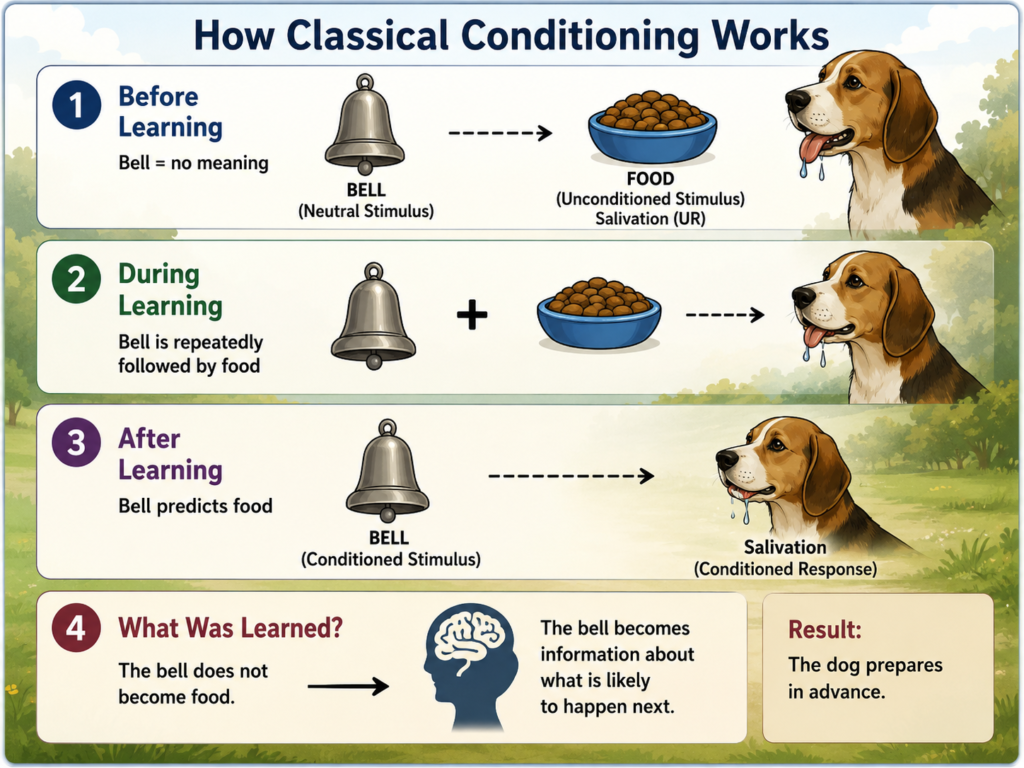
Instead, the sound has acquired significance because it has become useful information about what is likely to happen next.
This is the basic idea behind classical conditioning, also commonly called Pavlovian conditioning.
Classical conditioning is a form of associative learning in which an organism learns that one event predicts, or is related to, another event. As that relationship is learned, something that previously had little relevance can begin producing anticipatory changes in behaviour or physiology.
This apparently simple process is extremely important because organisms live in environments filled with signs of things that have not happened yet.
- A smell can predict food.
- A sound can predict danger.
- A place can predict safety.
- A bodily sensation can predict something that happened previously.
Learning these relationships allows an organism to begin preparing for events before they occur.
Learning That One Thing Predicts Another
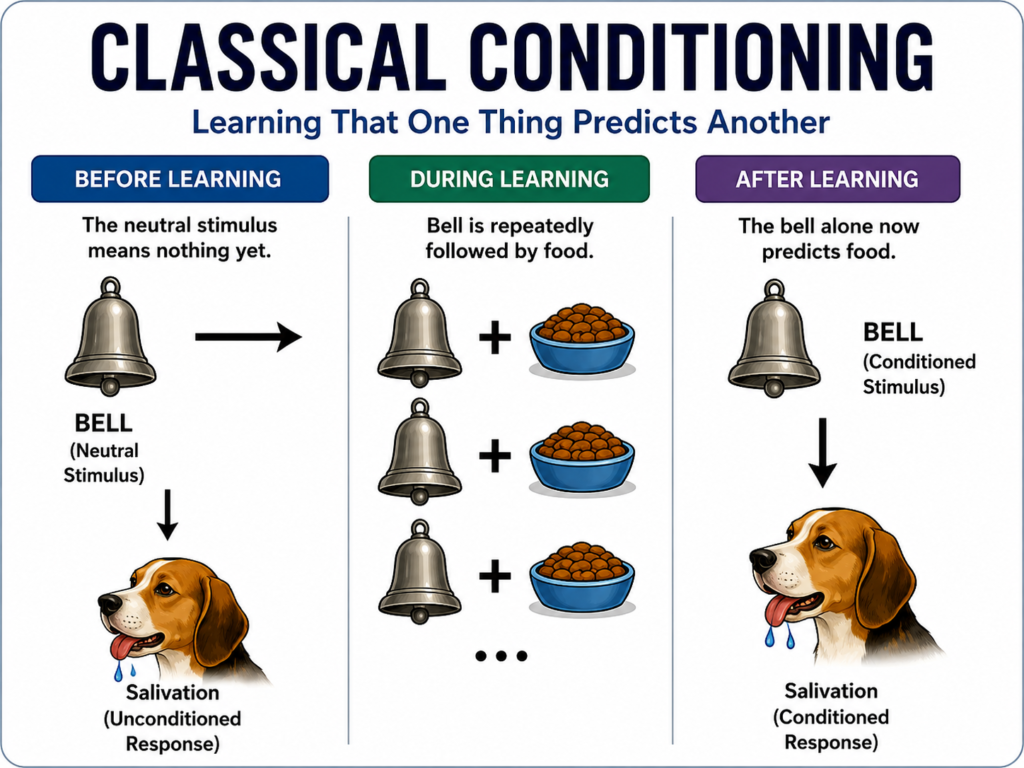
Suppose food is placed in front of a hungry dog: the food already has biological significance no special learning is required before food can produce responses such as orientation, approach and salivation.
Now imagine that we introduce a sound.
The first time the dog hears the sound, it may look towards it, but the sound does not yet predict food.
We then repeatedly arrange events so that:
sound > food
Eventually, the sound can begin producing anticipatory behaviour before the food appears, and something has been learned.
The important change is not in the physical sound. It is in the relationship the organism has learned between the sound and what follows it.
In experimental terminology, the food is called an unconditioned stimulus, while the initially non-predictive sound becomes a conditioned stimulus once its relationship with the food has been learned.
The response produced by food without this particular learning history is called an unconditioned response. The learned anticipatory response to the sound is called a conditioned response.
These terms can look more complicated than the underlying idea.
- Something already meaningful happens.
- Another event begins predicting it.
- The organism learns the relationship.
- The predictive event now produces a response of its own.
That is the basic structure of classical conditioning.
What Do “Conditioned” and “Unconditioned” Mean?
The terminology becomes easier if we avoid thinking of conditioned as meaning controlled or forced.
In this context, conditioned means learned through a particular relationship.
An unconditioned stimulus, usually abbreviated US, is an event capable of producing an important response without first requiring the particular association being studied.
Food can be an unconditioned stimulus in an appropriate feeding experiment.
An unpleasant electric shock is commonly used as an unconditioned stimulus in laboratory studies of defensive learning.
The response produced by such an event is called the unconditioned response, or UR. A stimulus that initially does not predict the important event can become a conditioned stimulus, or CS, if the organism learns that it provides information about that event. And the resulting learned response is called the conditioned response, or CR.
So our simplified feeding example becomes:
Food (US) > response to food (UR)
Before learning, the sound does not predict food.
During learning:
Sound + food
After learning:
- Sound (CS) > anticipatory response (CR)
The labels therefore describe the role that events play within a learning relationship. They should not be mistaken for permanent properties of the objects themselves.
A sound is not inherently a conditioned stimulus. It becomes one within a particular learning history.
What Has the Organism Actually Learned?
Early descriptions of classical conditioning can make the process sound as though the nervous system simply connects two things because they repeatedly occur together.
There is some truth in this. Timing matters. Events that occur in useful temporal relationships can become associated. But simple repetition is not the whole story.
A particularly important series of experiments by Robert Rescorla demonstrated that what matters is not merely whether a conditioned stimulus and an outcome sometimes occur together. The relationship also depends upon whether the conditioned stimulus provides information about the probability of that outcome.
If an unpleasant event occurs just as frequently without a particular signal as it does when that signal is present, the signal provides relatively little useful information about whether the event is going to occur. Rescorla’s experiments showed that this difference in predictive relationship strongly affects conditioning (Rescorla, 1968).
This gives us a more useful introductory interpretation of classical conditioning:
The organism is learning what predicts what.
That interpretation is important for the model we have been developing in this series.
An organism cannot prepare intelligently for everything in its environment. It benefits from learning which features of the environment actually provide useful information about what may happen next.
Conditioning Is Therefore About Prediction
If we return to our dog: If the kitchen appliance runs many times every day but food appears only occasionally afterwards, the sound is a poor predictor of food.
If, on the other hand, the sound occurs almost exclusively just before feeding, it becomes much more informative.
The physical stimulus may be identical. What differs is its predictive significance.
This helps explain why modern learning research often discusses concepts such as contingency, expectation, surprise and prediction error when investigating conditioning.
Learning is often especially informative when what actually happens differs from what was expected. Recent experimental work continues to investigate how prediction errors contribute to Pavlovian learning, although exactly how different physiological and neural measures represent such errors remains an active area of research.
We do not need to understand prediction-error models yet, at this stage, the important principle is simpler:
Experience can teach the organism that one event contains information about another.
The Conditioned Response Does Not Have to Be a Copy
There is another common misunderstanding worth avoiding, it is tempting to imagine classical conditioning as simply transferring an existing response from one stimulus to another:
- Food causes salivation.
- A sound is paired with food.
- Therefore the sound causes salivation.
- That can certainly occur, but it is not a complete description of conditioning.
A conditioned response may instead prepare the organism for the event that has been predicted. The precise form of that preparation can depend upon what is being predicted, when it is expected, the context and what actions are available.
The organism is not necessarily reproducing the unconditioned response, it may be anticipating the coming event.
This fits particularly well with the broader picture we have been developing: organisms continually change themselves in preparation for possible futures.
What Is Acquisition?
The period during which a new conditioned relationship develops is usually called acquisition.
At first:
cue > little or no expectation of the outcome
Then the organism repeatedly experiences a relationship between the cue and the outcome.
Over time:
cue > increasing expectation or preparation
Eventually, presentation of the cue alone may produce measurable changes in behaviour, physiology or expectation.
This does not imply that every conditioned relationship requires hundreds of repetitions. Learning rates differ considerably according to what is being learned, how informative the events are and the biological significance of the outcome.
Some associations can be acquired surprisingly rapidly.
The important point is that acquisition describes the development of the learned relationship, rather than a particular number of repetitions.
Can a Conditioned Response Disappear?
Suppose our dog has learned that the sound predicts food, and we then repeatedly make the sound without providing food. It is reasonable to understand that eventually, the dog may stop coming into the kitchen when it hears it.
This process is called extinction.
At first sight, extinction looks as though the original association has simply been erased:
sound used to mean food > now sound means nothing
Research suggests that this interpretation is often too simple, and that responses that have declined during extinction can sometimes return when circumstances change. For example, experiments have demonstrated renewal, in which an extinguished conditioned response reappears when the stimulus is encountered outside the context in which extinction occurred. Recent experiments continue to demonstrate robust renewal even after substantial intervals between original conditioning and extinction.
This suggests that extinction can involve new learning rather than merely deleting the earlier relationship, that the organism may learn something closer to:
In these circumstances, this cue no longer predicts that outcome.
That distinction will become useful later because it shows that learning can accumulate rather than simply replacing everything that came before it.
What Is Generalisation?
Learning would be surprisingly limited if an organism responded only to the exact stimulus it had encountered previously.
Suppose an animal has learned that one particular sound predicts danger, but a slightly different sound may also be important.
The spread of conditioned responding from a learned stimulus to other, sufficiently similar stimuli is called stimulus generalisation.
Human experiments have demonstrated measurable gradients of conditioned defensive responding: stimuli increasingly different from a learned threat cue tend, on average, to produce progressively weaker conditioned responses (Lissek et al., 2008).
Generalisation has an obvious potential advantage: That an organism encountering a dangerous animal once cannot rely upon meeting precisely the same individual again. Learning that transfers to related situations may provide useful protection.
But generalisation also raises a problem: if learning spreads too broadly, things that do not actually predict danger may begin producing defensive responses.
The organism therefore also needs ways of learning difference.
What Is Discrimination?
Suppose two sounds are similar, one regularly predicts an unpleasant event, but the other does not.
If the organism learns to respond differently to them, this is called discrimination learning, and we can therefore suggest that generalisation and discrimination are solving two opposing problems.
Generalisation asks:
Could this new thing mean something similar?
Discrimination asks:
Does this difference tell me that the situation is actually different?
An adaptive learning system probably requires both, responding only to exact repetitions would be too narrow, while responding identically to everything remotely similar would be too broad.
The organism has to discover which similarities and differences matter.
Does Classical Conditioning Require Conscious Thought?
This question becomes more complicated in humans. A person can certainly learn explicit relationships, and someone participating in an experiment may consciously realise:
Whenever that blue square appears, a shock usually follows.
Human studies show that conscious knowledge of these relationships can interact strongly with conditioned responding. For example, neural and physiological experiments have found relationships between explicit contingency awareness and conditioned responses, although different conditioning procedures do not always produce identical results (Carter et al.; Clark and colleagues’ later conditioning work illustrates how closely awareness and responding can sometimes be related).
It would therefore be unwise to describe human classical conditioning as an entirely unconscious reflex mechanism.
At the same time, classical conditioning does not require somebody deliberately deciding:
I shall now learn this association.
Organisms can acquire relationships simply through experience.
Human conditioning consequently provides another example of the interaction between learning, prediction, bodily responses and conscious understanding rather than a clean division between a conscious and unconscious system.
Classical Conditioning and Defensive Responses
We can now connect classical conditioning directly to our earlier discussion of defensive responses. Imagine hearing an unfamiliar tone.
Initially, the tone may have little defensive significance.
Now imagine that every time the tone occurs, something unpleasant follows. Now the organism can begin learning:
tone > possible danger
Eventually, the tone itself may produce increased attention, autonomic changes, freezing, expectation or other defensive preparation before the unpleasant event occurs.
The external sound has not physically become dangerous, and its meaning to the organism has changed. It has therefore become information about possible danger.
Human laboratory studies commonly demonstrate this process by pairing one previously innocuous cue with an aversive event while another cue predicts its absence. Conditioned defensive responses can subsequently be measured using behaviour, expectancy and physiological responses such as skin conductance or startle.
This gives us one possible answer to a question raised by earlier articles: How can the nervous system come to regard something as threatening?
One answer is:
Because experience has taught the organism that it predicts something harmful.
Classical conditioning is therefore one mechanism through which otherwise ordinary features of the world can acquire defensive significance.
The Cue Is Not the Danger
This distinction deserves particular attention. Let us suppose someone is bitten by a dog.
The bite is harmful, but many other things may be present:
- the dog’s appearance,
- barking,
- the street,
- the smell of wet fur,
- the movement of an approaching animal,
- the place where the event happened.
Some of these features may later function as predictors of similar danger, for example, a future bark does not contain another bite, but may nevertheless cause defensive preparation because the nervous system has learned that barking can form part of a pattern associated with harm.
This fits closely with the threat-imminence model developed in the previous article.
A conditioned cue can provide new information, and that information changes the organism’s estimate of what may happen next. Then the revised estimate can then alter the defensive state.
So we might provisionally extend our developing model:
something is perceived > previous learning gives it predictive meaning > a possible future outcome is anticipated > the estimated probability or imminence of that outcome changes > the organism prepares accordingly
Classical conditioning therefore gives us one mechanism through which experience can contribute to the meaning assigned to present information.
Classical Conditioning Does Not Explain Everything
It would be easy to go too far, however, not every fear has to originate in a direct conditioning experience. Humans can learn about danger through language.
- We can learn from watching other people.
- We can reason about consequences we have never personally experienced.
- We can combine memories, cultural information, imagination and present circumstances.
- We can also change our own environment through our actions and learn from the consequences of those actions, which introduces another major form of associative learning usually called operant conditioning.
Classical conditioning should therefore not be treated as a universal explanation for why an organism behaves as it does. It describes one extremely important learning process:
learning relationships between events.
How Is This Different From Operant Conditioning?
The distinction can initially be expressed quite simply. In classical conditioning, the organism learns relationships such as:
cue > outcome
In operant conditioning, the organism learns relationships involving its own behaviour:
action > consequence
Suppose a dog hears a click immediately before receiving food, thus learning that the click predicts food can involve classical conditioning.
Suppose the dog learns that pressing a panel causes food to appear, now its own action is part of the predictive relationship.
That is the territory of operant conditioning.
Real behaviour can involve both processes at once, so this distinction should not be treated as an absolute division between two independent organisms or nervous systems. It is primarily a useful distinction between different kinds of learning problem.
Classical Conditioning Changes Meaning
Perhaps the most useful conclusion is not simply that classical conditioning makes organisms respond to new stimuli. Something more interesting has happened.
The informational significance of the stimulus has changed.
Before learning:
sound = sound
After learning:
sound = information about what may happen next
That does not mean the organism necessarily represents this relationship in words, nor that every nervous system represents predictions in exactly the same way humans consciously experience them.
It means that subsequent behaviour shows that the organism has become sensitive to a relationship between events.
The world has not necessarily changed, the organism’s learned relationship with the world has.
A Predictive Organism
We can now place classical conditioning within the larger picture developed in this series.
An organism benefits from responding not only to what is happening now, but also to what present information suggests may happen next. Classical conditioning provides one way of acquiring those predictions.
Something initially unimportant repeatedly occurs in an informative relationship with something significant. And the organism learns the relationship.
The previously unimportant event acquires predictive value When that event appears again, the organism can begin preparing before the predicted outcome arrives.
In simplified form:
event A repeatedly provides information about event B > the relationship is learned > event A becomes predictive > event A alone can now alter the organism > the organism prepares for event B
This means classical conditioning may be better understood not merely as learning to respond to a stimulus, but as part of a broader capacity for learning what the present predicts about the future.
That takes us directly back to defensive responding – If an organism can learn that something predicts danger, another question immediately follows:
How does the nervous system learn which predictions should be strengthened, weakened or ignored?
That will require us to look more closely at association, expectation and prediction error.
References
- Carter, R. M., O’Doherty, J. P., Seymour, B., Koch, C., & Dolan, R. J. (2006). Contingency awareness in human aversive conditioning involves the middle frontal gyrus. NeuroImage, 29(3), 1007–1012. https://doi.org/10.1016/j.neuroimage.2005.09.011
- Charles, J. W., Moriarty, S. K., Fournier, D. I., Winterbauer, N. E., Cooper, E. A., & Todd, T. P. (2025). Robust renewal after extinction of remotely acquired Pavlovian conditioning. Learning & Memory, 32(5–6), a054103. https://doi.org/10.1101/lm.054103.125
- Clark, R. E., Manns, J. R., & Squire, L. R. (2002). Classical conditioning, awareness, and brain systems. Trends in Cognitive Sciences, 6(12), 524–531. https://doi.org/10.1016/S1364-6613(02)02041-7
- Lissek, S., Biggs, A. L., Rabin, S. J., Cornwell, B. R., Alvarez, R. P., Pine, D. S., & Grillon, C. (2008). Generalization of conditioned fear-potentiated startle in humans: Experimental validation and clinical relevance. Behaviour Research and Therapy, 46(5), 678–687. https://doi.org/10.1016/j.brat.2008.02.005
- Liu, H., Linnell, J., & Bach, D. R. (2026). Psychophysiological outcome responses in human Pavlovian fear conditioning: A prediction error analysis. Psychophysiology, 63(4), e70300. https://doi.org/10.1111/psyp.70300
- Pavlov, I. P. (1927). Conditioned Reflexes: An Investigation of the Physiological Activity of the Cerebral Cortex (G. V. Anrep, Trans. & Ed.). Oxford University Press.
- Rescorla, R. A. (1968). Probability of shock in the presence and absence of CS in fear conditioning. Journal of Comparative and Physiological Psychology, 66(1), 1–5. https://doi.org/10.1037/h0025984
- Rescorla, R. A. (1988). Pavlovian conditioning: It’s not what you think it is. American Psychologist, 43(3), 151–160. https://doi.org/10.1037/0003-066X.43.3.151
- Rescorla, R. A., & Wagner, A. R. (1972). A theory of Pavlovian conditioning: Variations in the effectiveness of reinforcement and nonreinforcement. In A. H. Black & W. F. Prokasy (Eds.), Classical Conditioning II: Current Research and Theory (pp. 64–99). Appleton-Century-Crofts.


0 Comments