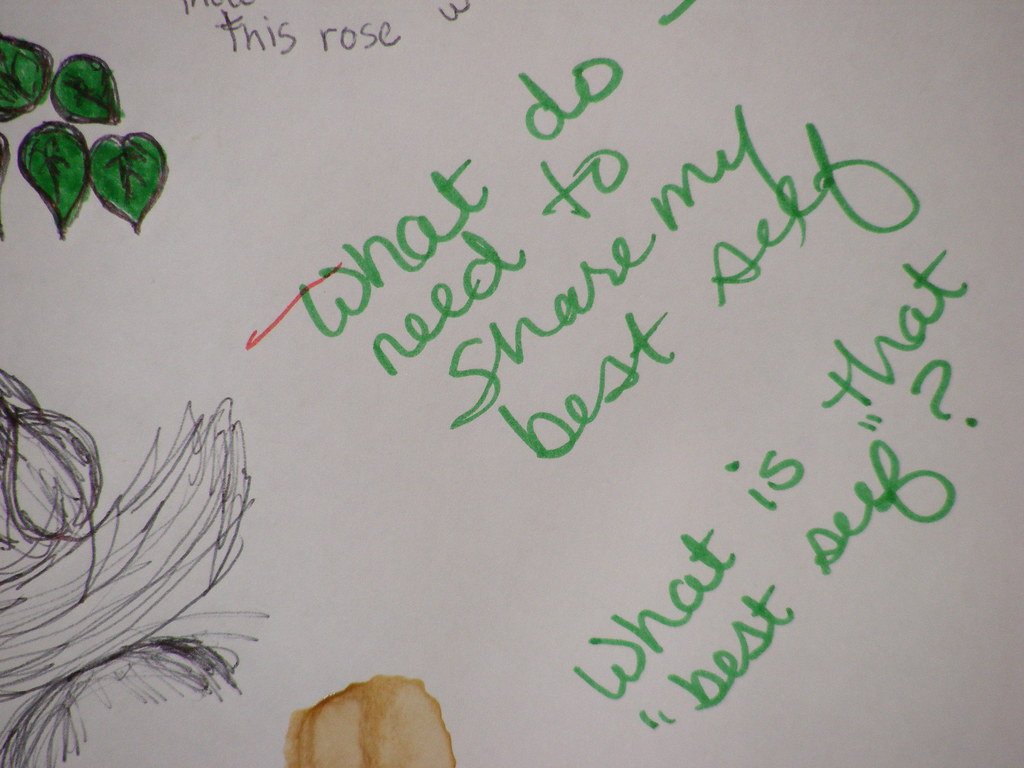
“Table paper (Best self)” by renoir_girl is licensed under CC BY-NC-SA 2.0
Contents
Your True and Best Self
Being your true and best self is less about winning at life and more about living in a way that actually fits who you are. Many people quietly swap that for “being successful” and then use external success as a weapon against themselves.
What “true and best self” really means
- True self: your real feelings, values, and preferences – how you are when you feel safe and not performing for anyone.
- Best self: that true self, well‑supported and developed – using your strengths, learning from mistakes, growing over time.
Psychology talks about gaps between the actual self (how you see yourself now), the ideal self (who you want to be), and the ought self (who you think you should be to please others). Big gaps, especially when the ideal/ought is perfectionistic, are linked to shame, anxiety, and low mood.
What goes wrong when “best” = “most successful”
Modern “achievement culture” and social media push the idea that worth = success, looks, productivity, or status.
Common results:
- Constant upward comparison (“they’re ahead of me”) fuels perfectionism and feeling “never enough.”
- The ideal self becomes extreme (always confident, always productive, always improving), so your everyday self always looks like a failure next to it.
- Self‑criticism becomes the main motivator: “If I’m hard enough on myself, maybe I’ll finally be good enough.” Research shows this actually increases distress and burnout, not healthy motivation.
In short: the more you chase an external, perfectionistic “best,” the further you drift from your authentic self, and the worse you tend to feel.
How to avoid that trap
Name the three selves:
- “This is my actual self: where I’m really at.”
- “This is my ideal self: my hopes and values, softened to be human.”
- “This is my ought self: what I think others demand.”
Notice when you’re attacking yourself from the “ought” or perfectionist ideal.
Redefine “best” as “most congruent”: Instead of “best = most impressive,” use “best = most aligned with my real values, limits, and strengths.” That matches humanistic ideas of healthy self‑development.
Swap self‑criticism for self‑compassion: Studies show that self‑compassion (being fair and kind to yourself while still taking responsibility) reduces self‑criticism and supports real growth better than harshness does.
Watch your comparison diet: Limit environments (especially online) that constantly push you to compare and perform. Reflect on how curated images and “success stories” affect your mood and self‑standards.
Do small, honest check‑ins: Regularly ask: “Does this goal or choice feel like me? Or am I doing it mainly to look successful?” Let that question guide adjustments.
In everyday terms: being your true and best self means building a life that fits you, not forcing yourself to fit a shiny picture. The more you shift from “How do I measure up?” to “How do I live honestly and kindly, as myself?”, the closer you move to the version of you that is both real and genuinely at your best.
Further Reading
https://article.sciencepublishinggroup.com/pdf/10.11648.j.pbs.20200903.11.pdf
https://online-learning-college.com/knowledge-hub/gcses/gcse-psychology-help/carl-rogers/
https://pmc.ncbi.nlm.nih.gov/articles/PMC4023076/
https://en.wikipedia.org/wiki/Self-discrepancy_theory
https://psychgrid.com/blog/self-discrepancy
https://pmc.ncbi.nlm.nih.gov/articles/PMC11389274/
https://www.apa.org/monitor/2024/10/antidote-achievement-culture
https://www.linkedin.com/pulse/hidden-struggles-how-perfectionism-comparison-fuel-sarah-jzlwc
https://www.renascence.io/journal/self-discrepancy-theory-gaps-between-actual-ideal-and-ought-selves
https://self-compassion.org/wp-content/uploads/2016/12/Self-Criticism.pdf
https://pmc.ncbi.nlm.nih.gov/articles/PMC4182604/
https://pmc.ncbi.nlm.nih.gov/articles/PMC10435861/
https://pmc.ncbi.nlm.nih.gov/articles/PMC8549076/
https://sanad.iau.ir/en/Journal/jwc/Article/1103835
https://www.jstage.jst.go.jp/article/pacjpa/87/0/87_2A-031-PD/_article/-char/ja/
https://www.semanticscholar.org/paper/f673d2e4a640b24c71bd0a11a573fd17829fcc5f
https://www.semanticscholar.org/paper/d3227b3db98d08f2c4e53f8ee92beba5adcd0c82
https://www.semanticscholar.org/paper/90107635a577b5eb1e62d2df7d7e074c3fff9bb9
https://www.semanticscholar.org/paper/b35ee15af9359e82846348e3c9d54e0c076a64d7
https://www.semanticscholar.org/paper/d4119f777c17f2eeaee899e9f041e6b37a430687
https://www.semanticscholar.org/paper/a2711b3facafa33073cd36ecd4b1007c8fb6f88b
https://www.semanticscholar.org/paper/b0d3e488e779370d2e1af8bea9236b1210f81b9e
https://www.semanticscholar.org/paper/80c6348265cc4ce2c63cd514fdfacf810b0c20fc
https://europepmc.org/articles/pmc4023076?pdf=render
https://pmc.ncbi.nlm.nih.gov/articles/PMC10718412/
https://pmc.ncbi.nlm.nih.gov/articles/PMC11745033/
https://www.frontiersin.org/articles/10.3389/fnhum.2023.1128209/pdf
https://www.psychologytoday.com/gb/blog/dont-delay/200805/whats-your-ought-self-like
https://www.linkedin.com/pulse/perfectionism-social-media-teresa-angle-young
https://pmc.ncbi.nlm.nih.gov/articles/PMC11916919/
https://www.sciencedirect.com/science/article/pii/002210319090071S
https://www.sciencedirect.com/science/article/abs/pii/S0191886921007340


0 Comments