Contents
Self-Fulfilling Prophecy
A self-fulfilling prophecy is a belief or expectation that helps bring about the very outcome it predicts, because it subtly changes behavior in ways that make the outcome more likely. It can work for or against someone, shaping performance, relationships, health, and even broader social systems.
What it is
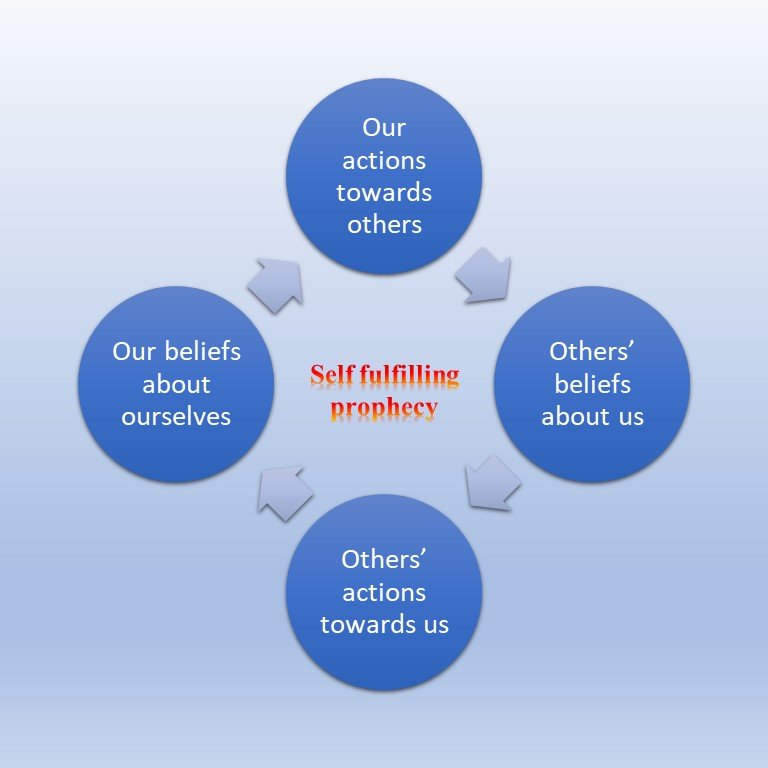
A self-fulfilling prophecy starts as an expectation (true or false) about yourself, another person, or a situation, which then influences actions so that the expectation becomes reality.
Classic definitions describe it as an originally false view of a situation that evokes behavior making the false view come true, creating a feedback loop between belief and outcome.
This ability of people, to form a mindset that delivers the predicted outcome, can clearly by good, of bad, for that individual. More often than not, though, it is self-defeating, life limiting self-prophesies that the individual ends up delivering for themselves. Even physical changes can come about, thanks to this, working in a similar way to the placebo effect, but in reverse.
For example, a person that becomes convinced that their partner is cheating on them, may become hypervigilant and become oppressive to their partner, who may well choose to leave, or otherwise confront that situation. Thus a fear of being abandoned caused the very behaviour that delivered the abandonment.
How the cycle works
Step 1: Form a belief or prediction (for example, “I always mess up presentations” or “This exam will go well for me”).
Step 2: That belief shapes attitude and behavior (nervous avoidance and little practice, or calm focus and extra study), often through nonverbal cues as well.
Step 3: Others respond to those behaviors, or the situation unfolds accordingly, reinforcing the original belief when the outcome matches what was expected.
Common life examples
Performance: Expecting to fail a test can lead to procrastination, poor concentration, and higher anxiety during the exam, increasing the chance of a bad grade.
Relationships: Believing coworkers dislike you can make you withdrawn or defensive, prompting them to avoid you, which then “confirms” your belief.
Society: Stereotypes and teacher expectations can cause students to perform in ways that align with those expectations over time.
Turning it to your advantage
Identify a specific domain (work, study, health, relationships) and write down your recurring predictions about yourself there, especially the ones that sound like fixed labels (“I’m terrible at speaking up”).
Deliberately replace one limiting prediction with a realistic but encouraging one (“I can become a more confident speaker with practice”) and pair it with concrete action steps such as practice sessions, feedback, or small challenges.
Track small wins that match the new belief, so your attention starts reinforcing a positive prophecy instead of the old negative one.
Breaking negative prophecies
Question the evidence: ask what facts support your prediction, what facts contradict it, and whether you are confusing past events with permanent traits.
Change behavior first: even if beliefs feel stubborn, act as if a more helpful belief were true (for example, preparing thoroughly, engaging kindly, or seeking support), and let new experiences gradually reshape the internal story.
Use structured supports like realistic goal-setting, positive reframing, and small, repeated experiments to weaken old expectations and build a more empowering pattern of self-fulfilling prophecies.
Further Reading