Contents
- 1 Organismic Binary Logic: Why Zero Becomes Three
- 1.1 Abstract
- 1.2 1. Scope: a proposed organismic mathematics
- 1.3 2. Conventional binary and organismic opposition
- 1.4 3. The central insight: zero becomes three
- 1.5 4. Differentiation is not NOT
- 1.6 5. Persistence, memory, and two different recursion rules
- 1.7 5.1 State-updating persistence
- 1.8 6. An unexpected exact recurrence in quantum operator space
- 1.9 7. The Bloch sphere: where the analogy holds and where it stops
- 1.10 8. Superposition: possibility-space is not “everything at once”
- 1.11 9. Schrödinger’s cat as a test case, not the foundation
- 1.12 10. Candidate organismic applications
- 1.13 11. Philosophical implications of a persistent origin
- 1.14 12. What would make this a scientific mathematics rather than an analogy?
- 1.15 13. A provisional formal statement
- 1.16 14. Conclusion
- 1.17 References
 Organismic Binary Logic: Why Zero Becomes Three
Persistent origin, recursive differentiation, and a possible structural parallel in quantum operator space
Abstract
This paper introduces Organismic Binary Logic (OBL) as a proposed mathematical framework for systems in which an opposition is generated from a persisting origin.
The proposal is not that ordinary binary logic has used the wrong symbols: any two-valued logic can be encoded as 0/1, -1/+1, or by other labels. The proposed difference is structural and temporal.
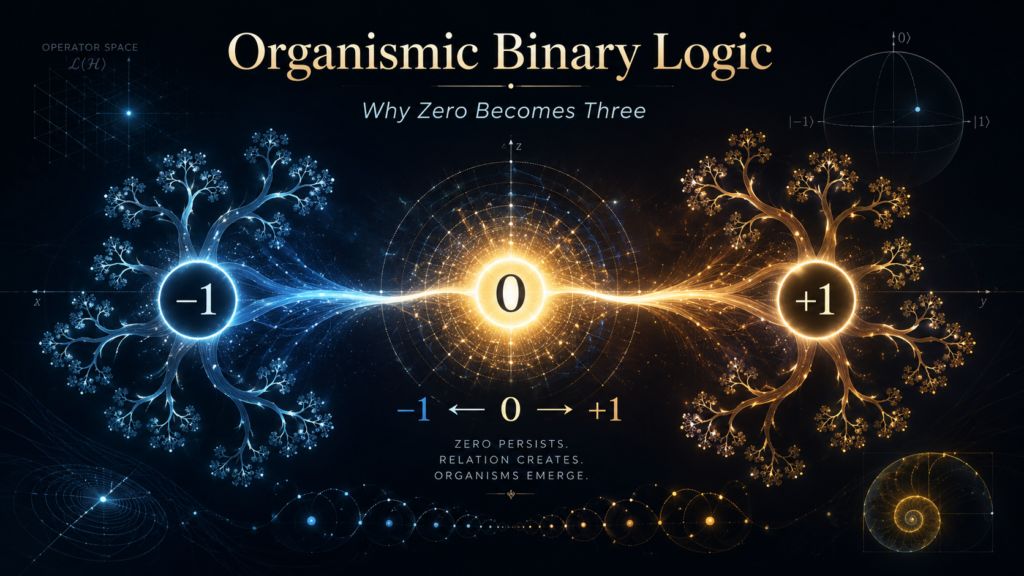
In OBL, an initially undifferentiated reference condition, written 0, differentiates into two opposed poles, -1 and +1, while the originating relation remains present as an updated 0. The resulting event is therefore represented as -1 <- 0 -> +1. If the origin retains information about the differentiation, the post-differentiation zero is no longer informationally identical to the pre-differentiation zero.
The paper separates this differentiation process from NOT or inversion, develops two possible recursion rules, and shows that one strong form of historical persistence generates the sequence of newly introduced components 3, 12, 48, 192, … while the cumulative space grows 1, 4, 16, 64, 256, … .
A strikingly exact recurrence already exists in the Pauli-operator representation of multi-qubit quantum density operators: an n-qubit operator basis has 4^n Pauli strings, and adding one qubit introduces 3 x 4^(n-1) new basis elements while preserving 4^(n-1) inherited elements (Huang and Mendl, 2022, pp. 1-2, arXiv pagination).
This numerical and structural correspondence is not presented as evidence that OBL is quantum mechanics. It is presented as a precisely stated comparison that suggests testable mathematical questions about persistence, operator growth, measurement, and the relation between a rich state-space Organismic Binary Logic (OBL) and locally binary observations.
Possible applications are then considered in quantum measurement, Schrödinger’s cat, biological regulation, and human reasoning.
Human cognition is treated as one candidate organismic application rather than as the foundation of the model. The aim of this first paper is to define the proposed logic clearly enough that later papers can test its recursive, physical, and psychological consequences without confusing metaphor with formal equivalence.
1. Scope: a proposed organismic mathematics
The term Organismic Binary Logic is used here for a proposed form of relational mathematics.
It is intended to describe a particular kind of binary differentiation: a system begins from an undivided or unresolved reference condition, generates two opposed possibilities, and yet retains the originating relation through which those possibilities were distinguished. The word organismic does not mean that every example must be biological. It identifies the feature of interest: continuity through change, in which later distinctions remain related to a persisting domain rather than replacing it without history.
This is a conceptual and mathematical proposal, not an established branch of logic, neuroscience, or quantum theory.
The first task is therefore definitional. The symbols -1, 0, and +1 must not be allowed to carry meanings imported from ordinary arithmetic unless those meanings have been justified.
In the present model they initially denote relational roles: negative pole, originating or balancing relation, and positive pole. Their numerical appearance is useful because it makes opposition and symmetry visible, but their deeper algebraic properties remain to be derived.
Two earlier exploratory papers approached parts of this problem through quantum NOT operations and the Bloch sphere. The first emphasised reversible inversion between binary states; the second attempted to combine Pauli/Bloch geometry, superposition, four-valued reasoning, and psychological masking (Barra, 2025a, p. 1; Barra, 2025b, pp. 2-4). The present paper revises that starting point. NOT is treated as an operation that acts after an opposition has been defined. The more fundamental question is how the opposition is generated, and what happens to the origin after generation.
2. Conventional binary and organismic opposition
A conventional binary variable has two possible values. In digital switching these are commonly labelled 0 and 1;
Shannon’s switching calculus made the two-valued restriction explicit and defined negation as exchanging the two values (Shannon, 1938, pp. 714-715). Nothing prevents the same two alternatives from being relabelled -1 and +1. Merely replacing 0/1 with -1/+1 would therefore not create a new logic.
The proposed organismic distinction is that the binary alternatives are understood as poles generated relative to an origin. The minimal diagram is:
-1 <- 0 -> +1
Here 0 is not simply a third answer to the same question. It has a different logical role. The two poles are differentiated positions. The zero is the relation or reference from which their opposition becomes meaningful. If the system is symmetric, -1 and +1 may be interpreted as equal-and-opposite deviations from that reference; in other applications they may simply mark mutually opposed alternatives.
This means that OBL is not, at least in its present form, ordinary three-valued logic. In a conventional three-valued logic the three values are members of one truth-value set and are manipulated by defined truth tables.
In OBL the central term has a generative and historical status that the poles do not share. A complete formalisation may therefore require typed elements, temporal indices, or an explicit history relation rather than a single three-valued truth table.
3. The central insight: zero becomes three
Consider an origin before any distinction has been made. Write this as 0_0. A differentiation event produces two opposed poles. If the origin disappeared during that event, the result would be an ordinary split into two descendants. The present proposal instead assumes that the originating awareness or relational centre persists through the event.
To show that persistence without pretending that nothing has changed, the zero should be indexed through time:
Before differentiation: 0_0
After differentiation: {-1_0, 0_1, +1_0}
The notation 0_1 is important. It identifies continuity with 0_0 while also recording that the origin is now in a different informational condition. It has participated in, or retained information about, the distinction between -1_0 and +1_0. Thus the claim is not that three objects mysteriously arise from the numeral zero. The claim is that one relational process yields two differentiated poles plus a continuing origin.
The phrase zero becomes three is therefore shorthand for a temporal relation:
differentiation(0_n) -> {-1_n, 0_(n+1), +1_n}
where 0_(n+1) is continuous with 0_n but is no longer informationally identical to it. If the system has memory, then 0_(n+1) contains or can recover some representation of the event that transformed 0_n into a differentiated domain.
3.1 Zero is not nothing
This point also changes the meaning of zero. The model does not use zero as absolute non-existence. It uses zero as an undifferentiated reference condition.
Before differentiation, 0_0 is a condition in which the later opposition has not yet been expressed. After differentiation, 0_1 is a condition from which both poles are related and, under the persistence hypothesis, remembered.
That gives two conceptually distinct kinds of zero: an uninformed zero before a distinction and an informed zero after it. They may occupy the same relational centre, but they do not contain the same history. This distinction will become important when recursion is considered.
4. Differentiation is not NOT
The earlier NOT paper correctly identified inversion as important, but the present model places it one step later. A NOT operation presupposes that the relevant alternatives already exist. In classical binary logic, negation exchanges 0 and 1. In a qubit computational basis, the Pauli-X gate exchanges |0> and |1>. In both cases the operation transforms a defined binary opposition; it does not explain how the domain of opposition came to exist (Barra, 2025a, p. 1).
OBL therefore distinguishes at least two operations:
Differentiation: D(0_n) -> {-1_n, 0_(n+1), +1_n}
Inversion: N(+1_n) = -1_n, N(-1_n) = +1_n
The status of N(0) should not be assumed. If zero is the relational origin, inversion may leave it unchanged, may be undefined for it, or may require a different operation entirely. That is a question for the eventual algebra, not something that should be settled by analogy.
This distinction is conceptually important because generation and reversal answer different questions. Differentiation asks: what relation produces an opposition? NOT asks: given an established opposition, how can one pole be transformed into the other? Treating NOT as fundamental can obscure the prior existence of the relational domain within which NOT makes sense.
5. Persistence, memory, and two different recursion rules
The next question is what it means for the origin to persist. There are at least two mathematically different interpretations, and they lead to different growth laws. The theory should keep them separate until evidence favours one.
5.1 State-updating persistence
In the weaker interpretation, 0_0 persists only by becoming 0_1. The earlier version is represented inside the later state as memory, but it is not independently available as another active element. The current domain after one differentiation therefore contains three active positions: -1_0, 0_1, and +1_0.
If every active position can undergo the same kind of differentiation and old versions are not independently addressable, the number of current positions would grow as:
1 -> 3 -> 9 -> 27 -> 81 -> …
This is a ternary branching law for the current frontier, even though the logic is not ordinary ternary logic.
5.2 Historically addressable persistence
The stronger interpretation follows the original intuition more literally: the pre-differentiation origin is not merely compressed into the new state but remains recoverable as a distinct relational perspective. The current triad is still -1, 0, +1, so zero has become three at the level of visible differentiated positions. But the historical origin is also retained as an independently addressable informational component.
After the first event there are therefore four addressable components in the complete domain:
{0_0 ; -1_0, 0_1, +1_0}
The semicolon is deliberate. It separates the retained ancestral condition from the three positions generated by the differentiation event. If every addressable component can in turn support another differentiation, each existing component is retained while three new components are added. The total therefore multiplies by four at each stage.
Total addressable components: 1 -> 4 -> 16 -> 64 -> 256 -> …
The number newly introduced at each stage is the difference between successive totals:
New components: 0 -> 3 -> 12 -> 48 -> 192 -> …
For stage n >= 1, the two quantities can be written in WordPress-safe form as:
Total(n) = 4^n
New(n) = 3 x 4^(n-1)
This is the precise assumption required for the previously suggested 0, 3, 12, … sequence. It does not follow from zero becomes three by itself. It follows only if ancestral states remain separately addressable and each retained component can participate in further differentiation.
Table 1. Strong historical-persistence recursion.
| Stage n | Total retained/addressable components | New components introduced at stage n |
|---|---|---|
| 0 | 1 | 0 |
| 1 | 4 | 3 |
| 2 | 16 | 12 |
| 3 | 64 | 48 |
| 4 | 256 | 192 |
| 5 | 1024 | 768 |
6. An unexpected exact recurrence in quantum operator space
At this point the proposed organismic recursion encounters a mathematically exact pattern already used in quantum information theory. This is the most important quantum comparison in the present paper because it is not based on a loose visual resemblance.
For a single qubit, any density operator can be expanded using four basis operators: the identity I and the three Pauli operators X, Y, and Z. Huang and Mendl write the single-qubit density operator in terms of the identity and the three-component Bloch vector, then generalise to n qubits by taking tensor products of these four operators.
The resulting multi-qubit density operator has a Pauli-string representation with 4^n real coefficients before the physical trace and positivity constraints are imposed (Huang and Mendl, 2022, pp. 1-2, arXiv pagination).
The recursive structure is especially revealing. Suppose A is any Pauli-string basis operator for n-1 qubits. When one more qubit is added, four descendants of that operator appear in the n-qubit operator basis:
A x I, A x X, A x Y, A x Z
Here x denotes the tensor product in plain-text notation. A x I preserves the previous operator structure on the old subsystem while doing nothing non-trivial to the newly added qubit. The other three terms introduce the three Pauli directions on the new qubit. Consequently, every inherited operator basis element is accompanied by three new ones.
The counting rule is therefore:
Inherited at stage n = 4^(n-1)
New at stage n = 3 x 4^(n-1)
Total at stage n = 4^n
This gives exactly:
0, 3, 12, 48, 192, … new operator-basis elements
1, 4, 16, 64, 256, … total operator-basis elements
The match is exact at the level of the recurrence relation. It is also more specific than the earlier observation that four qubits have 16 computational basis states. Those are different mathematical objects. An n-qubit pure state vector has 2^n computational basis amplitudes.
By contrast, the real vector space of Hermitian operators on n qubits has dimension 4^n, and the Pauli strings form a basis for that operator space (Huang and Mendl, 2022, pp. 1-2). Thus 16 appears for four qubits in state-vector basis counting, but it already appears for two qubits in Pauli-operator basis counting. The new 3, 12, 48 recurrence points much more naturally toward operator space than toward the number of computational basis states.
6.1 Why the identity operator matters
This comparison suggests an important correction to the symbolism of OBL. In ordinary operator algebra, the zero operator annihilates a vector; it does not preserve it. A persisting organismic zero therefore should not be identified with the quantum zero operator. Functionally, the closer quantum analogue of persistence is the identity operator I, which leaves the state unchanged.
That does not mean that organismic 0 = quantum I. It means that the role played by the organismic origin – persistence of the prior domain while new differentiations are added – is identity-like rather than annihilating. In the Pauli basis, one identity direction plus three non-trivial Pauli directions gives the fourfold operator recursion. This may be the first indication that the word zero in OBL describes a relational centre, while the corresponding operation of persistence may need a different symbol in the eventual formal mathematics.
6.2 Three operators, each with opposed outcomes
The three Pauli operators X, Y, and Z also have another property relevant to organismic opposition: each has two eigenvalues, +1 and -1. An eigenvalue is the numerical result associated with a definite measurement outcome for that observable. Thus a single qubit possesses three standard Pauli measurement axes, and each axis defines a binary opposition of outcomes.
This gives a quantum structure that can be described, carefully, as three binary questions rather than one three-valued answer. X asks one two-outcome question, Y another, and Z a third. These observables do not generally commute, meaning that they cannot be treated as three simultaneously definite classical properties of an arbitrary qubit.
A state that is definite for one Pauli observable is generally a superposition relative to the eigenbasis of another. This is important for the later idea of silent oppositions: the unasked alternatives are better understood as available measurement relations, not as a hidden list of simultaneously possessed classical answers.
7. The Bloch sphere: where the analogy holds and where it stops
The Bloch sphere provides a geometric representation of a single-qubit state. In density-operator form the state can be written in plain text as:
rho = 1/2 ( I + r_x X + r_y Y + r_z Z )
The three real numbers r_x, r_y, and r_z are the Bloch-vector components. Pure states lie on the surface of the Bloch sphere; mixed states lie inside it. The identity component is fixed by normalisation, while the three Pauli components describe the variable part of the single-qubit density operator (Huang and Mendl, 2022, pp. 1-2).
This is close enough to OBL to be mathematically provocative, but not close enough to justify identification. The centre of the Bloch ball represents the maximally mixed single-qubit state, rho = I/2. It is not an observing origin, a memory store, or an undifferentiated consciousness. Likewise, X, Y, and Z are not the organismic values -1, 0, and +1. They are operators whose measurements have +/-1 outcomes.
The useful comparison is therefore structural: a quantum binary system is not exhausted by one pair of labels. Its operator description contains an identity component and three independent Pauli directions; each Pauli direction defines a binary opposition of outcomes.
OBL independently proposes that a binary opposition should be understood relative to a persisting relation, and its strong historical recursion produces the same 1-plus-3 multiplicative count. Whether those facts have a deeper common mathematical cause is an open question.
8. Superposition: possibility-space is not “everything at once”
Quantum superposition is often described informally as a system being in several classical states at once. That phrase is useful pedagogically but can become misleading.
Formally, a superposition is a state vector expressed as a linear combination of basis vectors. Which coefficients appear depends on the basis in which the state is described. A state that is definite in the Z basis, for example, is generally expressed as a superposition in the X basis.
This suggests a more disciplined way to connect OBL with quantum theory. OBL need not claim that its zero is itself a quantum superposition.
Instead, it may describe the generation of binary questions or relational axes within a richer state-space. A measurement then selects one observable relation and produces an outcome from the alternatives defined by that observable.
This distinction matters because it prevents two different levels from being collapsed into one. The quantum state is the mathematical state of the physical system. The observable is the operator defining what is being measured. The measurement outcome is one of the allowed results.
In OBL, the origin, the differentiation operation, and the generated poles may play roles more analogous to the relation between a domain, a question, and its opposed outcomes than to a literal list of simultaneous physical states.
9. Schrödinger’s cat as a test case, not the foundation
Schrödinger’s cat is useful precisely because it makes the difference between a rich physical system and a coarse binary description impossible to ignore.
In the original 1935 thought experiment, a radioactive decay is coupled through a detector and poison mechanism to the macroscopic alternatives of a living or dead cat. Schrödinger used the example to show how an indeterminacy originating at the atomic scale would, under an unrestricted reading of the quantum state, become a macroscopic indeterminacy involving the cat (Schrödinger, 1935/Trimmer 1980, p. 328).
For OBL, the first observation is that alive/dead is already a selected binary axis. It is a question imposed by the experimental description. The full physical state of the cat, apparatus, radioactive source, box, and environment contains vastly more information than this one distinction expresses.
Quantum theory represents that larger state in Hilbert space, while the chosen measurement distinguishes particular alternatives.
The second observation is that the cat should not be assumed to consciously experience a coherent quantum superposition of “alive” and “dead” thoughts.
Modern decoherence theory explains how interaction with the environment destroys observable coherence between macroscopically distinct alternatives and selects robust pointer states from a much larger Hilbert space (Zurek, 2003, pp. 717-718).
OBL can therefore use the cat experiment without claiming that the animal’s nervous system is literally maintaining a macroscopic coherent superposition.
The more interesting organismic question comes later: what binary or oppositional questions can the cat’s own regulatory and perceptual systems generate from within the box?
Pain/not-pain, safe/danger, breathe/fail-to-breathe, approach/avoid, act/wait, and many others may be more biologically relevant than alive/dead.
Those distinctions would belong to an organismic modelling process, not to the quantum wavefunction itself.
This is one route by which the later unconscious/subconscious/conscious proposal might be developed, but it is an application of the mathematics rather than the mathematical foundation.
10. Candidate organismic applications
If OBL is more than an attractive diagram, structures with the required features should recur outside introspective psychology. The defining features to look for are not merely the presence of three values. A candidate system should show: (1) an identifiable reference or organising condition; (2) generation of opposed responses or deviations relative to that condition; (3) persistence of the organising relation after differentiation; and, for the strong recursion, (4) independently addressable retention of earlier states or relations.
10.1 Homeostatic regulation
Biological homeostasis is an obvious candidate domain because it concerns the maintenance of relatively stable conditions through regulation.
Cannon explicitly framed living systems in terms of their capacity to maintain stability despite disturbance (Cannon, 1929, p. 399). A regulated variable can often be described as deviation below a reference, near a reference, or above a reference. That resembles -1, 0, +1 at a coarse level.
The resemblance is not yet evidence for OBL. Most physiological variables are continuous, control loops can be asymmetric, and set-points can move. The relevant test would be whether the regulatory architecture itself preserves a reference relation while generating opposed corrective actions, and whether successive layers of regulation show the predicted persistence and recursion.
10.2 Cellular and neural differentiation
Activation/inhibition, depolarisation/hyperpolarisation, promotion/suppression, and approach/avoidance are examples of oppositional descriptions common in biology.
OBL would not treat every such pair as proof of a universal binary law. It would ask whether the pair is generated relative to a persisting organising domain, whether that domain records the differentiation, and whether later differentiations remain connected to the same lineage.
This turns the model into a research programme rather than a naming exercise. The target is not to find pairs; pairs are everywhere. The target is to find the specific combination of opposition, retained origin, memory, and recursive addressability.
10.3 Human reasoning as one example
Human reasoning then becomes one particularly accessible example rather than the starting point.
A person can generate an opposition such as accept/reject, approach/avoid, self/other, or true/false while retaining awareness that both alternatives arose within one deliberative domain. If the person also retains earlier versions of the question and can revisit them, the stronger historical-persistence model becomes psychologically plausible.
This possibility may help explain why mature reasoning is not simply the selection of one pole. An integrated judgement can retain knowledge of rejected alternatives, earlier interpretations, and the path by which the present conclusion was reached.
In OBL terms, the post-decision centre is not informationally identical to the pre-decision centre. It has acquired a lineage.
This application should be tested separately. The fact that human thought can be represented using the same diagram does not establish that neural computation follows the 4^n recursion or that thought-forms are quantum states.
It only shows why cognition is a useful domain in which to ask whether historical addressability is real.
11. Philosophical implications of a persistent origin
Although the model is mathematical in intent, its central rule has philosophical consequences. The first concerns identity through change. If 0_1 retains continuity with 0_0 but contains information that 0_0 did not possess, then identity cannot mean complete sameness of informational content. It may instead be represented as continuity of lineage through transformation.
The second concerns unity. Differentiation need not mean that unity has been destroyed. A system may become internally differentiated while retaining the relation that connects its parts. This suggests a progression from undifferentiated unity to differentiated opposition and then to informed unity.
The later unity is not a return to the earlier state, because the history of differentiation remains present.
The third concerns balance. In OBL, zero need not mean the absence of both poles. A post-differentiation zero may instead mean a relation capable of containing or coordinating both poles without being reducible to either. That is a different concept from neutrality. It describes integration rather than erasure.
Finally, the model challenges the assumption that a binary answer exhausts the system that produced it. A measurement, decision, or judgement may expose one opposition while leaving the larger relational domain mostly unexpressed.
This is already familiar in quantum mechanics, where the state-space is richer than the outcome of one measurement, and it may also be true of biological and cognitive systems for entirely different physical reasons.
12. What would make this a scientific mathematics rather than an analogy?
The strongest result in the present paper is not that several fields contain opposites. It is the derivation of explicit alternative recursion laws and the discovery that the strong historical-persistence recurrence is exactly the recurrence of Pauli-operator basis growth. That makes it possible to state questions that could, in principle, falsify or refine the model.
• Can the differentiation operation D be defined algebraically so that its domain, codomain, composition rules, and invariants are unambiguous?
• Is 0 best represented as a value, a state, a relation, or an identity-like operation? The quantum comparison suggests that these roles should not be conflated.
• Does memory merely update the current origin, giving a 3^n frontier, or do earlier states remain independently addressable, giving the 4^n cumulative recursion and the 3 x 4^(n-1) sequence of new components?
• Can an organismic system be identified in which those two hypotheses make different measurable predictions?
• Is there a formal mapping between OBL persistence and the identity-plus-Pauli decomposition {I, X, Y, Z}, or is the shared 1+3 recurrence only combinatorial?
• If a mapping exists, what corresponds physically to the tensor product that drives 4^n growth in quantum operator space? Organismic ancestry is not automatically a tensor product.
• Do the three Pauli directions provide a useful model for three possible binary questions generated from one quantum degree of freedom, and if so, what would be the organismic analogue of non-commutation?
• Can the concept of a silent opposition be stated operationally as an available but unmeasured binary relation, without treating unmeasured quantum observables as hidden classical values?
• In biological regulation, can reference, positive deviation, negative deviation, and historical state be operationally measured as distinct components rather than imposed retrospectively by the researcher?
• In cognition, can earlier decision states be shown to remain independently addressable and causally active, rather than merely stored as passive memory?
• Does the same recurrence appear across genuinely independent organismic systems after the counting rules are fixed in advance? Repeatedly finding 3, 12, 48 after changing definitions would not constitute evidence.
13. A provisional formal statement
The present proposal can now be stated compactly.
Organismic Binary Logic begins with a relational origin 0_n. A differentiation operation generates two opposed poles while preserving an updated origin:
D(0_n) -> {-1_n, 0_(n+1), +1_n}
The poles are locally binary; the complete differentiated relation is triadic. If 0_(n+1) retains information about 0_n and the generated poles, the post-differentiation origin is informationally richer than the pre-differentiation origin.
If earlier origins are only encoded within later states, recursive active positions can grow as 3^n. If earlier origins remain independently addressable and every addressable component can differentiate again, the complete domain grows as 4^n and adds 3 x 4^(n-1) components at stage n.
Quantum mechanics contains an independently established operator-space recurrence with exactly that latter form: the n-qubit Pauli-string operator basis has 4^n elements, obtained by preserving each previous basis element with I and adjoining three Pauli alternatives X, Y, and Z (Huang and Mendl, 2022, pp. 1-2). The equality of recurrence does not establish equality of mechanism. It identifies a concrete mathematical correspondence worthy of further investigation.
14. Conclusion
The original insight behind OBL is simple: an opposition generated by a persisting origin cannot be represented adequately as though the origin vanished. The local result of differentiation is not merely two poles. It is a relation containing -1, a continuing 0, and +1. Once the origin has participated in or remembered the differentiation, that zero has changed. The model therefore distinguishes an undifferentiated zero from an informed zero without abandoning continuity between them.
That distinction changes the mathematics of recursion. A weak persistence model gives one growth law; a strong, historically addressable model gives another. Under the stronger rule, the sequence of newly generated components is 3, 12, 48, 192, … and the cumulative space is 4, 16, 64, 256, … after the initial origin. Unexpectedly, the same 1-retained-plus-3-new rule appears exactly in the Pauli-string operator basis of multi-qubit quantum mechanics.
The correspondence should neither be dismissed as numerology nor promoted prematurely as a new quantum theory. It is stronger than a visual analogy because the recurrence relation can be derived independently on both sides; it is weaker than a physical identification because the entities and operations have not yet been mapped.
The next scientific task is therefore formal: define persistence, addressability, composition, and differentiation tightly enough to determine whether the shared recurrence reflects a deeper algebraic relationship or only a common combinatorial structure.
Human reasoning, biological regulation, and Schrödinger’s cat then become applications and tests of that mathematical proposal. They should not be allowed to define it. The first question remains the mathematical one: what kind of system produces opposed poles, retains their origin, remembers the differentiation, and continues to differentiate without losing its lineage?
References
Barra. (2025a). Quantum Math: The Importance of the NOT Operator. Self-Transcendence Research, 30 November 2025.Source
Barra. (2025b). The Bloch Sphere and our Genetic NOT Decisions. Self-Transcendence Research, 2 December 2025.Source
Cannon, W. B. (1929). Organization for Physiological Homeostasis. Physiological Reviews, 9(3), 399-431. https://doi.org/10.1152/physrev.1929.9.3.399Source
Huang, Q., & Mendl, C. B. (2022). Efficient quantum circuit simulation using a multi-qubit Bloch vector representation of density matrices. Physical Review A, 105, 022409. https://doi.org/10.1103/PhysRevA.105.022409. Page references in the text follow the arXiv v2 PDF pagination.Source
Schrödinger, E. (1935/1980). The Present Situation in Quantum Mechanics: A Translation of Schrödinger’s “Cat Paradox” Paper (J. D. Trimmer, Trans.). Proceedings of the American Philosophical Society, 124(5), 323-338. Original German papers: Naturwissenschaften, 23, 807-812, 823-828, 844-849.Source
Shannon, C. E. (1938). A Symbolic Analysis of Relay and Switching Circuits. Transactions of the American Institute of Electrical Engineers, 57, 713-723.Source
Zurek, W. H. (2003). Decoherence, einselection, and the quantum origins of the classical. Reviews of Modern Physics, 75, 715-775. https://doi.org/10.1103/RevModPhys.75.715Source