Personal Multiplicity Theory
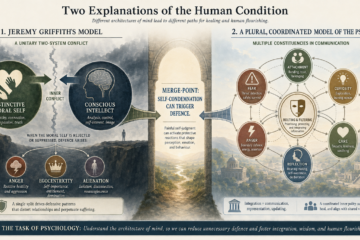
Plural Theory of Psychological Integration: Two Explanations of the Human Condition
A comparison of positions with regard to the Human Condition, between Jeremy Griffith and the Human Multiplicity Theory.
A comparison of positions with regard to the Human Condition, between Jeremy Griffith and the Human Multiplicity Theory.

Jeremy Griffith’s FREEDOM: The End of the Human Condition attempts something much larger than an ordinary theory of personality or psychological disorder. Griffith proposes a biological explanation for what he regards as the central contradiction of human existence.
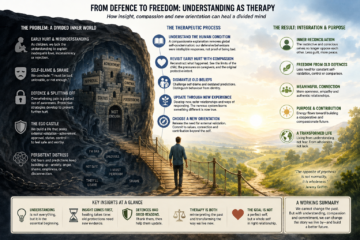
An examination of the therapeutic ideas of Jeremy Griffith, as developed in Therapy for the Human Condition, The Shock of Change, The Great Transformation and related writings
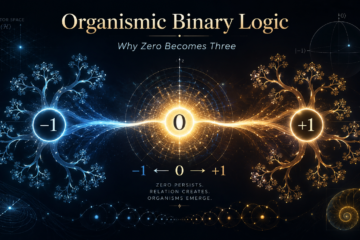
This paper introduces Organismic Binary Logic (OBL) as a proposed mathematical framework for systems in which an opposition is generated from a persisting origin.

asks whether the familiar existence of functional specialisation throughout biology and cognition makes a similarly differentiated psychological architecture scientifically plausible.

If one world can possess an anima, it then follows, that a plurality of worlds may also possess a soul appropriate to their collective form. And that in addition, all objects/structures and visible aspects of that universe are part of that universal soul
Part three of Personal Multiplicity Theory: psychological multiplicity might be another instance of a much more general organisational principle: complexity produced through differentiation, relationship and selective integration.

Schema Mask Theory (SMT), a theoretical model proposing that psychological schemas operate within a recursively organised self-system and that their effective functional boundaries are partly produced by dynamic schema masks regulating information access, transformation and routing.
Personal Multiplicity Theory: Chapter 2. This chapter explores the development of plural thinking by psychology, in order to provide an understanding of that cross bed of support.
This thesis extends the Human Multiplicity Theory. In Chapter 1, we introduce Personal Multiplicity.