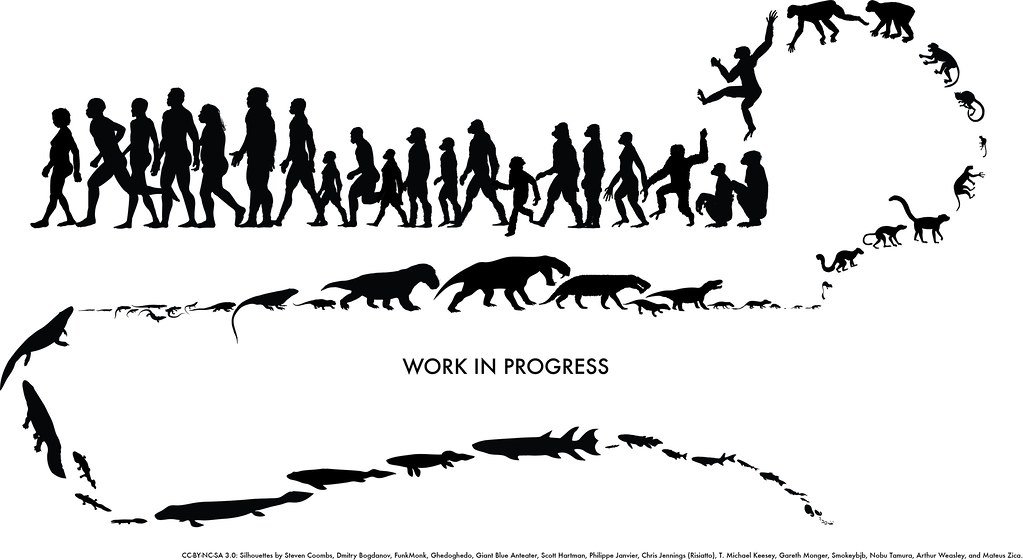
“Human Evolution (work in progress)” by tmkeesey is licensed under CC BY-NC-SA 2.0
Introduction to DNA
DNA, or deoxyribonucleic acid, is the molecule that contains the instructions for building and running all living things.
Structure of DNA
DNA is shaped like a twisted ladder, called a double helix.
Each strand is made of repeating units called nucleotides.
- A nucleotide consists of:
- A sugar (deoxyribose)
- A phosphate group
One of four bases: adenine (A), thymine (T), cytosine (C), or guanine (G).
The bases pair up: A with T, and C with G, forming the rungs of the ladder.
The two strands run in opposite directions (antiparallel) and are held together by hydrogen bonds).
This technical information gives us our first clue of understanding DNA. it is a four-way set of two-way oppositions. In other words, it includes a binary two way decision, that seems to be expressed via four potential “outcomes”.
I think this is important, because my understanding of Quantum Superposition, is that when Schrodinger’s cat-box is closed, that black/white, alive or dead possibility for the cat, splits into four superpositional states.
In addition, I can see that the human mind often takes a seemingly black and white decision, and finds there are two more options – the original yes, and no, plus both, and neither.
What I am seeing here, then, is commonality of a decision making process that seems universal, but expressed in different formats, both physically, and mentally.
It is this basic structural process that I am using in my concept of Peak Growth, and Rainbow Thinking.
Function of DNA
DNA stores the genetic code, which tells cells how to make proteins: DNA holds the blueprint, a sequence of bases (A, T, C, G) organized into three-base units called codons, which provide the instructions for building proteins, essential molecules for all cell functions, through processes called transcription and translation.
A gene is a DNA segment that codes for a specific protein, and these proteins carry out most of the cell’s work, from structure to function, determining an organism’s traits.
Proteins are essential for cell structure and function: such as enzymes and structural support. proteins are fundamental to life, playing diverse and essential roles in the body, ranging from catalyzing metabolic reactions to providing structural integrity to cells and tissues
The sequence of bases in DNA determines the sequence of amino acids in proteins: the sequence of bases (A, T, C, G) in a DNA strand dictates the specific order of amino acids that form a protein, a process involving transcription (DNA to mRNA) and translation (mRNA to protein), where groups of three bases (codons) code for individual amino acids, ultimately determining the protein’s structure and function.
DNA can copy itself during cell division, so genetic information is passed on: DNA copies itself through a precise process called DNA replication, happening before cell division (mitosis/meiosis) so each new daughter cell gets an identical, complete set of genetic instructions, ensuring continuity for growth, repair, and reproduction.
This mechanism uses each DNA strand as a template to build a new partner strand, with enzymes like DNA polymerase adding nucleotides accurately, making near-perfect copies for the next generation of cells.
Importance of DNA
DNA is found in nearly every cell and is crucial for heredity: DNA is the fundamental molecule carrying genetic instructions in nearly every cell, forming the blueprint for life, determining traits, controlling cell function, and ensuring hereditary continuity by passing these instructions from parents to offspring. It’s organized into chromosomes, primarily in the cell’s nucleus, using a code of four bases (A, T, C, G) to build and maintain an organism, while also existing in mitochondria.
Changes in DNA (mutations) can affect traits and health: DNA (mutations) significantly affect traits and health, acting as the source of genetic variation that drives evolution, with effects ranging from beneficial (like disease resistance or unique talents) to harmful (causing genetic disorders like Cystic Fibrosis or increased cancer risk), and often having neutral outcomes, all by altering how proteins function or are made
References


0 Comments