Contents
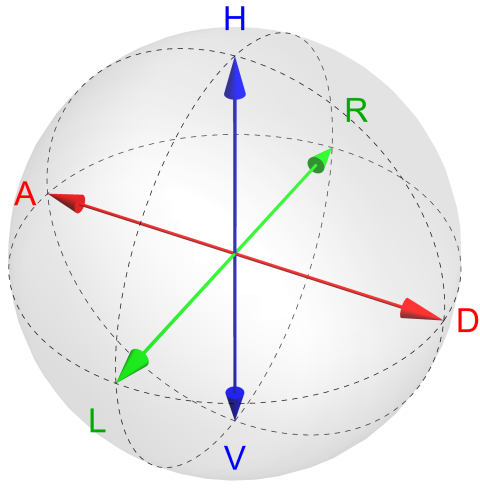 Bloch Sphere Fundamentals
Historical Origins
Felix Bloch, a Swiss-American physicist born in 1905, introduced the Bloch sphere concept in his seminal 1946 paper “Nuclear Induction,” published in Physical Review. This work stemmed from his post-WWII research at Stanford University, where he developed nuclear magnetic resonance (NMR) techniques to measure nuclear magnetic moments in solids, liquids, and gases – earning him the 1952 Nobel Prize in Physics shared with Edward Purcell.
Bloch’s visualization built on his earlier 1928 contributions to solid-state physics, including electron behaviour in crystal lattices (Zeitschrift für Physik), and neutron magnetic moment measurements with Luis Alvarez using Berkeley’s cyclotron in the late 1930s. wikipedia
Theoretical Foundations
The Bloch sphere emerged from quantum mechanics of spin-1/2 particles (two-level systems like qubits or nuclear spins) in magnetic fields, generalizing classical spin precession to quantum superpositions. link.springer

Bloch Sphere – Pauli Matrices
Bloch equations (1946) describe dynamics: unitary evolution as rotations (via Hamiltonians), decoherence as inward diffusion, linking spin coherence to NMR observables like Larmor precession. iopscience.iop
Development and Early Influences
Bloch’s idea drew from Wolfgang Pauli’s suggestions on superconductivity/ferromagnetism (1928–1930, Zürich/Utrecht) and Heisenberg’s exchange interactions, evolving into spin-wave theory and Bloch walls in ferromagnets. Pre-1946, molecular beam methods (Stern-Gerlach, Rabi) quantified nuclear moments, inspiring Bloch’s resonance techniques with oscillating fields. Post-1946, it influenced quantum information: extended to multi-qubit “Bloch balls” (SU(4) for two qubits) and qutrits via Lie algebras/projective geometries. mediatheque.lindau-nobel
Lasting Impact
Bloch served as CERN’s first Director-General (1954–1955), fostering quantum tech amid cosmic ray programs. The sphere remains central to quantum computing (qubit tomography), MRI (spin imaging), and education (Bloch cubes), visualizing entanglement and gates without full Hilbert space complexity. sis.cern
The Bloch Sphere
The Bloch sphere geometrically represents the pure state space of a single qubit – a two-level quantum system – as points on a unit sphere’s surface, with mixed states inside. wikipedia

Bloch Sphere – Qubit States
This proposal is relevant because it demystifies qubits’ “infinite possibilities” between binary extremes, clarifying how quantum operations rotate states smoothly rather than flipping bits classically, which affects thinking in quantum computing by making superposition, entanglement, and decoherence visually graspable instead of purely algebraic.
It helps by enabling practical design of algorithms (e.g., error correction via sphere trajectories), faster education through VR/models, and real-world apps like MRI spin tracking or qubit calibration in IBM/Google hardware, reducing development time and errors.
Key Axes and Pauli Operators
Three perpendicular axes correspond to Pauli matrices:
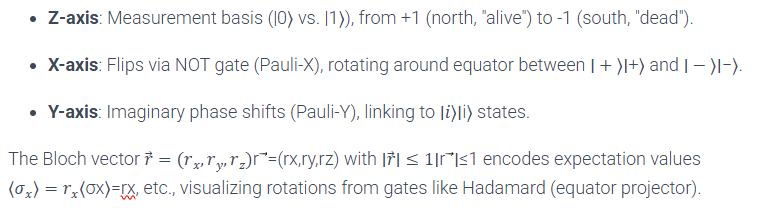
Bloch Sphere – Key Axes and Pauli Operators
Dynamics and Decoherence
Quantum evolution appears as smooth rotations on the sphere: Hamiltonians drive precession (e.g., magnetic field along Z spins around Z-axis), while measurements collapse to poles. Decoherence shrinks the vector inward toward the centre (maximal mixedness), and superpositions linger equatorially as unstable “0” points before collapsing. This mirrors our -1/0/+1 model for the DNA-Self schema-based, process for masking, or compartmentalising dissociative self-aspect denials and rejections. semanticscholar
Shadow Work and DNA-Self Theory
In shadow work, this concept helps us to understand how an accessible option, seemingly a binary one. For example, a thriving function will appear as in-use (the “1” state, alive), available, dormant, ( “0” neither alive, or dead, “ill”, in an undecided, superpositional state), and also, hidden, in shadow (“-1”, dead).
In addition, in regard to the self imposed masking rule; “I am NOT an artist”, for example, We can see that the supportive “inner-artist”, have a NOT function applied, via the scheme compartmentalising function, which chooses to cope with out utter denial that we can be an artist, by inverting to become our inner-anti artist, a critic with an underlying life position, to undermine and subvert our own attempts of expression, in relation to art.
Proposed model for the foundations of thinking
We propose that a useful model can be created, by combining the concept of the Bloch Sphere, with that of the Belnap–Dunn four-valued logic model (Explained in more detail here), to understand that the unconscious mind, has the ability to contemplate binary options “in the dark”, and, “without observation”, and thus enters a form of mental superpositional state, where these four states become disconnected, into potentially 16 individual conceptual ideas, each another binary option that may form part of the final answer/idea. Therefore, each has a further 16 individual option states. And that this is part of our process for imaginative and abstract thinking.
When we now apply this thinking to our hypothetical “NOT” inverted innate psychological function of the true DNA-Originated Self, then we can see that although in the conscious layer of the mind, we may see ourselves as an artist. That, behind that conscious overlay, hidden by a now more complex, “cherry picked”, selection of available states.
This means that the answer could, in reality be a far more complex one, a one that might mean “not quite”, or “Yes but no”. Due to perhaps only one of those operators having a single one of its 16 available states inverted by that NOT gate.
Thus, a childhood microaggression, on the displaying of a pencil drawing to an important person, might draw seemingly helpful criticism – “You just can’t draw straight lines, can you?” – from the wrong person, in the “wrong” state of mind, which could cause that aspect of the inner-artist, prevents the individual from drawing a straight line again.
Integrating Bloch Sphere, Belnap-Dunn, and DNA-Self Shadow Work
This fusion the Bloch sphere’s quantum geometry (-1 shadow/dead, 0 equatorial superposition/dormant, +1 thriving/alive) with Belnap-Dunn’s four-valued logic (True/in-use, False/hidden, Both/paradoxical tension, Neither/undecided), scaling to 16 (4^2) or 256 (4^4) states for unconscious ideation, helping us to visualise a model of how denial (“I am NOT an artist”) can invert a supportive DNA-self function via NOT gate into an anti-function, an artist self-critic and saboteur of our inner guided abilities, creating a less authentic, authentic self, rooted in micro-traumas such dismissive feedback. wikipedia
Four-Valued Superposition in Unconscious Processing
The logic of the Belnap-Dunn model handles this inconsistent/incomplete information by allowing us to understand that often, our conceptual understanding of oneself may be a subtle abstraction of the actual truth: In our example, we can see that each concept can be broken down into perhaps 16 micro-conceptualisations.
We can then show how a better range of human decision options and positions can be revealed from the implied bias being applied to the four potential conclusions:
- True: Supporting thriving, but possibly, not fully to some extent, undermined.
- False: Critical sabotage, but possibly, not to some extent, restrained.
- Both: Ambivalent “yes but no”, perhaps imbalanced, and chooses a decision that will easily be overturned.
- Neither: Dormant potential, perhaps with not all options visible, masking all choices.
This mirrors Bloch’s poles and equator without collapse, helping to show that “dark” contemplation of binaries within an overall self-concept can create a masked deliberately enforced disability (e.g., drawing straight lines?).
In DNA-Self Theory, childhood microaggressions “cherry-pick” inversions across 16 sub-states  , disconnecting the inner-artist: one NOT-flipped quadrant (e.g., “not straight lines”) propagates, masking fuller thriving codes in superposition until metacognitive observation coheres it. semanticscholar
Quantum Symbolism
Shadow work, then, can be seen as a way of interacting with this symbolic decision making matrix, and through a process of acceptance. This allows those decisions and individual has made in the past, on what they can-NOT do, can be removed, and help them to further explore what they CAN do.
This allows for that previously abstract and distorted view of this aspect of self, to become better understood, less distorted, and, hopefully, less scary,
Jung’s process of individuation, then, can be mapped into this quantum symbolic field, represented by this four directional slice of a bigger picture, which can be represented by the Bloch Sphere.
Expanding into the full Bloch Matrix
We can say, that there are three initial stages of thinking development, and each of these forms three views. These can by thought of as three levels of pattern matching:
Binary thinking: 1 dimensional thinking: Yes/No,
Belnap-Dunn four-way thinking: 2 dimensional thinking – Yes, no, neither, both. This can also resolve to the equivalent of fight. flight, or freeze, where freeze now has two options – comply/please, and enforce/please (Stockholm Syndrome).
Bloch based global thinking: 3 dimensional thinking, where the Belnap four-way model has the additional polarities of the future (do what we did before), and the future (Try something new).
Pruning our Genes
In childhood play, let us say, a child with a dinosaur toy: We can suggest that at that point, the intuitive symbolic link “helper function”, would presumably attempt to make a direct connection between that dinosaur, and some genetic memory.
As that child plays with that dinosaur, the symbolic connection would become more visible to them, through repeated play. We can suggest, then, that at some point, that the child will start having insight into that memory. However, we can also assume, that their helper, has already dissociated those memories, and only has their given “cultural assumptions”. We can see that by denying that child’s exploration of their true authentic genetically provide self. That this will also, become replaced with whatever cultural assumptions that the carer, and others “know”. Their innate knowledge, ruled as wrong, stupid, scary, and the cause a potentially fearful trauma of a caregiver disagreement.
We can now see, that this child, with this valuable and new insight, might ask their parent, “is its true?”. The parent may then answer and say “no”, and now, internally to the child, there is an argument. That caregiver was dominant, and deterministic, potentially to hide their own ignorance or fear. They may have felt that they needed to be the “font of all knowledge to that child, and felt pressured to show a certainty that was misplaced.
But if she said, “That is interesting, lets explore it”, then that argument, and potential denied connection to that very authentic and genetic trait would not be under the threat being dissociated and inverted.
Genetic Memory Activation in Childhood Play
Childhood play, then, with toys, etc., serves to directly activate the individuals symbolic interface, potentially surfacing ancestral echoes of abstract symbols that can be mapped to objects in the physical world. These, we suggest, can serve as “anchor points”, through which, the child can expand this view of its innate interests and traits. The toy can become a reflection of that DNS-Self aspect. The child will tend to gravitate towards toys that better map to this internal world of potentialities and attractions.
This may explain to some degree the observation in behaviourism, that, although repetition can work very well, as a learning tool, for some people, in some situations, it is not always successful as a way of removing inappropriate behavioural habits. However, we suggest that this is a more complex situation, and that we hope to deal with this in the near future.
The Parental Response as a NOT Overlay Trigger
The child’s query, effectively, “Is this real memory right?”, seeks validation across four values: True (valid insight), False (insight invalid), Both (uncertain, but sounds about right), Neither (uncertain, but unlikely).
The dominant caregiver’s abject “No!” response, of probably ego-driven certainty, masking their ignorance, contradicts the child’s confidence in their ability to “think acceptable thoughts”, that their parent would otherwise have rewarded. They may choose to not believe their insight, and to then apply a deterministic NOT operator. This will have the affect of inverting the supportive interface: inner-helper ally, who flips to an anti-helper, an anti-trait. wikipedia
Dissociation and Shadow Inversion Consequences
This micro-trauma enforces a “self-imposed masking rule,” compartmentalizing the genetic helper: the child’s play-insight becomes a shadowed saboteur, Belnap Both (“real but pretend”) collapses to False/hidden, propagating into every decision about themselves as a lifelong block or bias, that will ultimately limit the development of their authentic self (e.g., dismissing intuition, fearing “wild” ideas).
Instead, child will need to somehow cope with the loss of an inherited coping skill, by seeking external help, in order to replace it. They will need, increasingly, to be taught skills that were born with, but were conditioned to fear and ignore. wikipedia
Within the Theory of DNS-Self, we call this process of authentic-self depletion, as one of pruning the core-self. We think that much of these very early false-self creation trauma events are forgotten, and creates a dual-mask model, with much of this false-self, hidden behind long forgotten masking decisions, and therefore, incorrectly assumed as authentic.
Further Reading
https://en.wikipedia.org/wiki/Bloch_sphere
https://en.wikipedia.org/wiki/Four-valued_logic
https://computationalmindset.com/en/quantum-computing/not-cnot-operators.html
https://www.semanticscholar.org/paper/d8cb2bd940d9b7ac3a35a5be3b69a68a6d6ea780
https://gettherapybirmingham.com/donald-kalsched-archetypal-defenses-and-the-healing-of-trauma/
https://www.cl.cam.ac.uk/~jmb25/MCCRC/QC-commentary-2019-08-28.pdf
https://en.wikipedia.org/wiki/Qubit
https://arxiv.org/html/2412.03109v1
https://www.science.org/doi/10.1126/sciadv.abn1778
https://en.wikipedia.org/wiki/Schr%C3%B6dinger’s_cat
https://computationalmindset.com/en/quantum-computing/not-cnot-operators.html
https://link.aps.org/doi/10.1103/PhysRevA.99.063813
https://xlink.rsc.org/?DOI=D1CP05255A
https://www.nature.com/articles/s41586-024-07913-z
https://en.wikipedia.org/wiki/Jungian_archetypes
https://www.sciencedirect.com/science/article/abs/pii/S0303264723002344
https://genesispark.com/exhibits/historical-evidence/ancient-dinosaur-depictions/
https://www.observedimpulse.com/2025/09/prehistoric-brains-after-trauma-could.html
https://www.nationalgeographic.com/premium/article/trauma-genes-inherit-epigenetics-methylation
https://en.wikipedia.org/wiki/Bloch_sphere
https://en.wikipedia.org/wiki/Four-valued_logic
https://www.semanticscholar.org/paper/37937ed3ed3cc5bea6e872c766af050bd615245c
https://www.cl.cam.ac.uk/~jmb25/MCCRC/QC-commentary-2019-08-28.pdf
https://gettherapybirmingham.com/donald-kalsched-archetypal-defenses-and-the-healing-of-trauma/
https://en.wikipedia.org/wiki/Jungian_archetypes
https://www.sciencedirect.com/science/article/abs/pii/S0303264723002344
https://www.yorku.ca/earmstro/glasgow/The_Dragon_as_an_Archetype.doc
https://gettherapybirmingham.com/the-psychology-of-the-dragon-archetype/
https://iopscience.iop.org/article/10.1088/1361-6404/ad2393
https://link.springer.com/10.1007/978-3-030-63689-0_3
https://www.semanticscholar.org/paper/d8cb2bd940d9b7ac3a35a5be3b69a68a6d6ea780
https://www.semanticscholar.org/paper/14b344bc237bb02406f5d04ea30b4d6545a0b3a9
https://pubs.aip.org/jmp/article/57/12/122110/791439/The-extended-Bloch-representation-of-quantum
https://www.hindawi.com/journals/amp/2020/5825397/
https://iopscience.iop.org/article/10.1088/1751-8113/48/40/405202
https://www.mdpi.com/2073-8994/12/5/785
https://pubs.acs.org/doi/10.1021/acs.jctc.2c00654
https://www.semanticscholar.org/paper/389ed89727cd1aab1c87d6da4341e5c5be8b3aed
https://www.semanticscholar.org/paper/7a7bd4db13324462efb476ad9896057523fc2270
https://arxiv.org/pdf/1403.8069.pdf
https://arxiv.org/abs/0906.1259
https://arxiv.org/pdf/2402.09258.pdf
https://arxiv.org/pdf/1411.5381.pdf
https://arxiv.org/abs/1504.04781
https://arxiv.org/pdf/1804.01734.pdf
https://arxiv.org/pdf/2212.03448.pdf
https://arxiv.org/pdf/0801.2091.pdf
https://en.wikipedia.org/wiki/Bloch_sphere
https://www.quera.com/glossary/bloch-sphere


0 Comments